
Debt Fund Financial Model Excel Template
10 Year Debt Fund Financial Model Excel Template Template covering the Cover / Contents, Assumptions, Capital Call / Schedule, Portfolio / Loan Tape, Fund Cash Flows (Waterfall), and other financial statements to fully manage your debt fund.
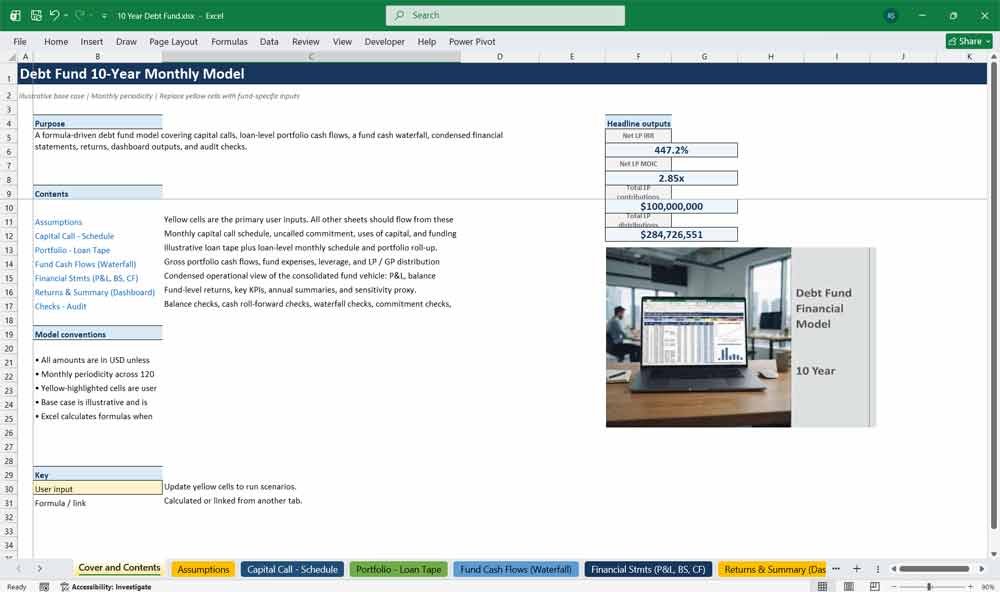
This 10-Year Debt Fund financial model contains all the tabs you would expect: “Cover / Contents”, “Assumptions”, “Capital Call / Schedule”, “Portfolio / Loan Tape”, “Fund Cash Flows (Waterfall)”, “Financial Statements (P&L, BS, Cash Flow): Condensed operational view of the management company or consolidated fund vehicle”, “Returns & Summary (Dashboard)”, “Checks / Audit”.
Cover / Contents
Purpose & Objective: Outlines the structural framework of the 10-year debt fund financial model, establishing its scope, periodicity, and core investment thesis (e.g., private debt, mezzanine, or direct lending).
Version Control & Metadata: Tracks model author, audit status, creation date, current version number, and base currency.
Table of Navigation: Provides a structured index of all worksheets, calculation engines, and dashboard outputs, noting whether each section is an input driver, dynamic schedule, or output summary.
Model Constants & Constants Definitions: Defines structural switches, such as tax regimes, default currency conventions, and rounding rules.
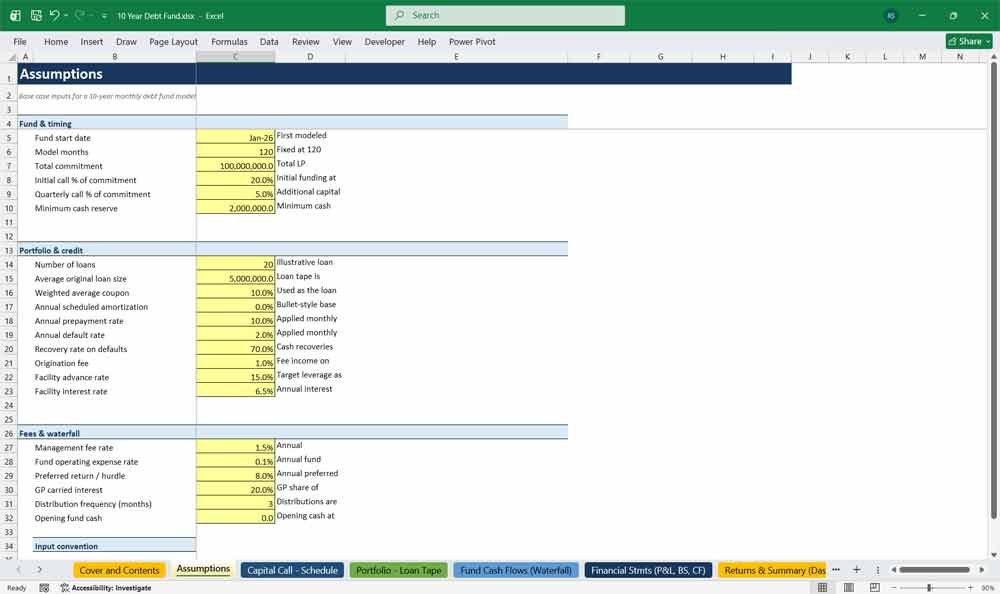
Assumptions
Macroeconomic Drivers: Defines base projections for reference rates (e.g., SOFR, EURIBOR), inflation indices, and foreign exchange rates over the 10-year horizon.
Fund Terms & Life Cycle: Establishes the investment period (typically years 1 to 5), harvest/deleveraging period (years 6 to 10), fund term extensions, target fund size, and management fee structures (e.g., percentage of committed capital during the investment period and invested capital thereafter).
Fee & Expense Budgets: Outlines organizational costs, annual fund operating expenses, legal/advisory fees, and hurdle rates (preferred return) for limited partners (LPs).
Origination & Underwriting Parameters: Sets baseline metrics for portfolio investments, including target loan sizes, coupon structures (fixed vs. floating spreads), upfront origination fees, original issue discount (OID), and prepayment penalty schedules.
Capital Call / Schedule
Commitment Tracking: Monitors total LP commitments, uncalled capital commitments, and cumulative capital called on a monthly basis.
Capital Call Mechanics: Models individual call notices triggered by investment drawdowns, fee payments, and expense reserves, accounting for default risk or late-funding penalties.
Distribution & Recycling Rules: Details policies regarding the recycling of proceeds, realization of short-term liquidity, and adjustment of uncalled commitments.
Investor Ledger: Maintains a granular monthly schedule of cash inflows and outflows per investor tranche or tier.
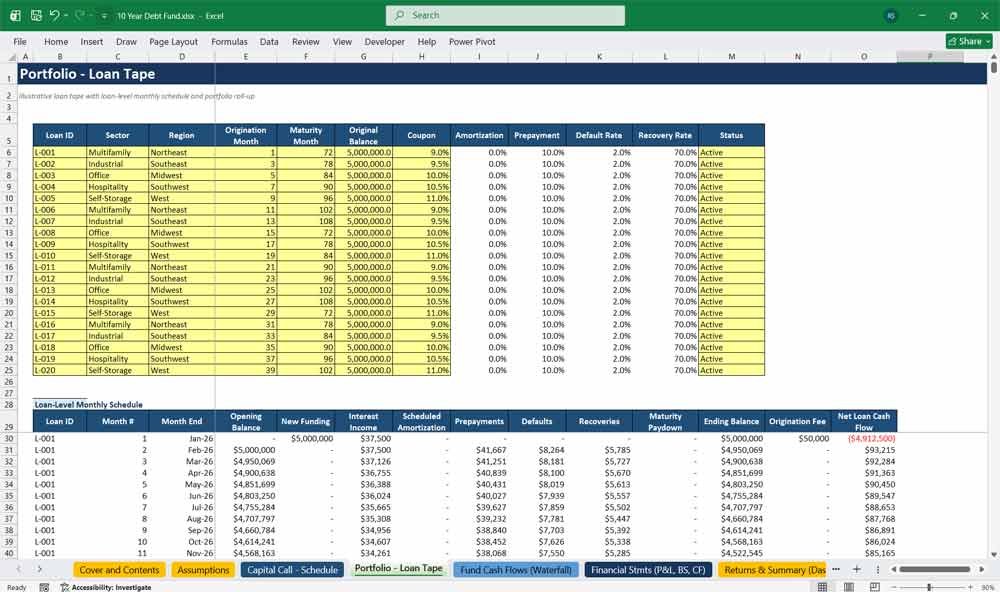
Portfolio / Loan Tape
Loan-by-Loan Schedule: Tracks individual debt instruments from origination to maturity or exit, detailing borrower profiles, sectors, and risk ratings.
Amortization & Cash Flow Engine: Calculates monthly scheduled principal repayments, interest payments (PIK vs. cash coupon), and fee income.
Credit & Impairment Tracking: Models expected credit losses (ECL), probability of default (PD), loss given default (LGD), and specific loan loss provisions on a monthly mark-to-market basis.
Collateral & Valuation: Monitors underlying asset values, loan-to-value (LTV) ratios, and debt service coverage ratios (DSCR) to flag covenant breaches.
Fund Cash Flows (Waterfall)
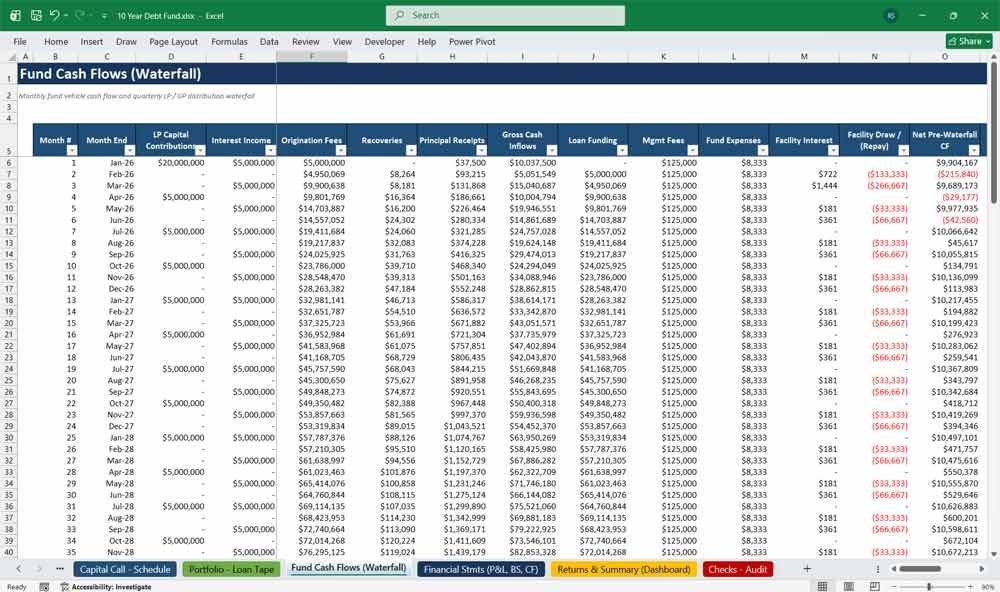
Aggregate Cash Flow Aggregation: Consolidates monthly cash inflows from portfolio interest, principal repayments, and fee income against fund-level outflows.
Debt Facility Integration (Subscription Line / NAV Facility): Models drawdowns, repayments, and interest expenses on subscription credit facilities or leverage lines utilized at the fund level.
Waterfall Distribution Engine: Implements the distribution waterfall mechanics:
Tier 1: Return of capital and payment of fund expenses.
Tier 2: Preferred return to LPs (hurdle rate).
Tier 3: General Partner (GP) catch-up provision.
Tier 4: Final residual split (e.g., 80% LP / 20% GP carried interest).
Other Tabs Within The Debt Fund Model
Financial Statements (P&L, BS, Cash Flow)
Condensed Operational View (Management Company / Consolidated Vehicle):
Profit & Loss (P&L): Captures management fee income, transaction fees, operational expenses, employee compensation, carried interest revenue, and net operating income over the 10-year monthly timeline.
Balance Sheet (BS): Details current assets, cash reserves, loan portfolio book values, short- and long-term liabilities (credit facilities), and partner capital accounts.
Cash Flow Statement: Reconciles net income to operating cash flows, investment cash flows (loan originations and repayments), and financing cash flows (capital calls, distributions, and debt service).
Returns & Summary (Dashboard)
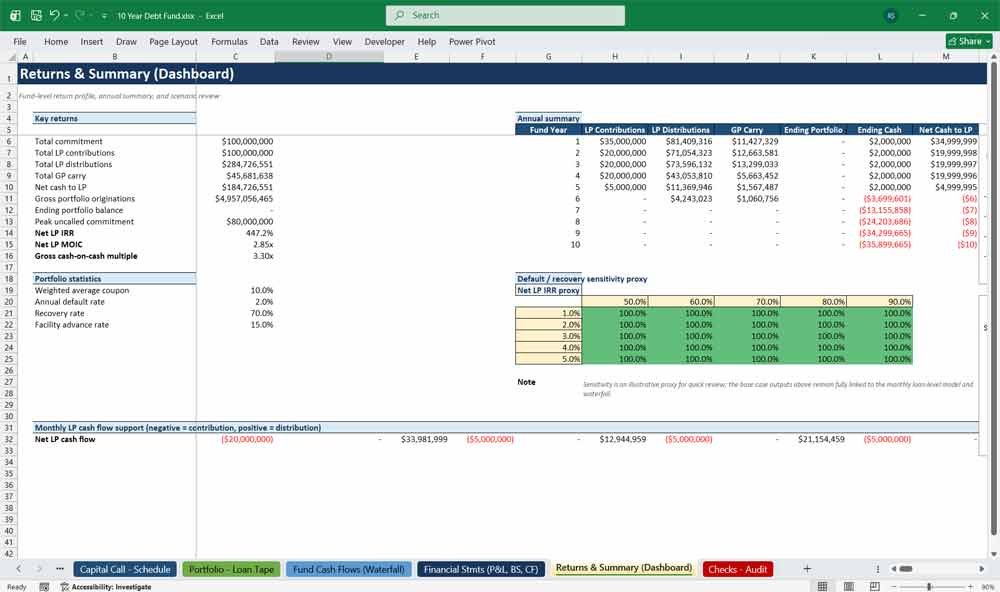
Core Return Metrics: Calculates Internal Rate of Return (IRR) and Multiple on Invested Capital (MOIC) on both a gross (portfolio level) and net (LP level) basis.
Performance Visualizations: Summarizes DPI (Distributed to Paid-In), RVPI (Residual Value to Paid-In), and TVPI (Total Value to Paid-In) ratios across the fund lifecycle.
Sensitivity & Scenario Analysis: Displays dynamic sensitivity matrices testing key variables such as default rates, recovery rates, benchmark interest rate shifts, and pace of deployment.
Checks / Audit
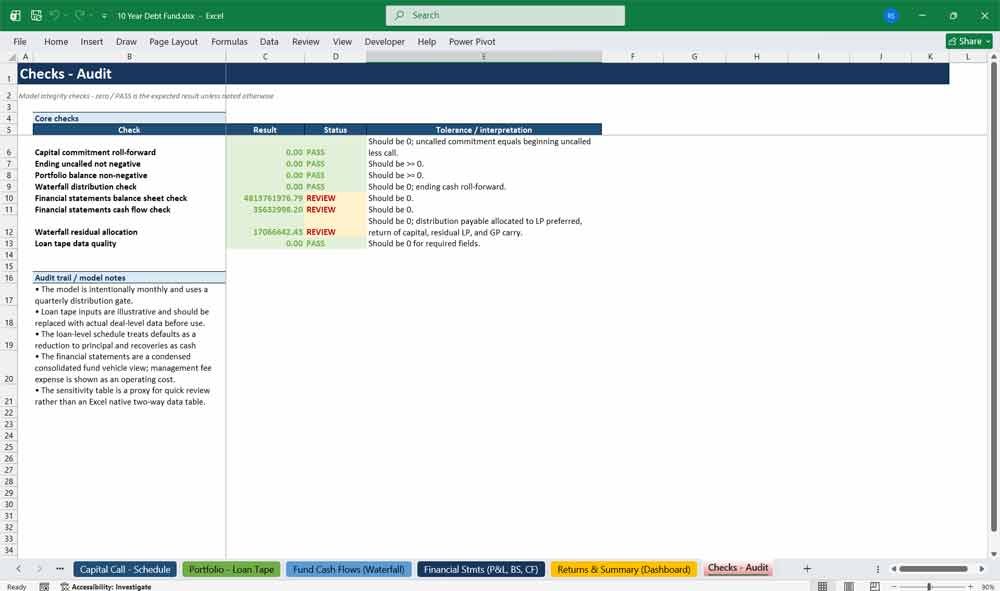
Balance Sheet Integrity Check: Verifies that total assets equal total liabilities plus equity across every monthly period.
Cash Reconciliation: Ensures ending cash balances tie precisely between the cash flow statement, balance sheet, and underlying cash ledger.
Waterfall & Commitment Balancing: Confirms that total capital called matches cumulative distributions plus residual net asset value adjustments, and flags any circularity or unhedged formula errors.
Final Notes on the 10 Year Financial Model Integration
This structured model helps Debt Fund investors have a broad market spectrum, offering the right balance between cost, and investment support.
Further Reading
Merger & Acquisitions Model: Download a professional M&A financial model. Dynamic valuation, accretion/dilution analysis, synergies, and debt schedules.
- Real Estate Private Equity Fund Financial Projection Model: Professional-grade Real Estate Private Equity (REPE) fund financial model in Excel.
- Leveraged Buyout Financial Model: Master your LBO finances minutes. Download this fully customizable financial model template with clear dashboard reports.