
Battery-as-a-Service (BaaS) & EV Battery Swapping Financial Model
The Battery-as-a-Service (BaaS), EV Battery Swapping Station Financial Model is an investor-grade Excel template for planning, financing and valuing an integrated e-mobility energy business. One workbook covers battery subscriptions and leasing, battery swap stations, public and fleet EV charging, second-life battery resale and recycling, rooftop solar PV and battery energy storage systems (BESS). Founders, investors, developers, lenders and consultants can use it to test the full economics of an EV battery swapping network or EV charging station rollout, from first site to exit.
(BaaS) & EV Battery Swapping Financial Model – with Integrated Charging, Solar & BESS
The model runs a 12-year horizon: 2 years of monthly construction, 5 operating years shown monthly with annual totals, and 5 further operating years shown annually. Every date, label and escalation index flows from one Model Start Date, so the whole model re-dates when you change it. Customer acquisition, churn, swap demand, charging sessions, kWh delivered, battery fleet sizing, degradation, replacement and electricity costs are all built from clear, editable assumptions. The output is a three-statement model (income statement, balance sheet and cash flow statement) with DSCR, LLCR, project IRR, equity IRR, NPV, payback and enterprise valuation.
The template follows lender-ready formatting conventions. Inputs are colour-coded, sections are consistent, the timeline is shared across every tab, there are no circular references, and a dedicated Model Checks tab confirms the balance sheet balances in every period. It includes six switchable scenarios, about 75 live sensitivities, two-way sensitivity grids, a risk matrix and a dashboard with charts. Use it for an EV infrastructure business plan, a battery swapping feasibility study, a fundraising deck or a project finance submission.
What’s Inside: Tab-by-Tab Guide
01. Cover & Dashboard
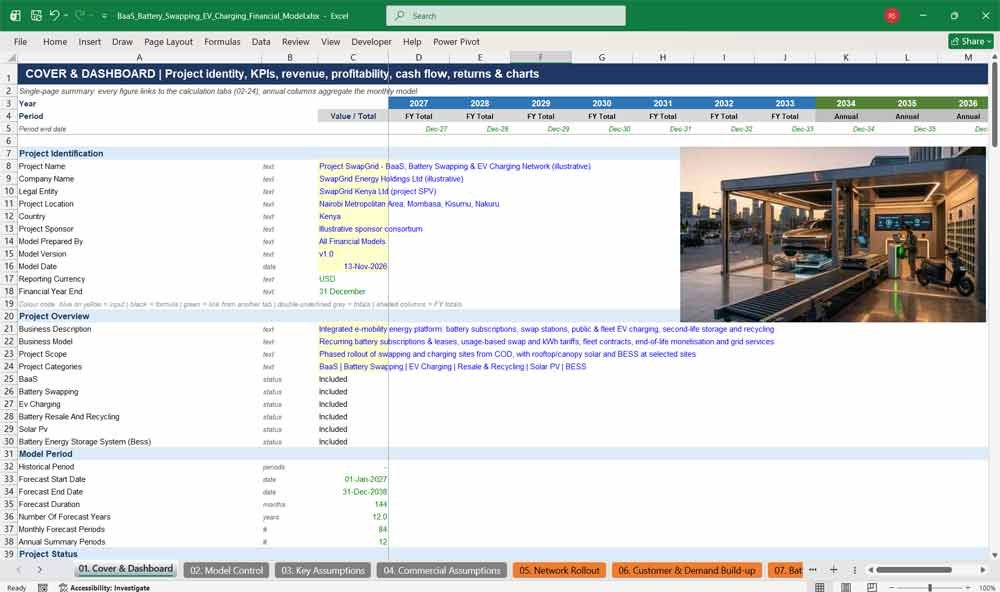
The dashboard gives investors and lenders a one-page summary of the EV battery swapping and charging business. It covers project identity, investment summary, operating KPIs, revenue by segment, profitability, cash flow, returns and energy economics. Annual figures and nine charts update automatically when any assumption changes, ready for pitch decks and board packs.
- Project identification, overview and project status timeline
- Investment summary: total CAPEX, equity, debt and peak funding
- Operating KPIs: customers, batteries, swap stations, chargers, solar and BESS capacity
- Project IRR, equity IRR, NPV, payback and DSCR at a glance
- Nine charts, including revenue by segment, EBITDA, CAPEX, cash flow and debt balance
- Live model check status (PASS / REVIEW)
02. Model Control
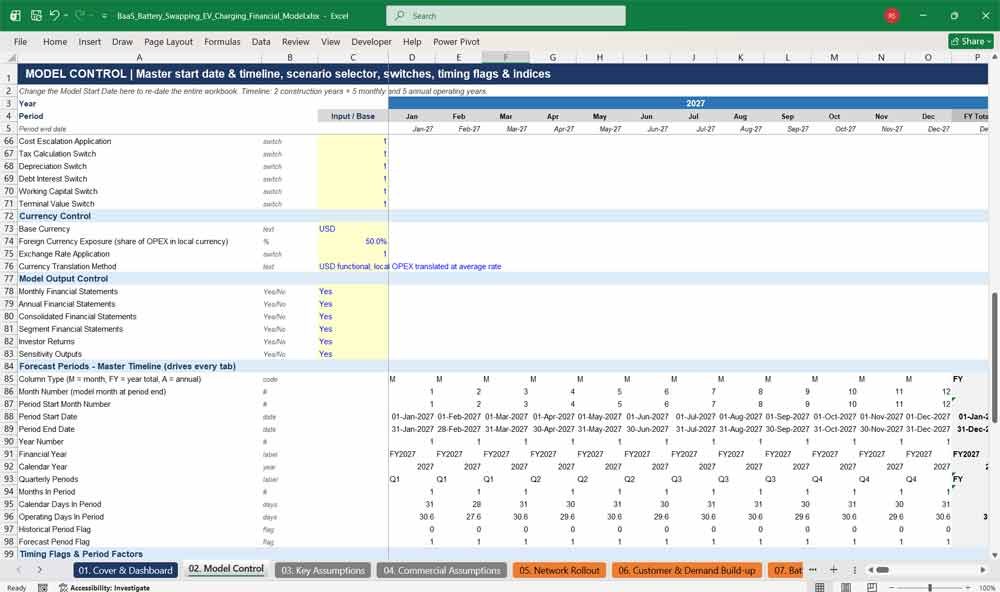
Model Control holds the master timeline and model settings. One Model Start Date drives every date, year label and escalation index across all 24 tabs. Here you select the scenario, switch business lines on or off, set operational timing, apply inflation and tax switches, and review the monthly and annual flags that drive the forecast.
- One start date re-dates the entire financial model
- Scenario selector: Base, Upside, Downside, Conservative, Aggressive Growth and Custom
- On/off switches for BaaS, swapping, charging, resale, recycling, solar, BESS, grid services and debt
- Construction, COD, ramp-up and rollout timing flags
- Escalation indices for inflation, labour, electricity, tariffs and contracts
BaaS & EV Battery Swapping Station Revenues
03. Key Assumptions
Key Assumptions holds the macroeconomic and financial drivers of the EV infrastructure model: inflation, exchange rates, interest rates, corporate tax, WACC, cost of equity, project life and asset lives. It also sets battery degradation, retirement threshold, energy price escalation, working capital days and terminal value inputs, all in one clearly labelled place.
- Inflation, FX, interest rate and tax assumptions
- WACC, cost of equity, target gearing and minimum cash
- Station, charger, solar and BESS useful lives
- Battery life, degradation, residual value and retirement threshold
- Terminal value method: exit multiple, Gordon growth or asset-based
04. Commercial Assumptions
Commercial Assumptions sets every price in the business. That covers battery subscription and leasing fees, fleet discounts, per-swap and swap subscription pricing, AC, DC, fast and ultra-fast charging tariffs, idle and membership fees, second-life battery prices, recycling values, solar export tariffs, PPA terms and BESS grid-service payments, each with its own escalation rate.
- BaaS subscription, leasing, deposit and security fee pricing
- Pay-per-swap, swap package, monthly and unlimited swap plans
- EV charging tariffs by charger type plus fleet and roaming pricing
- Second-life resale and material-based recycling values
- Solar export, PPA, renewable certificate and BESS grid-service tariffs
05. Network Rollout
Network Rollout models the growth of the battery swapping and EV charging network. It covers the site pipeline, station openings by operating year, cabinets, battery slots, AC and DC chargers, solar and BESS installations, grid connection capacity and site development costs. The initial network is commissioned at COD and later sites follow the rollout schedule.
- Development pipeline: evaluation, development, construction and operational sites
- Swapping stations, cabinets and battery slot capacity
- EV charging stations with AC, DC, fast and ultra-fast chargers
- Solar PV and BESS rollout with installed capacity
- Site capacity, grid connection and per-site development costs
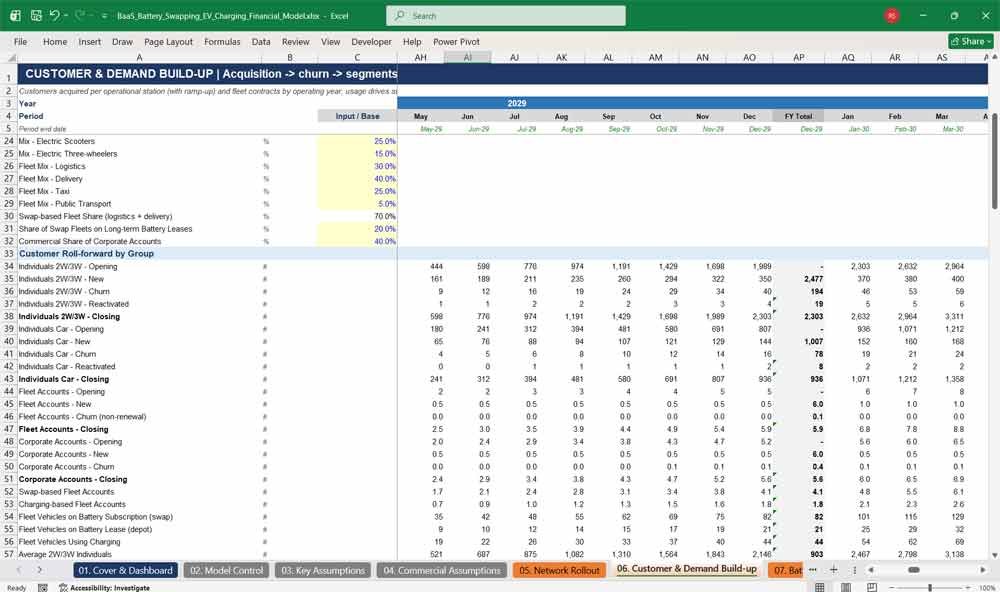
06. Customer & Demand Build-up
This tab builds EV customer demand from the ground up. Riders of e-motorcycles, scooters and three-wheelers, car owners, fleets and corporate accounts are acquired per station with ramp-up and churn. Demand flows into BaaS subscriptions, daily battery swaps and EV charging sessions and kWh, with ARPU, CAC, LTV and MRR metrics.
- Customer segments: individuals, logistics, delivery, taxi and public transport fleets
- Acquisition, churn, retention, renewal and reactivation
- Swap demand driven by mileage, energy use and usable battery capacity
- Charging sessions and kWh demand by customer group
- ARPU, CAC, LTV, MRR and ARR
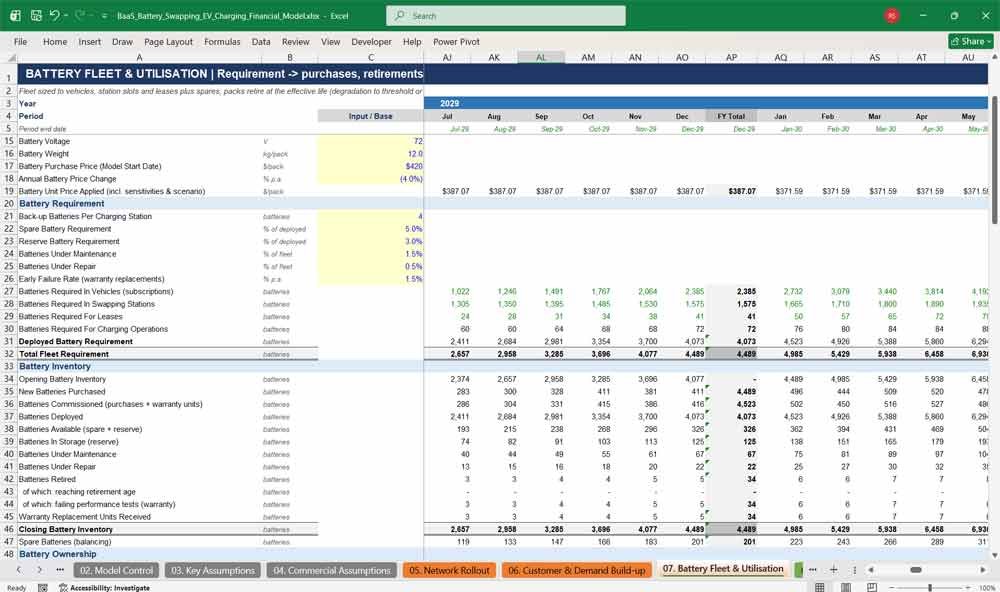
07. Battery Fleet & Utilisation
Battery Fleet & Utilisation sizes and manages the battery pack fleet. It works out how many batteries are needed in vehicles, in swap stations, on lease, as spares and in reserve, then models purchases, warranty failures, retirements, deployment, cycling, state of health and degradation, including cohort analysis by purchase year.
- Battery requirement and purchase schedule
- Inventory roll-forward: purchased, deployed, under maintenance, retired
- Daily, monthly and annual battery cycles and utilisation
- State of health, effective useful life and replacement timing
- Battery cohort analysis and maintenance cost build-up
08. BaaS Revenue
BaaS Revenue models Battery-as-a-Service subscription income for individual riders and fleets. It covers monthly and annual subscription plans, battery leasing, account fees, security fees, forfeited deposits and cancellation fees. Direct battery costs are allocated to give BaaS gross margin, contribution margin and segment EBITDA, along with MRR, ARR and revenue per battery.
- Subscriber and subscribed-battery roll-forward
- Individual, fleet subscription and leasing revenue
- Discounts, deposits and termination fees
- BaaS direct costs, gross margin and EBITDA contribution
- MRR, ARR, revenue per customer and per battery
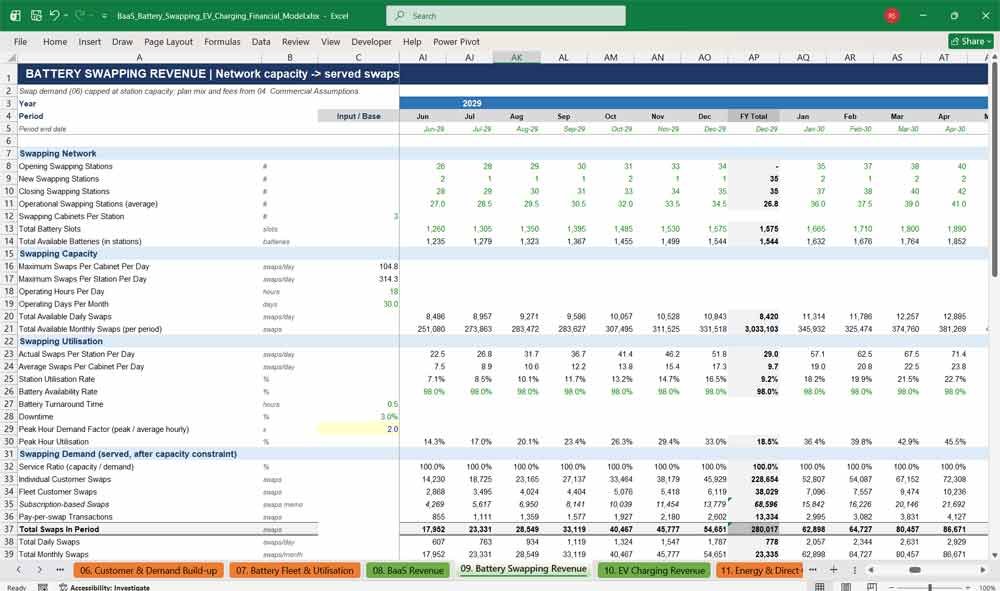
09. Battery Swapping Revenue
Battery Swapping Revenue turns swap demand into income, capped by real station capacity. Cabinet throughput, operating hours and charging time set the maximum swaps per station. Revenue comes from pay-as-you-go swaps, swap packages, subscriptions, fleet contracts, walk-in pay-per-swap users, battery rental and ancillary services.
- Swapping capacity per cabinet and station
- Station utilisation, service ratio and peak-hour load
- Individual, fleet, subscription and pay-per-swap volumes
- Revenue per swap, cost per swap and contribution per swap
- Swapping gross margin and segment EBITDA
10. EV Charging Revenue
EV Charging Revenue models public, fleet and roaming EV charging station income. Installed AC, DC, fast and ultra-fast chargers set deliverable capacity, and demand sets sessions and kWh delivered. Revenue includes per-kWh tariffs, fleet and roaming charging, session, idle, parking and membership fees, with utilisation, revenue per charger and margin per kWh.
- Charger capacity and utilisation by charger type
- Sessions and kWh delivered after the capacity limit
- Tariff revenue plus fleet, roaming and ancillary fees
- Direct costs: electricity, network, demand charges and maintenance
- Revenue, cost and margin per kWh
BaaS & EV Battery Swapping Station Costs & Financial Statements
11. Energy & Direct Costs
Energy & Direct Costs calculates site electricity demand and the full cost of grid power. That includes time-of-use tariffs, network charges, levies, fixed charges, demand charges and energy losses. Solar and BESS supply reduce grid imports, and electricity, battery, swapping and charging direct costs are allocated to each business segment.
- Site load from BaaS, swapping, charging and station auxiliaries
- Peak, off-peak and shoulder time-of-use tariffs
- Demand charges, maximum demand and network charges
- Energy losses: conversion, battery and BESS round-trip
- Segment cost allocation and total cost per kWh
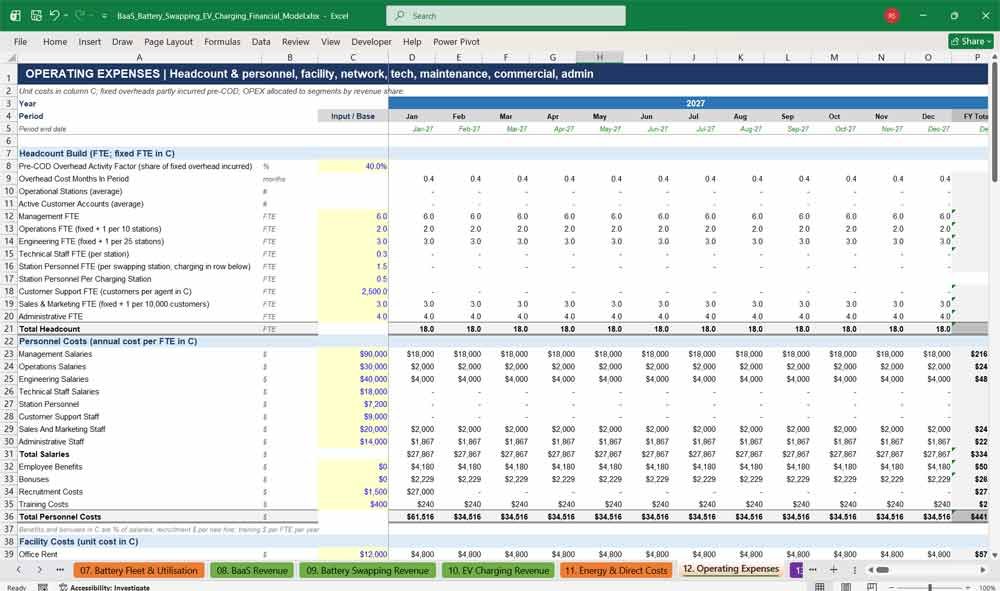
12. Operating Expenses
Operating Expenses builds a detailed OPEX budget for the e-mobility business. A headcount model covers personnel. Other lines include facilities, network operations, technology, maintenance, marketing, customer acquisition, administration, insurance, logistics and regulatory costs. Fixed overheads ramp up before COD, and OPEX is allocated to BaaS, swapping, charging, end-of-life, solar, BESS and corporate.
- Headcount build with salaries, benefits, recruitment and training
- Facility, network, technology and maintenance costs
- Commercial costs: marketing, CAC, incentives and fleet acquisition
- Admin, insurance, logistics and regulatory costs
- OPEX allocation by segment
13. CAPEX & Depreciation
CAPEX & Depreciation covers every capital cost in the project. That includes development, land and sites, batteries, swapping stations, EV chargers, transformers, solar PV, BESS, technology platforms and vehicles. Pre-COD spend builds up in construction in progress, then 13 asset classes depreciate straight-line, with charger, battery and inverter replacement CAPEX.
- Detailed CAPEX by category with unit costs
- Construction in progress and transfer at COD
- Fixed asset roll-forward for 13 asset classes
- Disposals, replacement CAPEX and decommissioning provision
- Fixed asset register by class
14. Working Capital
Working Capital calculates receivables, inventory and payables for each revenue stream and supplier group, using collection and payment days. It also includes prepayments, supplier and rental deposits, accruals, deferred subscription revenue, customer battery deposits and VAT balances, giving an accurate net working capital and cash flow impact every period.
- Receivables for BaaS, swapping, charging, fleet, corporate and grid services
- Battery component and spare parts inventory
- Electricity, battery, charger and maintenance payables
- Deferred revenue, customer deposits and VAT
- Net working capital and cash flow movement
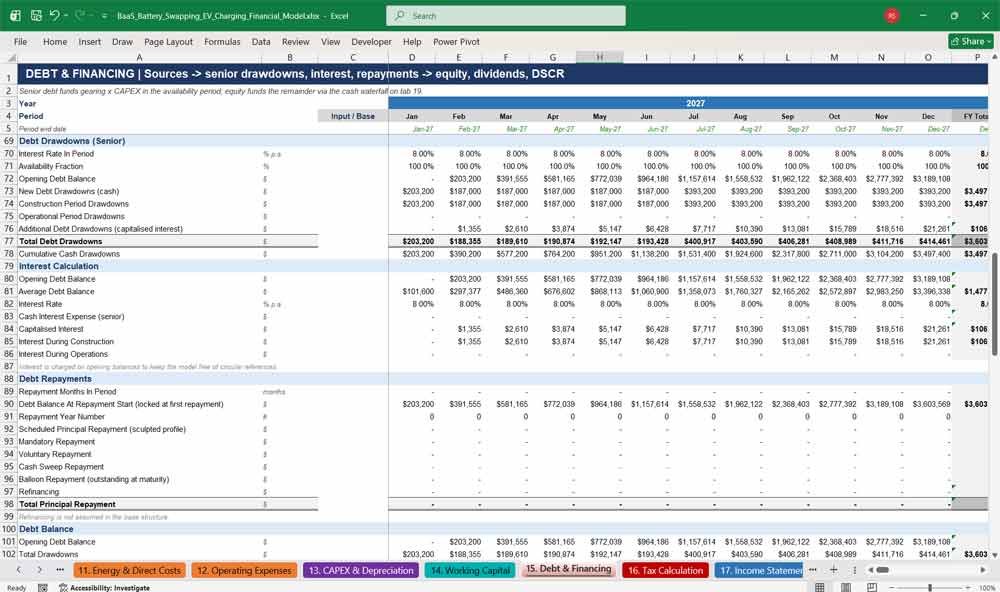
15. Debt & Financing
Debt & Financing models the capital structure. Senior debt is sized on target gearing, with drawdowns, interest capitalised during construction, a grace period, a sculpted repayment profile, cash sweep, balloon and DSRA. Optional junior and mezzanine tranches, equity funding, dividends, covenants and debt service metrics are included, so the tab is ready for project finance review.
- Sources of funds and financing structure
- Senior debt drawdowns, interest and sculpted repayments
- Commitment, arrangement, agency and legal fees
- Equity contributions, retained earnings and dividends
- DSCR, LLCR, PLCR and covenant tests
16. Tax Calculation
Tax Calculation computes corporate income tax monthly. It applies tax adjustments, a pooled capital allowance tax depreciation, interest deductibility limits, tax loss carryforward with expiry, green investment tax credits, tax holidays and a payment lag. It also models deferred tax assets and liabilities and VAT on sales and purchases.
- Taxable profit bridge from accounting profit
- Capital allowances and tax written-down value pool
- Tax losses with FIFO expiry
- Tax credits, incentives, payments and closing tax payable
- Deferred tax and VAT
17. Income Statement
The Income Statement brings every revenue stream and cost together: BaaS, leasing, swapping, EV charging, fleet charging, battery resale, recycling and grid services, less cost of sales and operating expenses. It reports gross profit, EBITDA, EBIT, finance costs, tax and net profit, plus a segment EBITDA reconciliation.
- Revenue by business line
- Cost of sales and gross margin
- EBITDA, EBIT and net profit margins
- Depreciation by asset class and finance costs
- Segment profitability for BaaS, swapping, charging, end-of-life, and solar & BESS
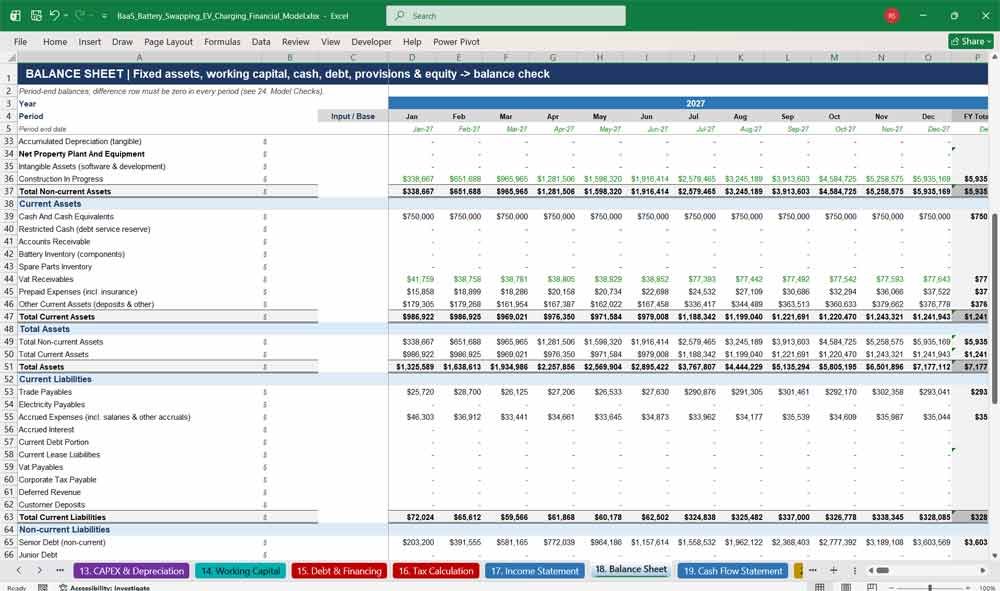
18. Balance Sheet
The Balance Sheet presents period-end assets, liabilities and equity. That includes net fixed assets by class, construction in progress, cash and restricted DSRA cash, working capital, debt split into current and non-current, deferred tax, warranty and decommissioning provisions, share capital and retained earnings. It balances in every month and year.
- Non-current assets by class and net fixed assets
- Current assets including restricted cash
- Current and non-current liabilities
- Shareholders’ equity and retained earnings
- Balance sheet check in every period
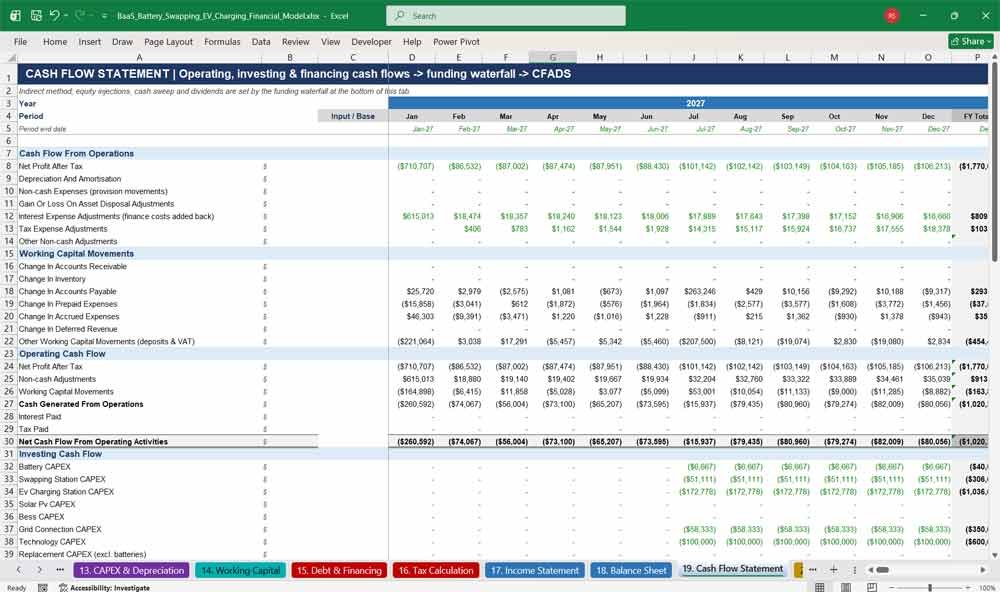
19. Cash Flow Statement
The Cash Flow Statement uses the indirect method to reconcile profit to cash from operating, investing and financing activities. A built-in funding waterfall sets equity injections, minimum cash, DSRA funding, cash sweep and dividends automatically, and the tab calculates free cash flow, FCFF, FCFE, CFADS and peak funding requirement.
- Operating, investing and financing cash flows
- Automatic equity funding waterfall
- Cash sweep and dividend distribution logic
- CFADS, free cash flow to firm and to equity
- Peak funding requirement and cumulative cash flow
BaaS & EV Battery Swapping Station Key KPIs
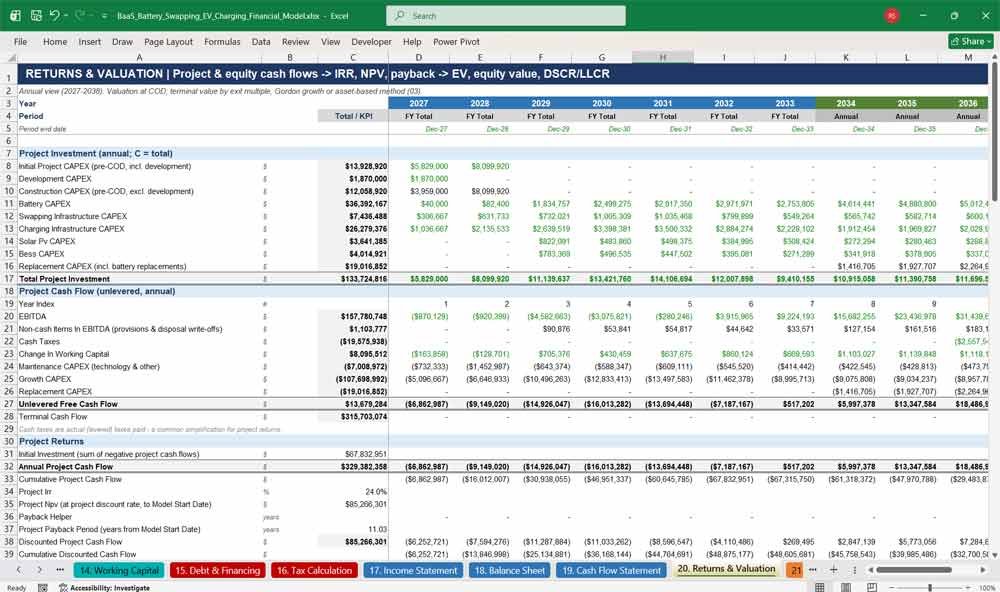
20. Returns & Valuation
Returns & Valuation calculates investor returns and business value from annual project and equity cash flows. It reports project IRR, equity IRR, NPV, payback, discounted payback, equity multiple and cash-on-cash return. Enterprise and equity value use the exit multiple, Gordon growth or asset-based terminal value, alongside DSCR, LLCR and PLCR.
- Unlevered project cash flow and project IRR / NPV
- Equity cash flow, equity IRR, NPV and multiple
- Payback and discounted payback periods
- Enterprise value and equity value per share
- DSCR, LLCR, PLCR and ROIC
21. Battery End-of-Life & Second-Life Economics
This tab captures the circular-economy value of retired EV batteries. Retired packs are tested and allocated to second-life resale, internal BESS redeployment, recycling or disposal. The tab models resale revenue, refurbishment and warranty costs, recovered lithium, nickel, cobalt and copper values, recycling costs and net battery recovery value.
- Battery retirement schedule and condition testing
- Second-life allocation: resale, BESS reuse, recycling, disposal
- Resale pricing per kWh or per unit
- Material-based recycling revenue and costs
- Net end-of-life value and warranty provision
22. Solar PV & BESS Economics
Solar PV & BESS Economics models on-site renewable generation and battery energy storage. Solar is allocated to self-consumption, BESS charging, export and curtailment. BESS dispatch delivers peak shaving, energy arbitrage and demand charge savings, and earns frequency response, demand response, capacity market and ancillary grid-service revenue.
- Solar generation, degradation and self-consumption
- BESS charging, discharging, round-trip losses and degradation
- Peak shaving, arbitrage and demand charge savings
- Grid services and renewable energy certificate revenue
- Cost before vs after solar & BESS, and CO2 avoided
23. Sensitivity & Scenarios
Sensitivity & Scenarios lets you stress-test the EV infrastructure investment. Six scenario cases apply demand, price, CAPEX, OPEX, tariff, rollout, churn and battery cost multipliers. About 75 live sensitivity flexes feed the full model. Nine two-way grids, a scenario output comparison and a risk matrix complete the analysis.
- Six scenario cases with a one-click selector
- About 75 live sensitivities across revenue, operations, batteries, energy, costs, CAPEX, financing, timing and valuation
- Nine two-way sensitivity tables
- Scenario output comparison: revenue, EBITDA, IRR, NPV, DSCR
- Risk matrix with likelihood, impact and rating
24. Model Checks
Model Checks gives you confidence in every number. It tests formula errors, broken links, missing inputs, balance sheet balance, cash, debt, interest, battery inventory, deployment, end-of-life allocation, energy, solar, BESS, CAPEX, depreciation, working capital, tax, revenue and returns, then rolls results up to a single Final Model Status.
- Model integrity and missing-input checks
- Balance sheet, cash flow, debt and interest reconciliations
- Battery, energy, solar and BESS reconciliations
- CAPEX, depreciation, working capital, tax and revenue checks
- PASS / REVIEW status per period and overall
Why Buy This Model
Building an integrated BaaS, battery swapping and EV charging financial model from scratch takes weeks of specialist work, and getting the links between customers, batteries, energy, debt and tax right is hard. This template gives you a fully linked, formula-driven 24-tab model that has already been tested end to end. The balance sheet balances in every period, there are no circular references, and every line can be traced. It covers the whole value chain in one workbook, from rider acquisition and swap station capacity to battery degradation, second-life recycling, solar and BESS savings, and project finance returns. Because every assumption is a clearly marked input, you can adapt it to any country, currency, vehicle segment or rollout plan in hours rather than weeks. Then you can present lender-ready outputs, scenarios and sensitivities to investors with confidence.
BaaS Battery Swapping Frequently Asked Questions (Faq)
Q: Who is this financial model designed for?
A: Founders and operators of EV battery swapping, Battery-as-a-Service and EV charging businesses, plus investors, lenders, infrastructure developers, consultants, energy companies and fleet operators who need to assess the economics of an e-mobility energy network.
Q: Can I use it for an EV charging station business only, without battery swapping?
A: Yes. Model Control has on/off switches for BaaS, battery swapping, EV charging, battery resale, recycling, solar PV, BESS, grid services and debt. Turn off the lines you don’t need and the rest of the model, including the financial statements, recalculates automatically.
Q: What time period does the model cover?
A: 12 years: a 2-year construction period shown monthly, 5 operating years shown monthly with annual totals, and 5 further operating years shown annually. Change the Model Start Date and every date and label across the workbook updates automatically.
Q: Does it work for my country and currency?
A: Yes. The model reports in USD by default, but every price, cost, tariff, tax rate, inflation rate and exchange rate is an editable input. You can rename the currency and enter local values. A local-currency OPEX exposure and depreciation setting is also included.
Q: Does the model include a full three-statement financial model?
A: Yes. It includes an integrated income statement, balance sheet and cash flow statement on a monthly and annual basis. The balance sheet balances in every period, and this is confirmed automatically on the Model Checks tab.
Q: How are battery replacements and degradation handled?
A: The battery fleet tab calculates effective battery life from annual degradation and the retirement state-of-health threshold, capped by calendar life. Retiring packs trigger replacement purchases and depreciation write-offs, then flow into the second-life and recycling tab.
Q: Can I model project finance debt and calculate DSCR?
A: Yes. The debt tab models senior debt sized on gearing, construction drawdowns, capitalised interest, a grace period, a sculpted repayment profile, cash sweep, balloon repayment and DSRA, plus optional junior and mezzanine debt. It reports DSCR, LLCR, PLCR and covenant tests.
Q: What return metrics does the model calculate?
A: Project IRR, equity IRR, project NPV, equity NPV, payback and discounted payback, equity multiple, cash-on-cash return, ROIC, enterprise value and equity value per share. Terminal value can use an exit EBITDA multiple, Gordon growth or an asset-based method.
Q: How do the scenarios and sensitivities work?
A: Pick one of six scenarios (Base, Upside, Downside, Conservative, Aggressive Growth or Custom) on Model Control. The Sensitivity tab also has about 75 live flex inputs, covering prices, volumes, CAPEX, tariffs, timing, financing and valuation, that feed straight into the full model.
Q: Does the model include solar PV and battery storage (BESS)?
A: Yes. It models solar generation, self-consumption, export and curtailment, plus BESS charging and discharging, peak shaving, energy arbitrage, demand charge savings and grid-service revenue such as frequency response and capacity market payments.
Q: Is second-life battery resale and recycling included?
A: Yes. Retired batteries are tested and allocated to resale, internal BESS reuse, recycling or disposal. Recycling value can be calculated from recovered lithium, nickel, cobalt and copper, or per kWh or per battery.
Q: Do I need macros or special software?
A: No. The model is a standard Excel workbook with no macros and no circular references. It works in Microsoft Excel, and all calculations are transparent formulas you can audit.
Q: How easy is it to update the assumptions?
A: Very easy. Inputs are blue text on a yellow background, calculations are black and links between tabs are green. Most inputs sit on the Model Control, Key Assumptions and Commercial Assumptions tabs, with unit costs clearly labelled on each calculation tab.
Q: How do I know the model is accurate?
A: The Model Checks tab tests the balance sheet, cash, debt, interest, battery inventory, energy, solar, BESS, CAPEX, depreciation, working capital, tax, revenue and returns, and reports a PASS / REVIEW status for each period plus an overall Final Model Status.
Q: Can I use the model for fundraising or a bank loan application?
A: Yes. The dashboard, charts, three financial statements, debt metrics and valuation outputs are laid out in a lender- and investor-ready format, suitable for pitch decks, information memoranda, feasibility studies and project finance submissions.
Further Reading
Looking for a comprehensive EV charging station financial model? this template allows operators and investors to project recurring kilowatt-hour revenues, evaluate hardware payback periods, and prepare bankable cash flow statements for stakeholders.
Final Notes On The Financial Model
This Battery as a Service BaaS EV Swapping Station Finance Model has:
- Profitability Focus: The station should aim for high-margin revenue streams (retainers and subscriptions).
- Cash Flow Management: Keep an eye on accounts receivable to avoid cash shortages.
- Scalability Strategy: Automate low-tier services to keep operational costs low.
- Long-Term Sustainability: Invest in branding, client loyalty, and technology to enhance efficiency.