
Tanning Salon Financial Model Template
This Tanning Salon Financial Model is a complete, ready-to-use Excel template for entrepreneurs, salon owners and investors planning to open or expand a tanning salon business. It builds a five-year monthly financial forecast from 2027 to 2031, with annual totals for every year, so you can see exactly how memberships, tanning bed sessions, spray tans, red light therapy and retail lotion sales turn into revenue, profit and cash. Whether you are writing a tanning salon business plan, applying for an SBA loan or pitching to investors, this model gives you lender-ready financial projections in hours rather than weeks.
5-Year Financial Model for a Tanning Salon
Built around the metrics that really drive a tanning salon, the model tracks active memberships, average membership price, monthly member churn, sessions per member, bed utilization, revenue per visit, retail attachment rate, electricity cost per operating hour and payroll as a percentage of revenue. Every assumption sits on one Assumptions & Drivers tab, and a single model start date updates every date, header and price increase across the workbook automatically. It includes an integrated income statement, cash flow statement and balance sheet, all checked to make sure they tie out every month.
Beyond the core forecast, the template calculates your startup costs and total funding requirement, break-even membership count, EBITDA margin, monthly cash runway, payback period, equity IRR, NPV and exit valuation. A built-in scenario manager lets you switch between Base, Upside, Downside and Severe Downside cases with one dropdown, while the sensitivity analysis shows which drivers move your profit and returns the most. It is a professional tanning salon financial projection template for anyone who needs credible numbers fast.
What’s Inside the Model – Tab by Tab
01. Executive Summary
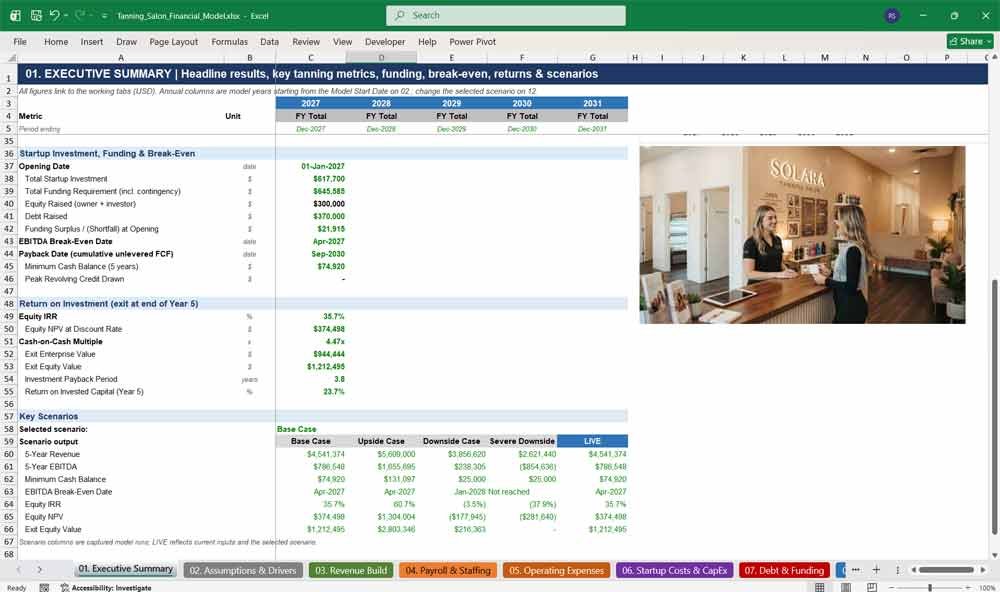
The Executive Summary presents your tanning salon’s headline financial results on one page. It covers revenue, EBITDA, net profit, cash balance, startup investment, break-even date, membership growth and return on investment, ready to drop straight into a business plan or investor pitch deck.
- Five-year revenue, EBITDA, net profit and closing cash
- Total startup investment, funding raised and break-even date
- Active memberships, bed utilization and revenue per customer
- Equity IRR, NPV, cash-on-cash multiple and payback date
- Side-by-side scenario results and charts
02. Assumptions & Drivers
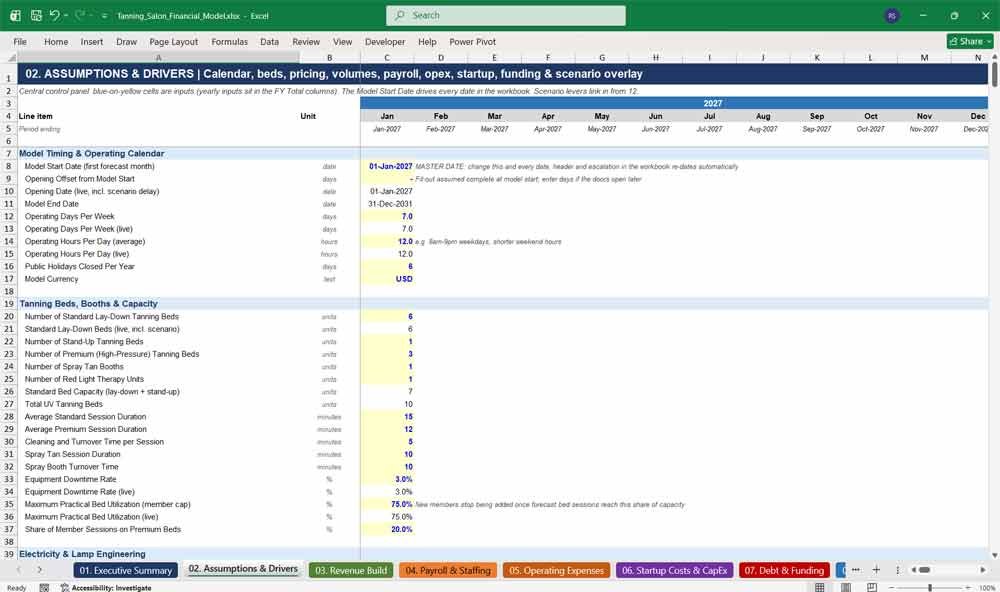
The Assumptions & Drivers tab is the control panel for your tanning salon forecast. Enter opening date, operating hours, tanning bed numbers, membership and walk-in pricing, wages, rent, inflation, tax, churn and seasonality. One start date updates every date throughout the whole model.
- Single master start date that re-dates the entire workbook
- Standard, stand-up and premium bed numbers, spray booths and red light units
- Eight membership plans with pricing and member mix
- Wage rates, rent escalation, inflation and tax inputs
- Monthly seasonality curve and colour-coded input cells
Tanning Salon Revenues & Expenses
03. Revenue Build
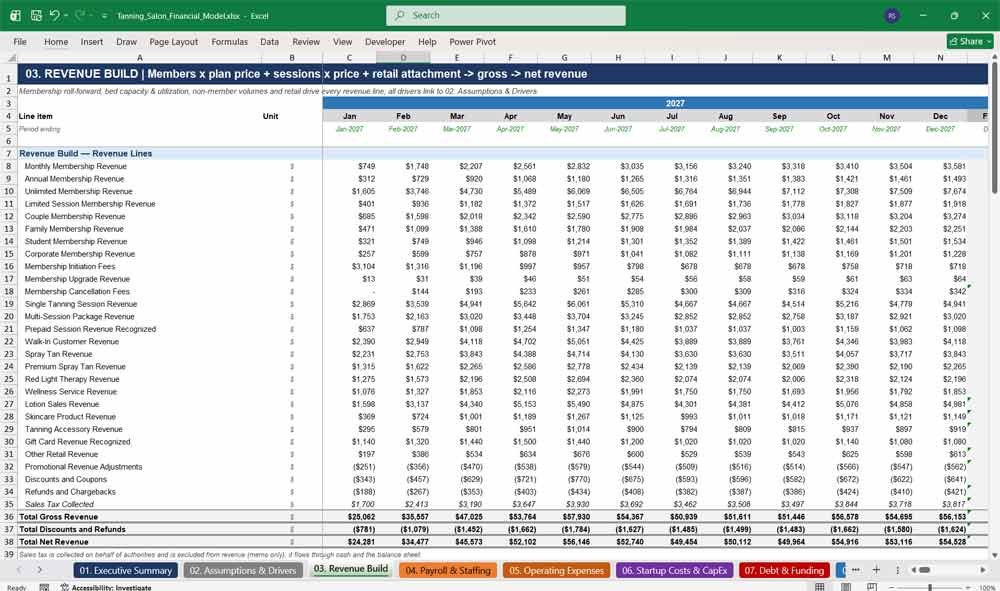
The Revenue Build tab forecasts every income stream for a tanning salon business. It models membership revenue by plan, single sessions, packages, spray tans, red light therapy, wellness services and retail lotion sales, driven by member numbers, bed capacity, utilization and seasonality.
- 31 revenue lines from memberships to gift cards, net of discounts and refunds
- Monthly membership roll-forward with new members, reactivations and churn
- Bed capacity and utilization, capped at a realistic maximum
- Retail attachment rate, lotion units sold and retail gross margin
- Revenue per customer, per bed and per operating hour
04. Payroll & Staffing
The Payroll & Staffing tab builds a detailed tanning salon labour budget. It covers headcount by role, weekly hours, hourly rates, salaries, overtime, commissions, employer taxes, benefits, recruitment and training, and shows payroll as a percentage of revenue and labour cost per operating hour.
- Headcount for 11 roles, from salon manager to contract staff
- Weekly and monthly staff hours, overtime, holiday and sick leave
- Wage inflation, salary increases, bonuses and sales commissions
- Employer payroll taxes, pension, health insurance and workers’ comp
- Payroll as % of revenue and revenue per employee
05. Operating Expenses
The Operating Expenses tab forecasts more than 110 tanning salon running costs. It covers rent, utilities, bed maintenance, lamp replacement, consumables, marketing, software, insurance and compliance. Electricity and lamp costs are calculated from actual bed usage, not guessed.
- Premises, utilities, equipment, consumables and marketing budgets
- Electricity cost per operating hour, worked out from bed power and session minutes
- Lamp replacement costs based on lamp life and bed usage
- Payment processing, software, insurance and compliance costs
- Fixed versus variable cost split and opex per bed
06. Startup Costs & CapEx
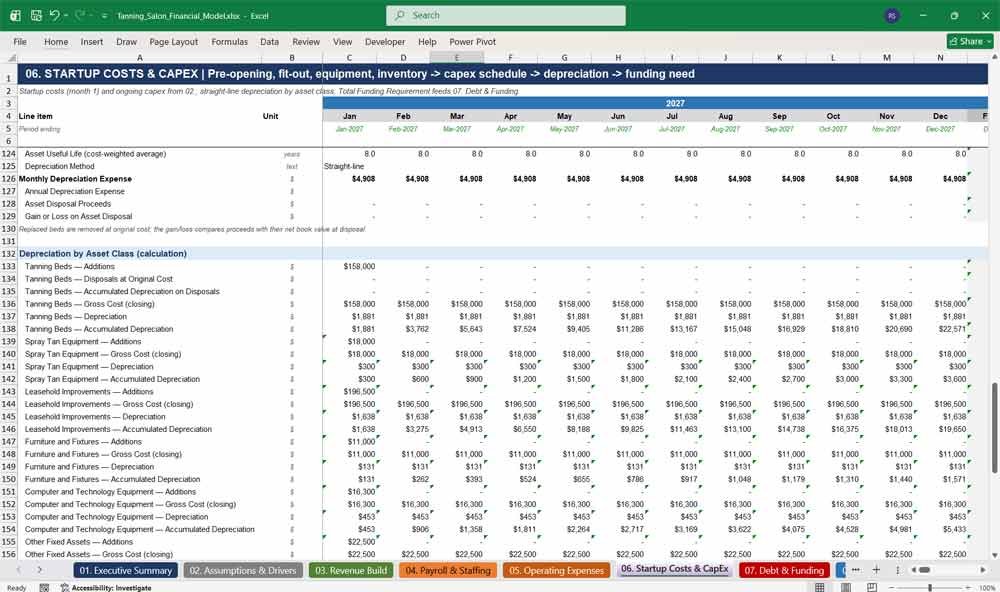
The Startup Costs & CapEx tab calculates exactly how much it costs to open a tanning salon. It covers pre-opening costs, fit-out, tanning beds, spray booths, furniture, technology and initial inventory, then builds the depreciation schedule and your total funding requirement.
- Over 100 itemised startup cost lines
- Tanning bed, spray booth and red light equipment purchases
- Ongoing capex, including bed replacement and upgrades
- Straight-line depreciation by asset class
- Total startup investment and funding requirement
07. Debt & Funding
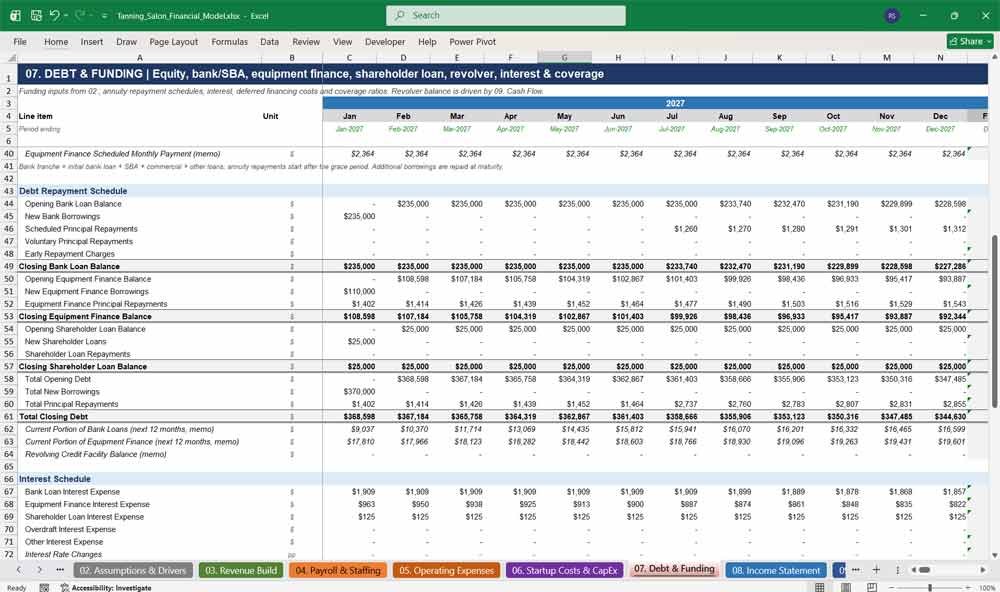
The Debt & Funding tab models how your tanning salon is financed. It covers owner and investor equity, bank and SBA loans, equipment finance and shareholder loans, with full repayment schedules, interest, an automatic revolving credit facility, and debt service coverage ratios.
- Owner, investor and additional equity contributions
- Bank, SBA, equipment finance and shareholder loan schedules
- Grace periods, loan terms and balloon payments
- Automatic revolving credit if cash falls below your minimum balance
- Interest coverage, DSCR and debt-to-equity ratios
Tanning Salon Financial Statements
08. Income Statement
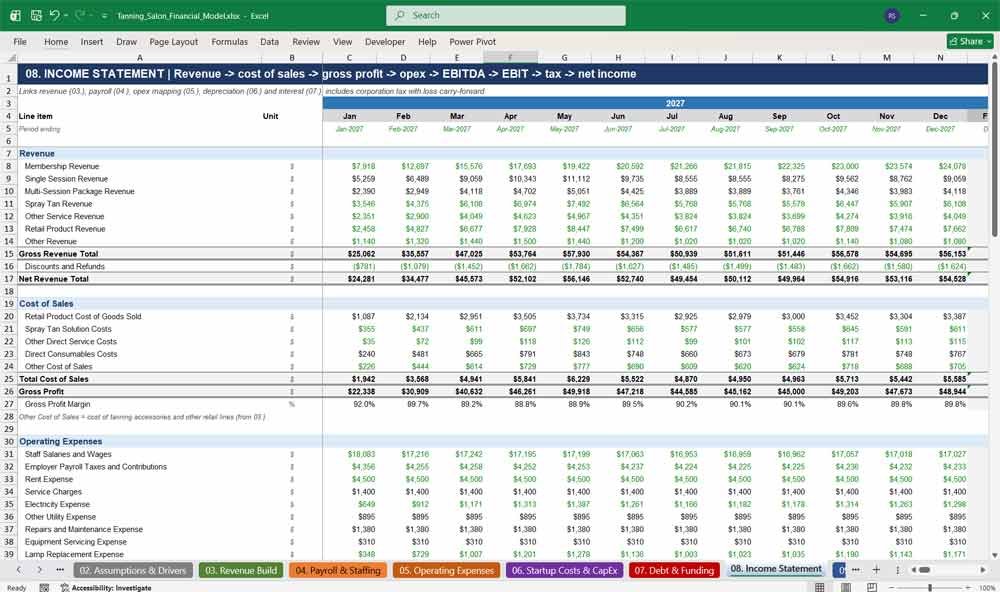
The Income Statement delivers a full monthly and annual tanning salon profit and loss forecast. It runs from revenue through cost of sales, gross profit, operating expenses, EBITDA, depreciation, interest and corporation tax to net income, with margins and growth rates.
- Revenue by stream, cost of sales and gross profit margin
- Operating costs grouped into clear expense categories
- EBITDA, EBIT and net profit, with margins
- Corporation tax with tax-loss carry-forward
- Revenue, gross profit, EBITDA and net income growth rates
09. Cash Flow Statement
The Cash Flow Statement shows how cash moves through your tanning salon every month. It separates operating, investing and financing cash flows, tracks working capital, and calculates monthly cash burn, cash runway, minimum cash balance and any extra funding required.
- Operating cash flow with working capital movements
- Capital expenditure and asset disposal proceeds
- Equity, loan drawdowns, repayments and distributions
- Monthly cash burn rate and cash runway in months
- Minimum cash balance and maximum funding shortfall
10. Balance Sheet
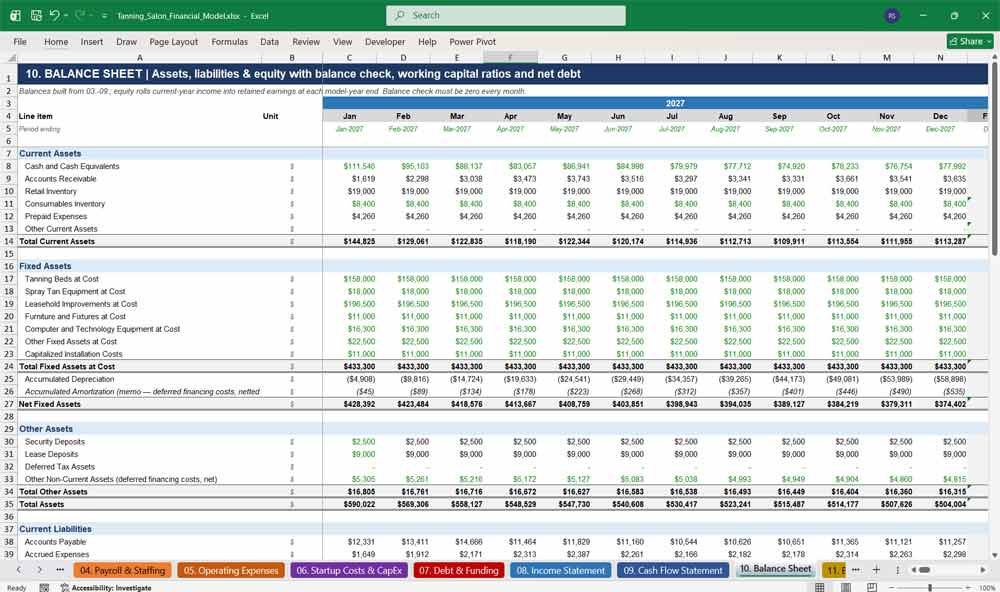
The Balance Sheet gives a full monthly and annual view of your tanning salon’s assets, liabilities and equity. It includes cash, inventory, fixed assets, deferred membership revenue, loans and retained earnings, with a balance check confirming the statements tie out.
- Current assets, net fixed assets and deposits
- Payables, deferred membership revenue and loan balances
- Owner capital, retained earnings and distributions
- Balance check that confirms the statements tie out every month
- Current ratio, quick ratio, net debt and net worth
Key Assumptions & Drivers For The Tanning Salon
11. BreakEven & Returns
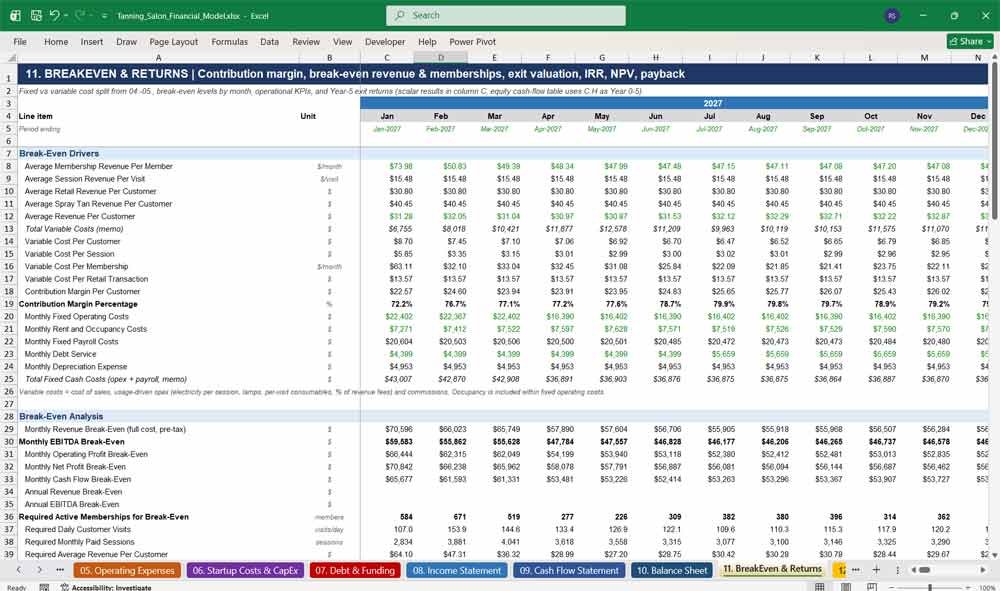
The BreakEven & Returns tab answers the key question: when will my tanning salon make money? It calculates break-even revenue, break-even membership count, required bed utilization and daily visits, plus investor returns including IRR, NPV, payback period and exit equity value.
- Contribution margin and fixed versus variable costs
- Monthly break-even revenue, memberships, sessions and daily visits
- Break-even date and required bed utilization
- Equity IRR, NPV, cash-on-cash multiple and payback date
- Customer lifetime value, acquisition cost and LTV:CAC ratio
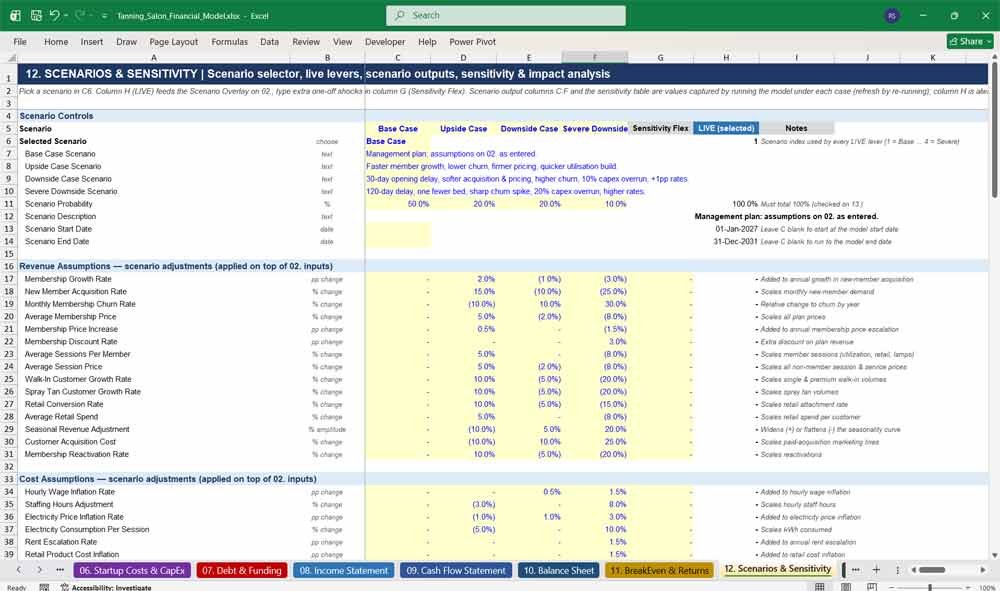
12. Scenarios & Sensitivity
The Scenarios & Sensitivity tab stress-tests your tanning salon business plan. Switch between Base, Upside, Downside and Severe Downside cases with one dropdown, adjust over 45 scenario levers, and see which drivers have the biggest impact on revenue, EBITDA, cash and investor returns.
- One-click scenario selector feeding the whole model
- Over 45 levers covering revenue, costs, operations and financing
- Probability-weighted scenario outputs
- 14 sensitivity tests, including churn, pricing, utilization and opening delay
- Impact analysis ranking the most and least sensitive drivers
13. Checks
The Checks tab gives you confidence that the financial model is accurate. It automatically tests that the balance sheet balances, cash reconciles and revenue, payroll, expenses, capex and debt tie out across tabs, returning a simple PASS or REVIEW flag.
- Balance sheet and cash flow reconciliation every month
- Cross-checks between revenue, payroll, opex, capex and debt tabs
- Input checks for membership mix, retail mix and seasonality
- One overall PASS / REVIEW model check
- Warnings for loan covenants and bed utilization
Why Buy This Model
Opening a tanning salon involves serious money: tanning beds, fit-out, electrical upgrades, staff and months of marketing before memberships build. This Tanning Salon Financial Model gives you a professional, bank-ready five-year forecast without hiring a consultant or building a spreadsheet from scratch. It is designed specifically for the tanning industry, so it already models membership churn, bed capacity, lamp replacement, electricity use and retail lotion sales, which generic templates miss. Every number is driven by clear, editable assumptions; the three financial statements are fully linked and checked; and the scenario and sensitivity tools let you show lenders and investors that you have planned for the downside as well as the upside. Change one start date and the whole model updates. It saves you weeks of work and helps you make better decisions, raise funding with confidence and open your salon on a solid financial footing.
Tanning Salon Frequently Asked Questions (Faq)
Q: I’m opening my first tanning salon and I’m not a finance expert. Will I be able to use this model?
A: Yes. All the inputs are on one tab, the 02. Assumptions & Drivers tab, and they’re clearly colour-coded: blue on yellow cells are the ones you change. Everything else calculates automatically. Each tab also has a short description at the top explaining what it does and where its numbers come from.
Q: Can I use this model to apply for a bank or SBA loan?
A: Yes. The model produces a monthly and annual income statement, cash flow statement and balance sheet, plus debt service coverage ratios, funding requirement and break-even analysis. These are the figures lenders typically ask for. It also models SBA 7(a) loans, bank loans and equipment finance with full repayment schedules.
Q: My salon will open in a different year. Can I change the dates?
A: Yes. Change the Model Start Date on the Assumptions tab and every date, month label, year header, price increase and loan schedule updates automatically across the whole workbook.
Q: Does it handle memberships properly, including churn?
A: Yes, membership is at the heart of the model. It tracks opening members, new members, reactivations, cancellations and closing members every month across eight membership plans, including monthly, annual, unlimited, couple, family, student and corporate. You set churn by year, and the model calculates average revenue per member, member lifetime value and acquisition cost.
Q: How does the model stop me from forecasting more customers than my beds can handle?
A: It calculates available sessions from your number of beds, operating hours, session length, cleaning time and equipment downtime. New members are capped once bed utilization reaches the maximum practical level you set, so your forecast stays realistic.
Q: Can I add spray tanning, red light therapy or wellness services?
A: Yes. Spray tans, premium spray tans, red light therapy and wellness services are already built in, each with its own price, daily volume, growth rate and direct costs. Set a volume to zero for any service you don’t offer.
Q: How accurate are the electricity and lamp costs?
A: They’re calculated from usage rather than entered as a flat monthly figure. The model uses each bed’s power draw, session minutes, base-load electricity and your price per kWh. Lamp costs come from lamps per bed, lamp life in hours and lamp price. You can see electricity cost per operating hour every month.
Q: Will it tell me how many members I need to break even?
A: Yes. The BreakEven & Returns tab calculates the break-even membership count, monthly break-even revenue, required daily visits, required bed utilization and the month your salon first reaches EBITDA break-even.
Q: I’m raising money from investors. Does it show returns?
A: Yes. It calculates equity IRR, NPV, cash-on-cash multiple, payback period, exit enterprise value and exit equity value based on an EBITDA multiple you choose, along with investor distributions and ownership share.
Q: Can I test what happens if things go wrong?
A: Yes. Select Base, Upside, Downside or Severe Downside from a dropdown and the whole model recalculates. You can also adjust over 45 individual levers, such as churn, pricing, opening delay, wage inflation, interest rates and startup cost overruns. The sensitivity table shows which drivers affect your results the most.
Q: Is the model in US dollars? Can I use it outside the US?
A: The model is built in USD with US-style payroll taxes, but every rate is an editable input. It even includes a line for employer National Insurance contributions, so you can adapt it for the UK or other markets by changing the tax, wage and pricing assumptions.
Q: Are the numbers in the model real benchmarks for my area?
A: The model comes pre-filled with illustrative assumptions for a 10-bed salon, so you can see how everything works straight away. You should replace them with your own local rent, equipment quotes, wages, utility rates and pricing to get a forecast that reflects your salon.
Q: How do I know the formulas are correct?
A: The Checks tab automatically confirms that the balance sheet balances, cash reconciles and the revenue, payroll, expense, capex and debt figures tie out between tabs every month. It shows a single overall PASS or REVIEW result.
Q: Which software do I need?
A: Microsoft Excel. The model uses standard Excel formulas with no macros, so it opens without security warnings and works on Windows and Mac.
Q: Can I edit and customise the model?
A: Yes. The workbook is fully unlocked, so you can add revenue lines, rename membership plans, change staffing roles or adjust any formula to suit your business.
Final Notes on the Financial Model
This 5 Year Tanning Salon Financial Model must focus on balancing capital expenditures with steady revenue growth from diversified PAYG and subscription-based services. By optimizing operational costs and efficiency and maximizing high-margin services, the model ensures sustainable profitability and cash flow stability.
Download Link On Next Page