
SaaS Startup Financial Model Template
5 Year 3 Statement SaaS Startup Financial Model Template in Excel with Pre-Seed Projections, Discounted Cash Flow (DCF) with Terminal Value, Sensitivity Analysis, WACC, NPV and IRR add-on can help business owners, investors, and analysts evaluate the financial feasibility and profitability of your SaaS Startup.
Financial Model for a SaaS Startup (Start up)
These financial models for a SaaS startup provide a structured framework to forecast revenue, expenses, cash flow, and financial health. They each span 5 years and include key metrics such as MRR (Monthly Recurring Revenue), CAC (Customer Acquisition Cost), LTV (Customer Lifetime Value), Churn Rate, and Gross Margins. CRM SaaS Model.
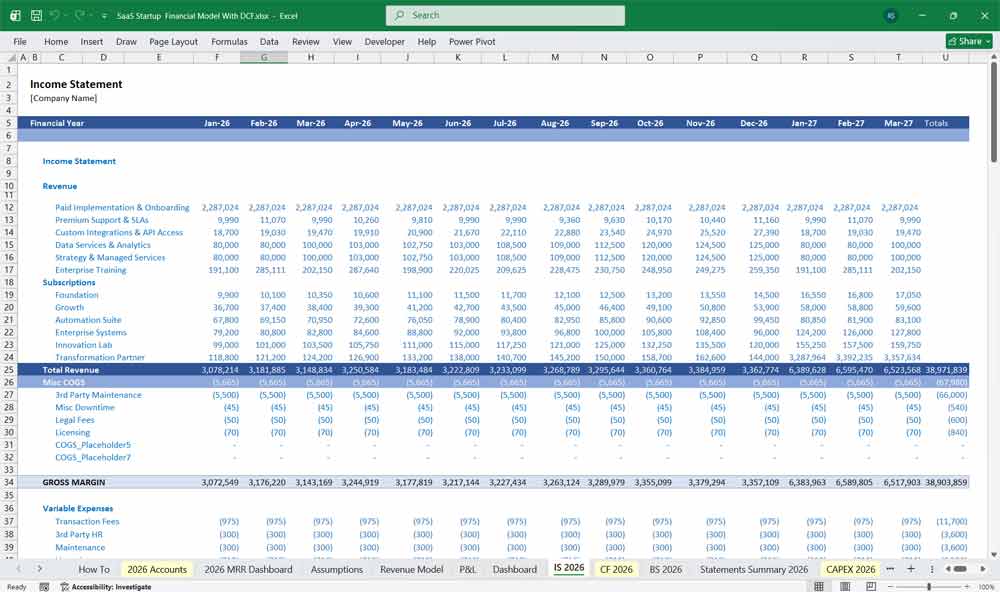
1. Income Statement (Profit & Loss Statement)
The Income Statement tracks revenue, expenses, and profitability over a period (monthly, quarterly, or annually).
Revenue Section
- Recurring Revenue (MRR/ARR)
- Subscription revenue from customers on a monthly/annual basis.
- MRR = Number of customers × Average Revenue per User (ARPU).
- One-Time Revenue
- Setup fees, consultation fees, or one-time software licensing fees.
- Expansion Revenue
- Upsells, cross-sells, and upgrades by existing customers.
- Churn Impact
- Lost revenue from customer cancellations.
Cost of Goods Sold (COGS)
- Hosting and Infrastructure Costs
- AWS, Google Cloud, or other cloud hosting expenses.
- Customer Support & Success
- Salaries of support teams, onboarding costs.
- Third-Party API & Software Costs
- Payment gateway fees, third-party integrations.
- Data Storage & Security
- Costs related to databases and compliance measures.
Gross Profit & Gross Margin
- Gross Profit = Revenue – COGS
- Gross Margin (%) = (Gross Profit / Revenue) × 100
- SaaS companies typically have 60-80% gross margins.
Operating Expenses (OPEX)
- Sales & Marketing
- Paid ads, content marketing, SEO, sales team salaries, commissions.
- Product Development (R&D)
- Engineering salaries, UI/UX design, product management.
- General & Administrative (G&A)
- Legal, accounting, HR, rent, office expenses.
- Customer Acquisition Cost (CAC)
- Total marketing & sales expenses / New customers acquired.
EBITDA (Earnings Before Interest, Taxes, Depreciation, and Amortization)
- EBITDA = Gross Profit – Operating Expenses
Net Income (Profit or Loss)
- Net Income = EBITDA – Interest – Taxes – Depreciation & Amortization
- If positive, the company is profitable. If negative, it indicates a loss.
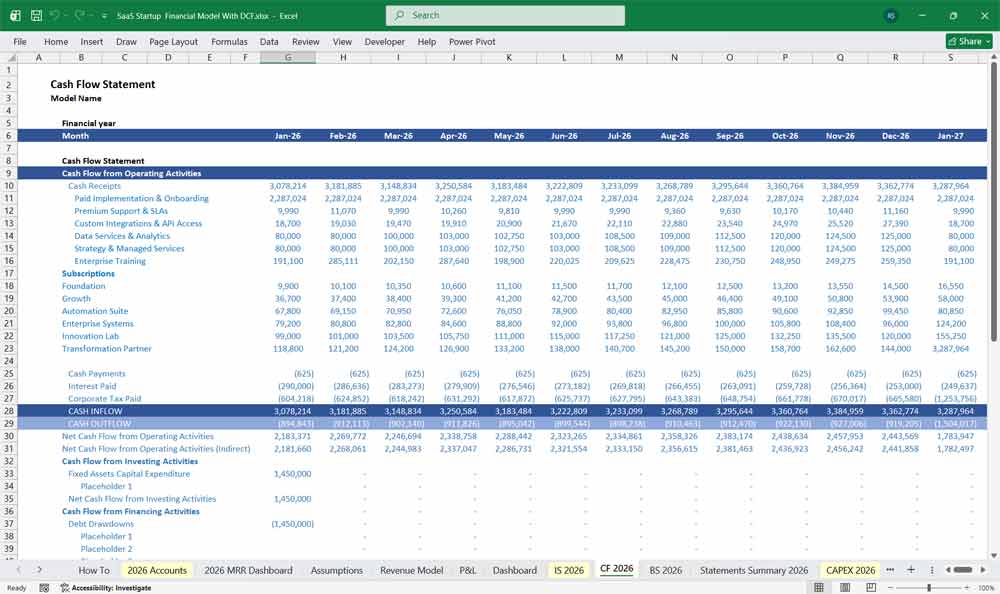
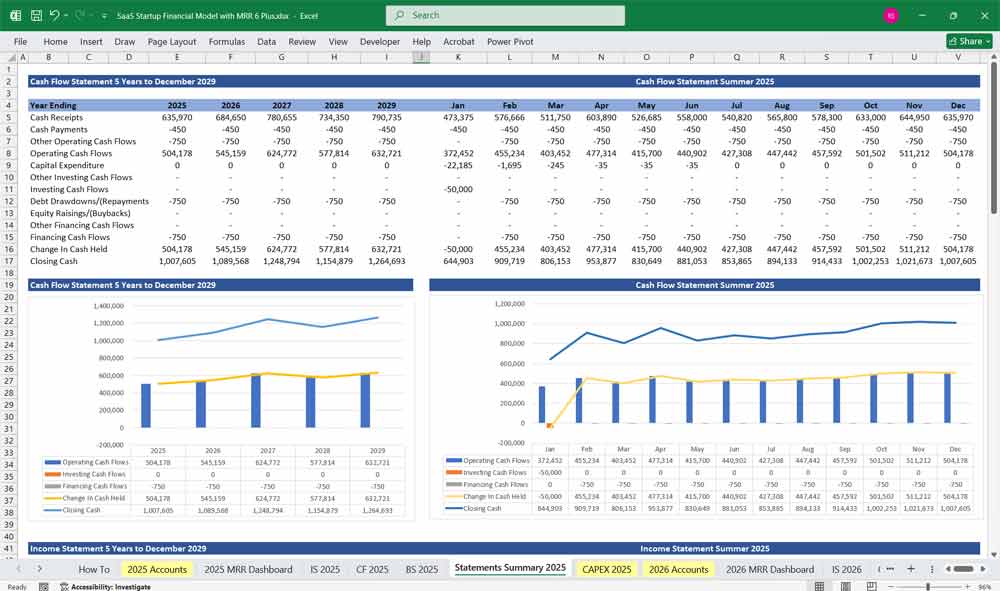
SaaS Startup Cash Flow Statement
The Cash Flow Statement tracks cash inflows and outflows, categorizing them into Operating, Investing, and Financing Activities.
Operating Cash Flow (OCF)
- Cash Inflows:
- Customer payments (subscription revenue).
- One-time service payments.
- Interest income (if applicable).
- Cash Outflows:
- Salaries, rent, and office expenses.
- Cloud hosting costs.
- Marketing expenses.
- Customer support costs.
Investing Cash Flow (ICF)
- Capital Expenditures (CapEx)
- Purchase of servers, office equipment, or software tools.
- Investment in Product Development
- R&D costs for long-term product improvements.
- Acquisitions or Mergers
- Cash spent on acquiring other companies or technologies.
Financing Cash Flow (FCF)
- Cash Inflows:
- Equity Financing (VC funding, Angel investments).
- Debt Financing (Loans, Convertible Notes).
- Cash Outflows:
- Loan repayments.
- Dividends (if applicable).
Net Change in Cash
- Net Cash Flow = Operating Cash Flow + Investing Cash Flow + Financing Cash Flow
- This determines whether the startup is cash-positive or burning cash.
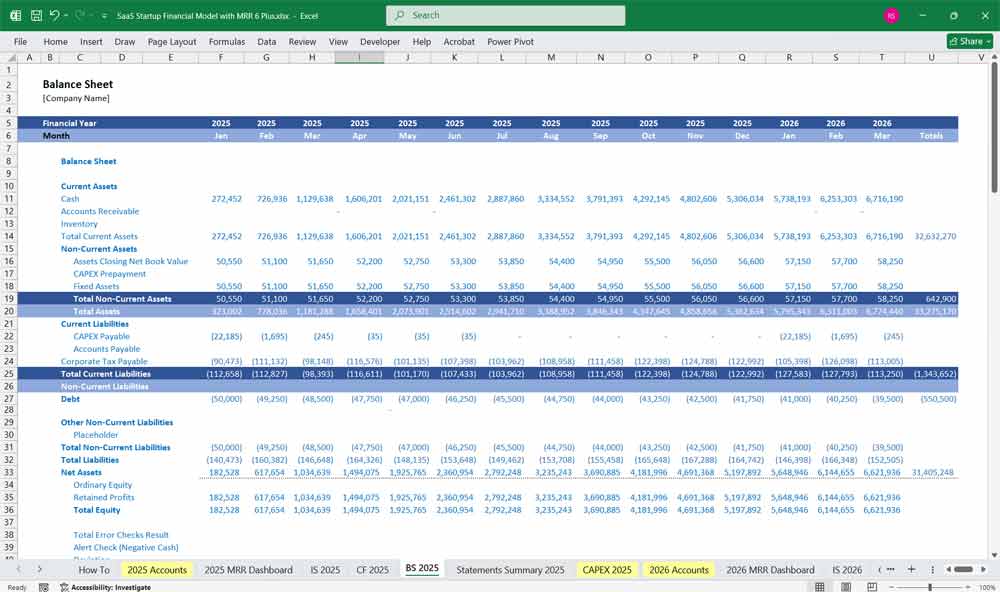
SaaS Startup Balance Sheet
The Balance Sheet provides a snapshot of the startup’s financial position at a given time.
Assets (What the Company Owns)
- Current Assets (Short-term assets convertible to cash within a year)
- Cash & Cash Equivalents
- Accounts Receivable (Pending payments from customers)
- Prepaid Expenses (Software subscriptions, office rent)
- Non-Current Assets (Long-term investments)
- Property, Equipment, and Servers
- Software Development Costs (Capitalized R&D)
Liabilities (What the Company Owes)
- Current Liabilities (Obligations due within a year)
- Accounts Payable (Bills due to vendors, hosting costs)
- Deferred Revenue (Prepaid customer subscriptions)
- Short-term Loans
- Long-term Liabilities
- Convertible Notes
- Long-term Loans or Debt
Equity (Shareholder Value)
- Founder’s Equity
- Retained Earnings (Profits reinvested in the business)
- Investor Capital (Funds raised from VCs or Angels)
Key Balance Sheet Formula
Assets = Liabilities + Shareholders’ Equity
- Ensures financial stability and solvency.
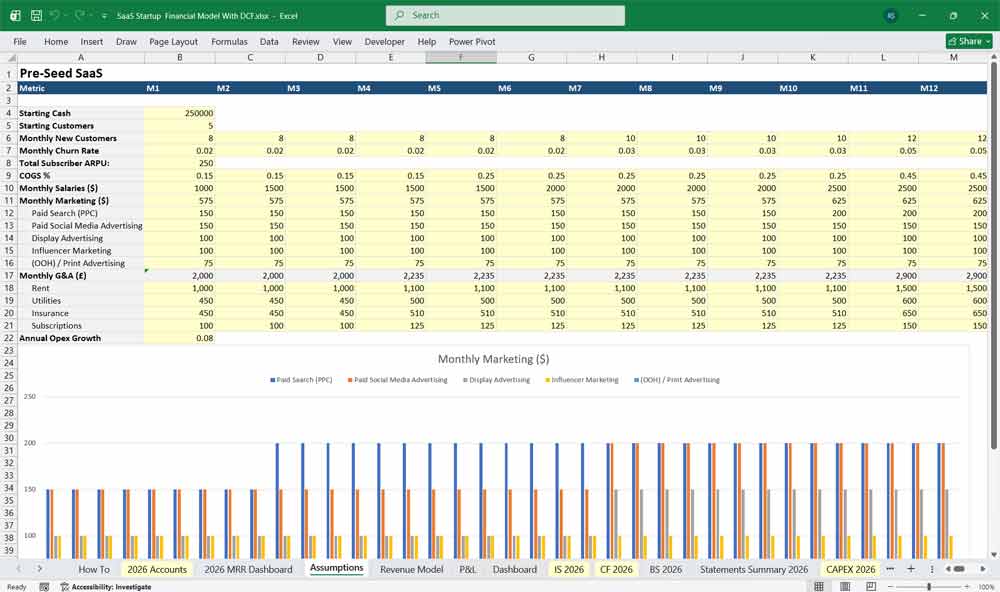
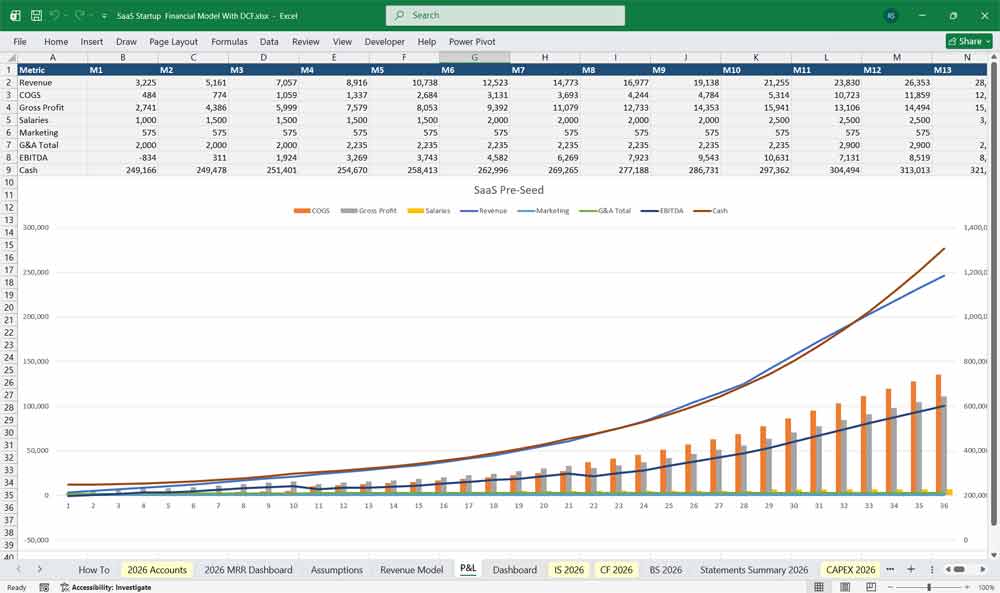
Pre-Seed SaaS Startup Projections Model
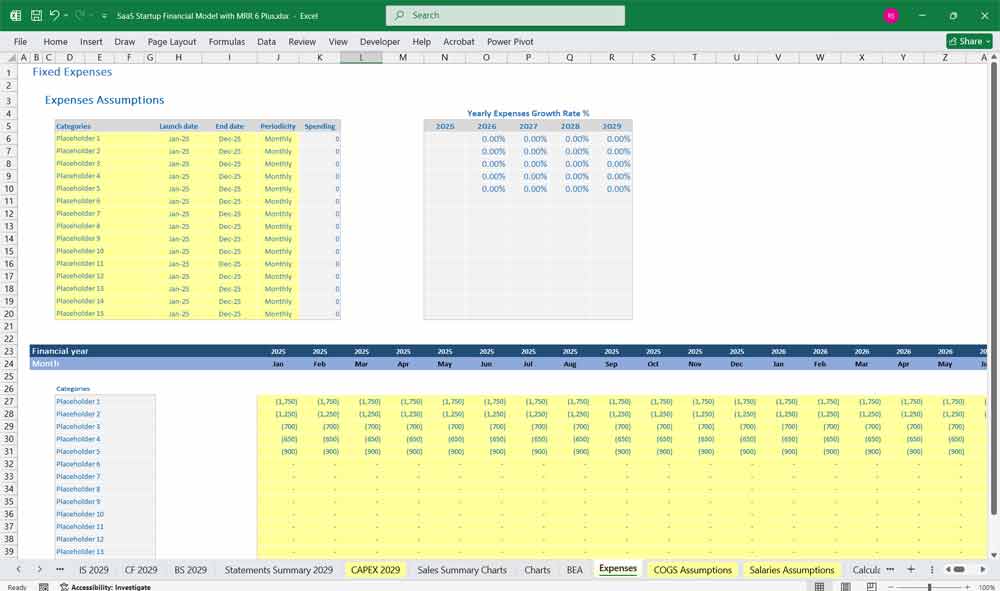
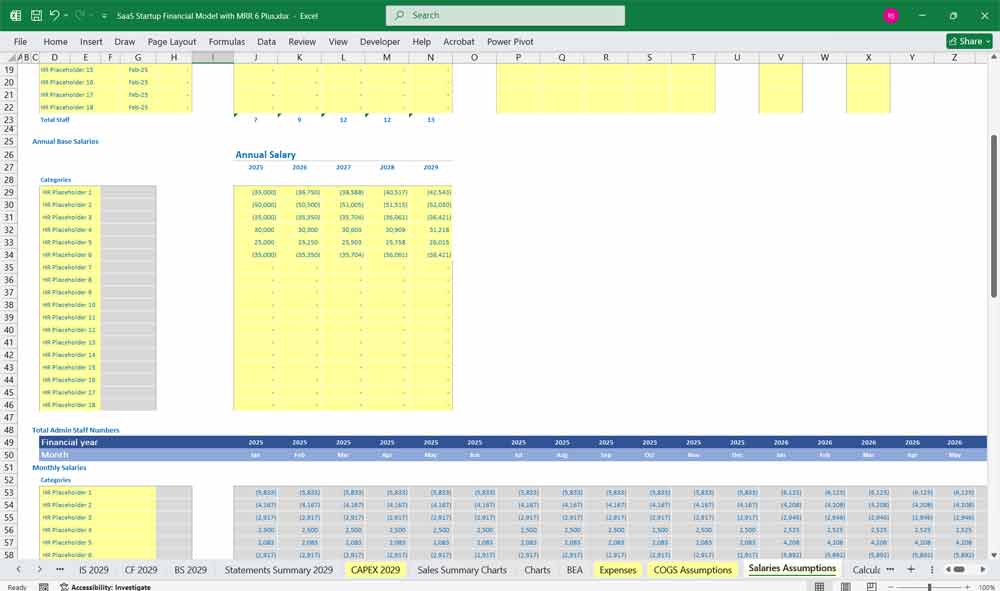
This pre-seed SaaS financial model add-on is designed to help founders, investors, and operators evaluate the growth potential, capital requirements, and scalability of an early-stage software business. The model provides a simple but robust framework for forecasting customer growth, recurring revenue, operating expenses, cash runway, and key SaaS metrics over a 36-month period.
Key Features
- 36-month integrated SaaS forecast
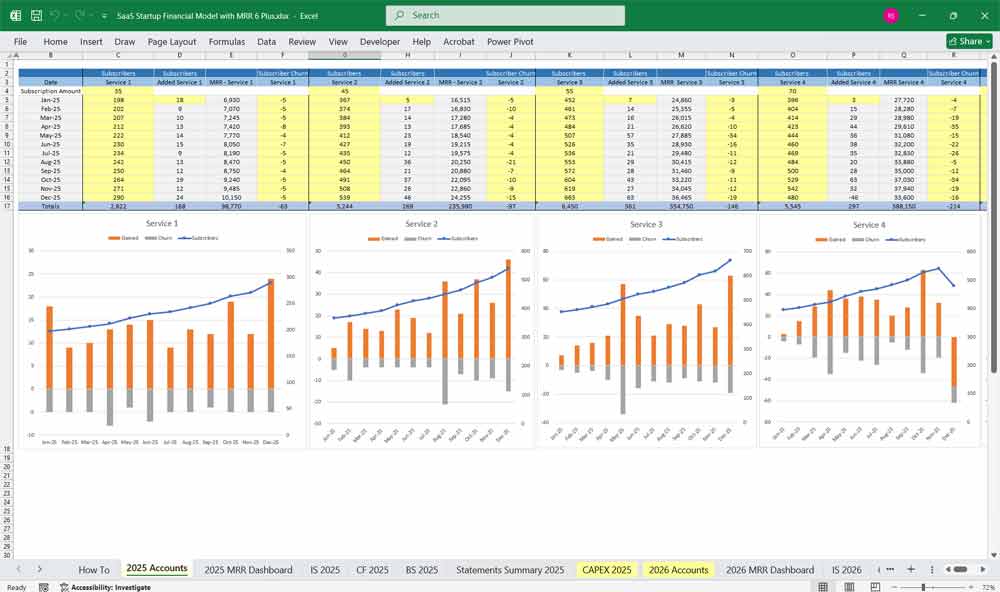
- Monthly customer acquisition and churn modeling
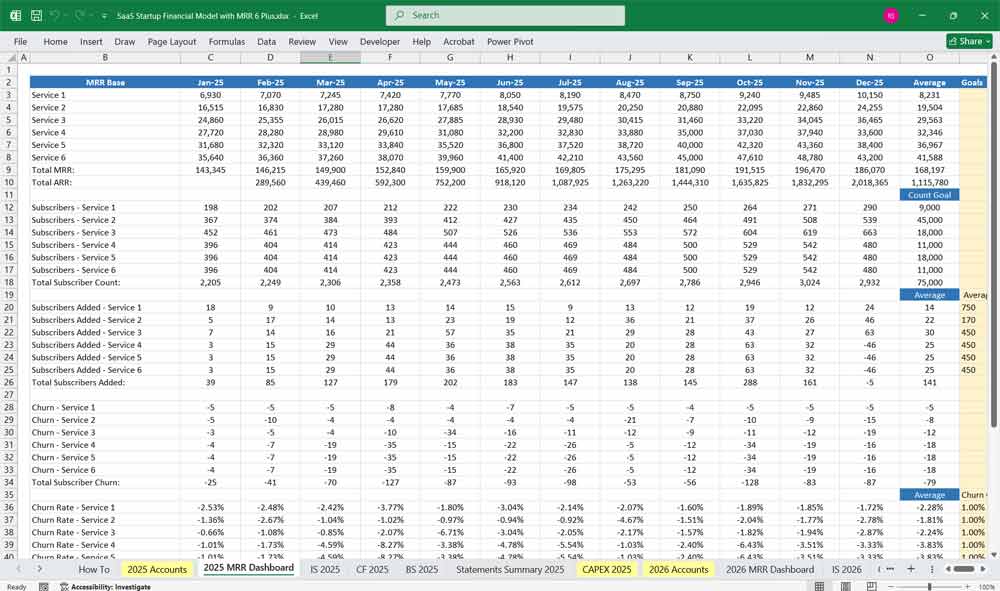
- Automated MRR (Monthly Recurring Revenue) projections
- ARR (Annual Recurring Revenue) tracking
- Revenue and gross profit forecasting
- Operating expense assumptions for salaries, marketing, and G&A
- EBITDA and cash balance calculations
- Runway visibility based on starting cash and burn rate
- Editable assumptions section for scenario planning
- Dashboard with key SaaS KPIs and growth charts
- Founder-friendly structure suitable for fundraising and board reporting
- Easy to customize for B2B SaaS, AI SaaS, vertical SaaS, or marketplace software businesses
Best Used For
- Pre-seed and seed fundraising
- Investor discussions and data rooms
- Cash runway management
- Hiring and growth planning
- Financial sensitivity and scenario analysis
- Establishing key SaaS operating metrics and milestones
6-Tier Subscription Model For A SaaS Startup
A well-structured SaaS subscription model provides options for different customer segments, from individuals to large enterprises.
1. Free / Freemium SaaS Startup Tier
- Target Audience: Individual users, startups, and small businesses testing the product.
- Features:
- Limited access (e.g., 10 free tasks, 1 user seat, basic reporting).
- Watermark branding (for design or video tools).
- Community support only.
- Monetization:
- Upsells (storage, premium features, removing limits).
- Data collection for improving AI-based recommendations.
2. Basic / SaaS Startup Plan (Entry-Level Paid Tier)
- Price: $10 – $25/month per user.
- Target Audience: Solopreneurs, small businesses, and freelancers.
- Features:
- Full access to core product features.
- Basic customer support.
- Limited integrations (e.g., only Google Drive, not Slack or Zapier).
- Up to 3-5 team members.
3. Pro / SaaS Startup Growth Plan (For Scaling Businesses)
- Price: $50 – $100/month per user.
- Target Audience: Growing startups, mid-sized teams.
- Features:
- Advanced reporting & analytics.
- Priority support (email + chat).
- Custom branding.
- 10+ team members, role-based access control.
- API access & custom integrations.
4. Business / Premium SaaS Startup Plan
- Price: $200 – $500/month (flat or per user).
- Target Audience: Mid-sized companies with complex needs.
- Features:
- Workflow automation, AI-based recommendations.
- Dedicated account manager.
- Advanced security (2FA, SSO, SOC 2 compliance).
- White-label options for customization.
5. Enterprise Plan (For Large SaaS Startup Organizations)
- Price: Custom pricing ($1,000+ per month).
- Target Audience: Large enterprises, corporations, government entities.
- Features:
- Unlimited users, advanced role management.
- On-premise deployment or private cloud.
- SLA-backed 24/7 support.
- Custom development & integrations.
- Dedicated training & onboarding.
6. Custom / White-Label SaaS Startup Plan
- Price: Custom Quote (varies by company size & customization).
- Target Audience: Large enterprises, agencies, software resellers.
- Features:
- Fully white-labeled version of the product.
- Custom feature development based on client needs.
- API-first model for complete integration.
- Enterprise-level SLAs & dedicated engineers.
5 Pay-As-You-Go (PAYG) SaaS Revenue Streams
For customers who prefer flexible, usage-based pricing instead of a fixed subscription.
1. SaaS API Usage-Based Billing
- Revenue Model: Charge per API request or data usage.
- Example: $0.01 per API call after the free 1,000 requests.
- Ideal For: AI tools, analytics platforms, fintech services.
2. Storage & SaaS Bandwidth Fees
- Revenue Model: Charge based on GB stored or transferred.
- Example: $0.10 per extra GB after the free 5GB limit.
- Ideal For: Cloud storage services, video hosting, file-sharing platforms.
3. Pay-Per-Feature SaaS Model
- Revenue Model: Charge for accessing premium features on demand.
- Example: $5 per advanced report, $10 for a one-time security scan.
- Ideal For: Business intelligence tools, cybersecurity platforms.
4. Transaction-SaaS-Based Fees
- Revenue Model: Charge a percentage or flat fee on transactions.
- Example: 2.5% fee per payment processed, $0.50 per invoice generated.
- Ideal For: Payment processing, e-commerce SaaS, invoicing platforms.
5. SaaS AI/ML Processing Fees
- Revenue Model: Charge per computation or AI model run.
- Example: $0.02 per AI-generated image, $0.05 per document scanned.
- Ideal For: AI-powered SaaS, automation tools, NLP services.
Conclusion
- The 6-Tier Subscription Model provides a structured upgrade path for users, from free to enterprise levels.
- The 5 PAYG Revenue Streams offer additional revenue flexibility, especially for data-heavy or AI-driven SaaS.

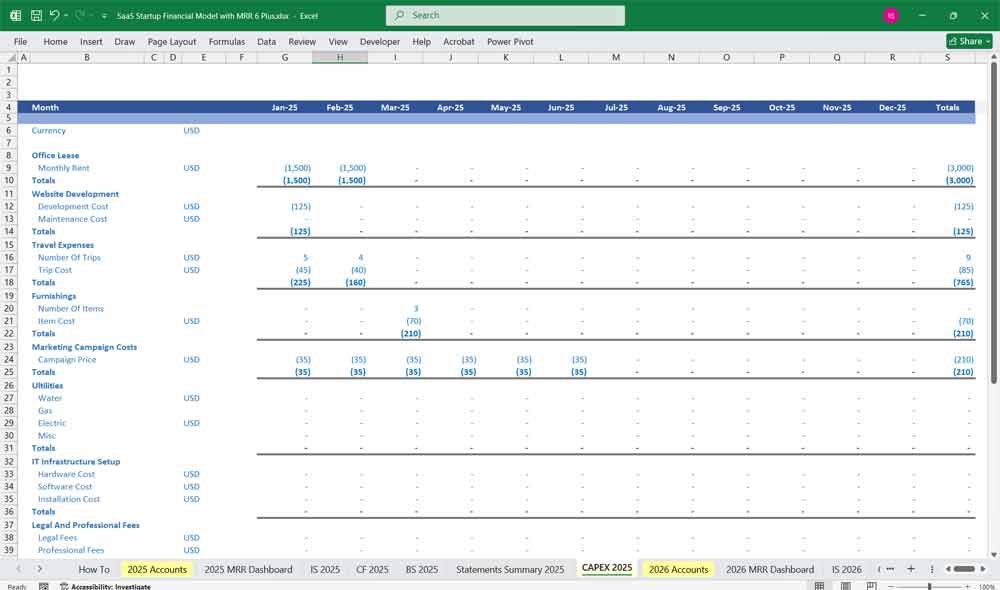
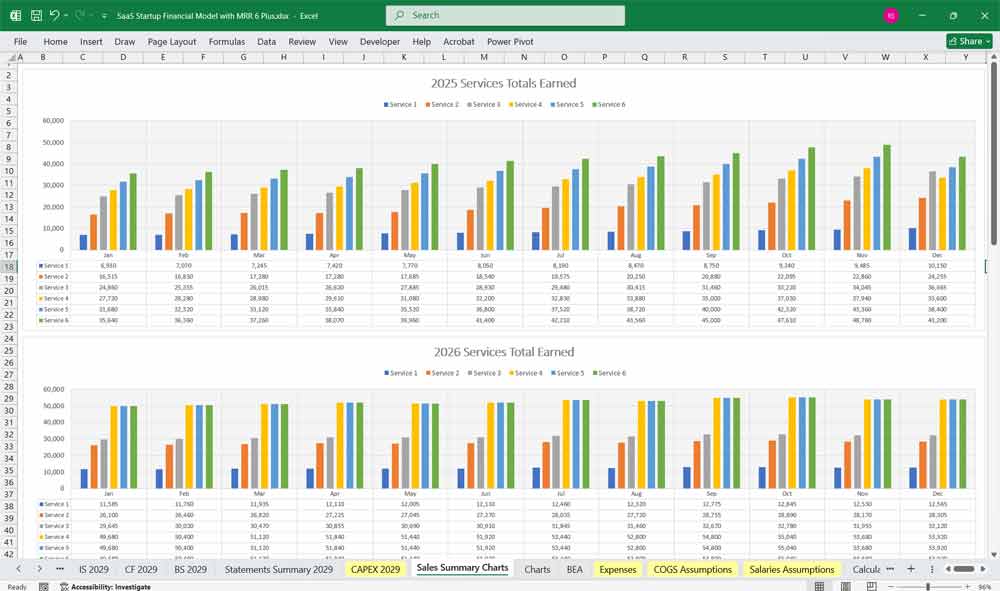
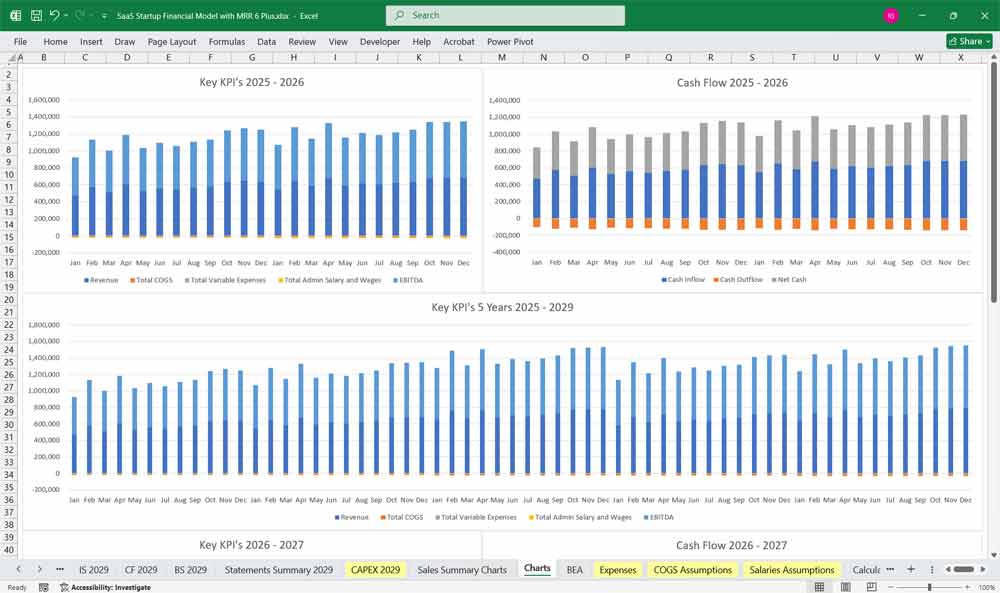
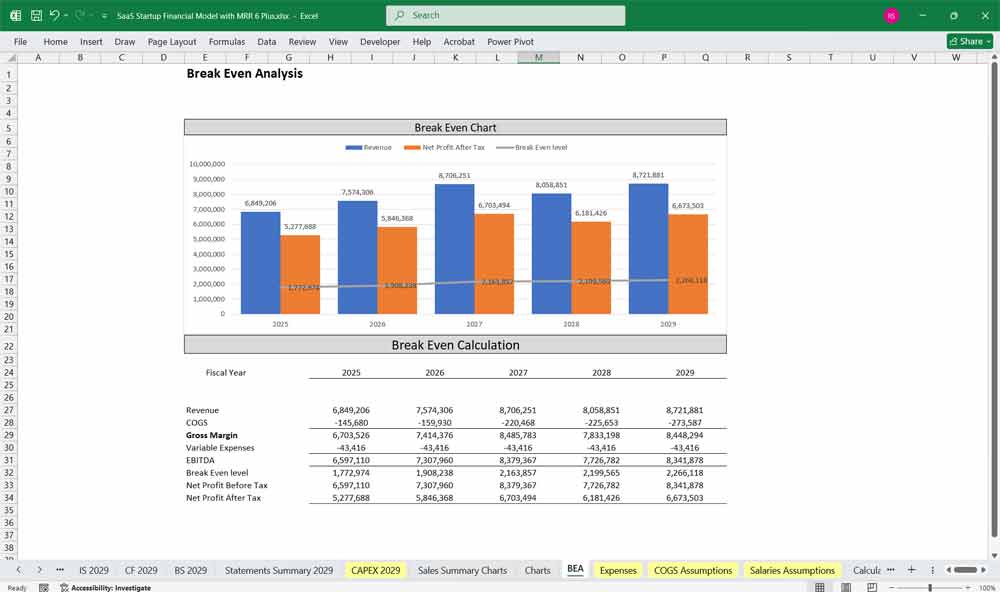
Value Your SaaS Startup With A DCF
Discounted Cash Flow (DCF): Valuing the “Compounding Code” Annuity
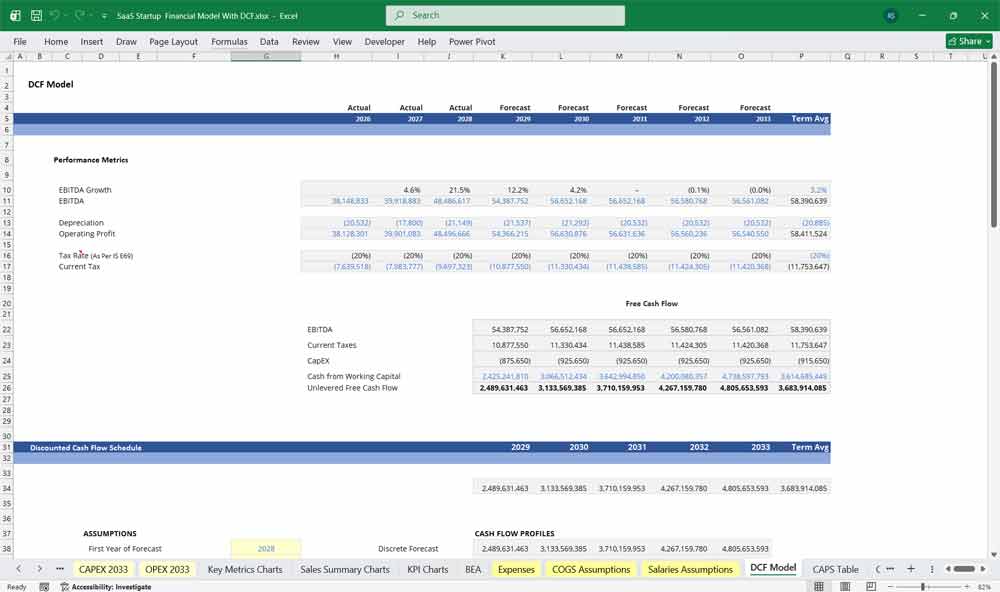
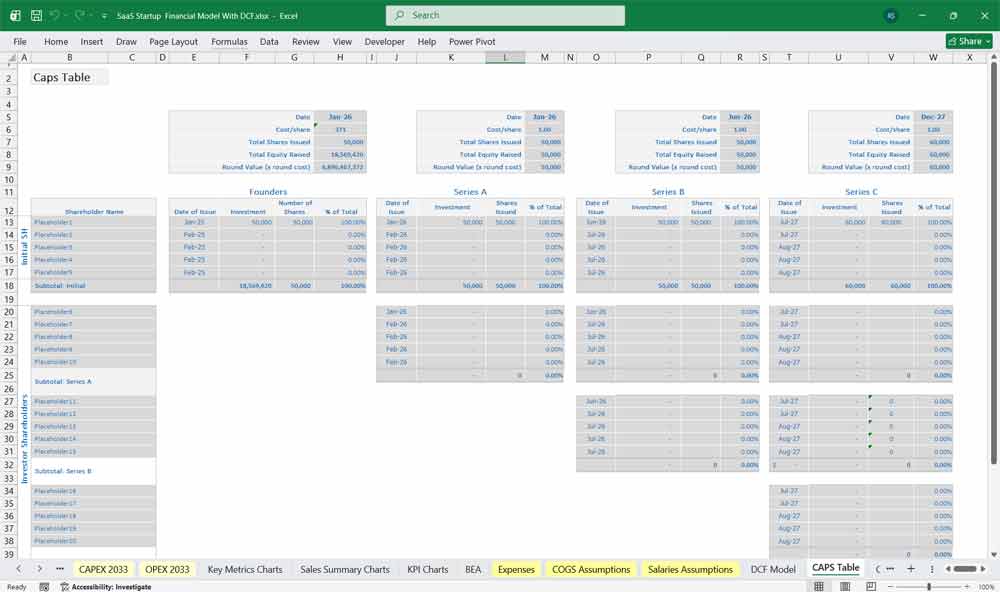
This DCF model values a SaaS startup by forecasting future cash flows from subscription-based revenue, recurring customer contracts, and potential expansion sales, then discounting them to present value. Key drivers include annual recurring revenue (ARR) growth, customer acquisition, retention rates, and pricing. Since many SaaS startups operate at a loss during their growth phase, long-term assumptions regarding scalability, profitability, and market penetration have a significant impact on valuation.
WACC: Pricing Intangible Assets and “Platform Inertia”
WACC represents the startup’s blended cost of financing from equity and debt, though early-stage SaaS companies are typically funded primarily through equity capital. Due to higher business risk, uncertain cash flows, and competitive market dynamics, SaaS startups generally have a higher WACC than mature businesses. As recurring revenues become more predictable and the company demonstrates sustainable growth, the cost of capital may decrease over time.
Sensitivity Analysis: Stress-Testing the “LTV-to-CAC” Engine
Sensitivity analysis assesses how changes in key assumptions affect the startup’s valuation. Important variables include revenue growth rates, customer churn, operating margins, customer acquisition costs (CAC), terminal growth rates, and WACC. By testing scenarios such as slower growth, increased churn, or higher funding costs, analysts can identify the most significant value drivers and evaluate the startup’s financial resilience under different market conditions.
Key Metrics for The Financial Model
To assess financial performance, SaaS startups track key performance indicators (KPIs):
- MRR (Monthly Recurring Revenue) & ARR (Annual Recurring Revenue)
- Predictable revenue from subscriptions.
- CAC (Customer Acquisition Cost)
- Total Sales & Marketing spend / New customers acquired.
- LTV (Customer Lifetime Value)
- Average Revenue per Customer × Customer Lifetime.
- Churn Rate
- Percentage of customers canceling subscriptions.
- Burn Rate
- Monthly net cash outflow (Operating Cash Flow – Expenses).
- Runway
- Available cash / Monthly burn rate (Months before funding is needed).
This SaaS startup financial model focus on recurring revenue growth, efficient customer acquisition, and sustainable cash flow management. Balancing customer retention, cost control, and investor funding ensures long-term viability.
Download Link On Next Page