
Animal Feed Financial Model Template Excel
This Animal Feed Manufacturing Financial Model is a fully integrated, 20-tab Excel template built for anyone who needs a bankable, investor-ready model for a feed mill or livestock feed business — fast. It combines three years of historical financials with a ten-year forecast (monthly detail for Years 1–5, annual thereafter) across a complete operating build: animals and customers served, feed demand, tonnes sold, product mix, and pricing, all the way through to raw material costs, manufacturing costs, and gross profit. Whether you’re preparing a lender package, raising equity, evaluating an acquisition, or simply building a business plan for your own feed operation, this template gives you a professional-grade starting point instead of a blank spreadsheet.
10-Year Financial Model for an Animal Feed Supplier
Every number in this financial model template flows from a single, editable Model Start Date — change it once, and every date, month label, and year band across all twenty tabs updates automatically. The model is fully formula-driven, color-coded (blue for inputs, black for formulas, green for cross-tab links), and built with zero circular references, so it recalculates cleanly in Excel, Google Sheets, or LibreOffice without triggering warnings or broken chains. A dedicated Checks tab independently verifies that the balance sheet balances, cash reconciles, and gross profit ties out across every single period — the same standard used by lenders and private equity analysts reviewing a real deal.
Beyond the three integrated financial statements, this feed manufacturing valuation model includes a full working capital schedule, an eleven-category capex and depreciation build, a term loan and revolver debt schedule, a Base/Upside/Downside scenario switch, and a complete DCF with Gordon Growth and Exit Multiple terminal value methods plus a built-in sensitivity table. An IRR and MOIC returns analysis and a management-ready dashboard round out the package. If you need a serious financial model for an animal feed, livestock feed, or agribusiness manufacturing company — and you want to spend your time on strategy instead of formulas — this template was built for exactly that.
Animal Feed Model Tab-by-Tab Breakdown
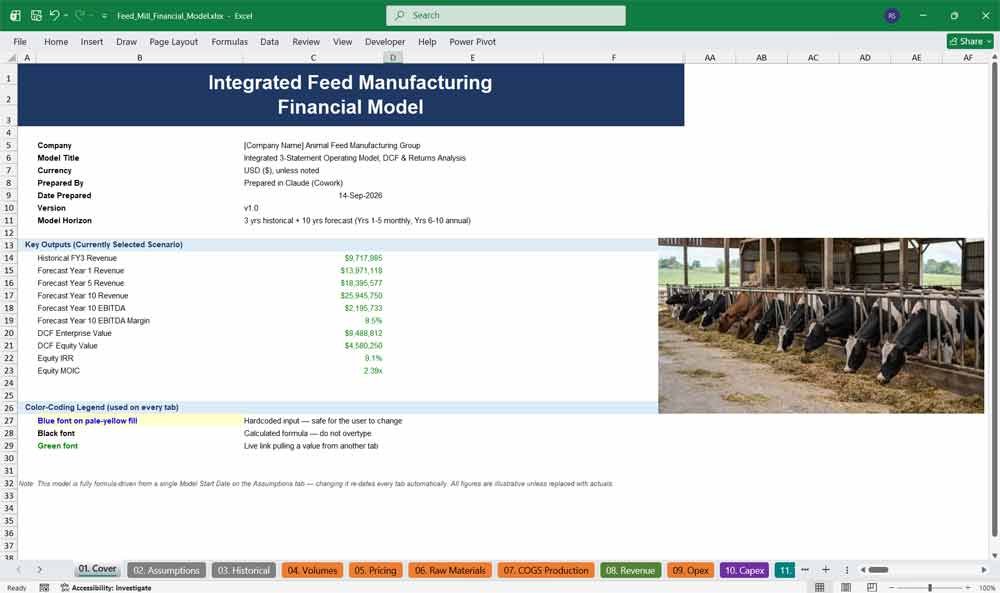
01. Cover
The Cover tab anchors this animal feed manufacturing financial model with company details, version control, and a live key-outputs summary. Investors and lenders reviewing your feed mill valuation see revenue, EBITDA, IRR, and equity value at a glance before opening a single other tab.
- Instant snapshot of revenue, EBITDA, IRR, MOIC, enterprise value, and equity value
- Color-coded legend explaining every input, formula, and link cell in the model
- Fully linked KPIs that update automatically the moment any assumption changes
- Professional, investor-ready presentation from the very first page
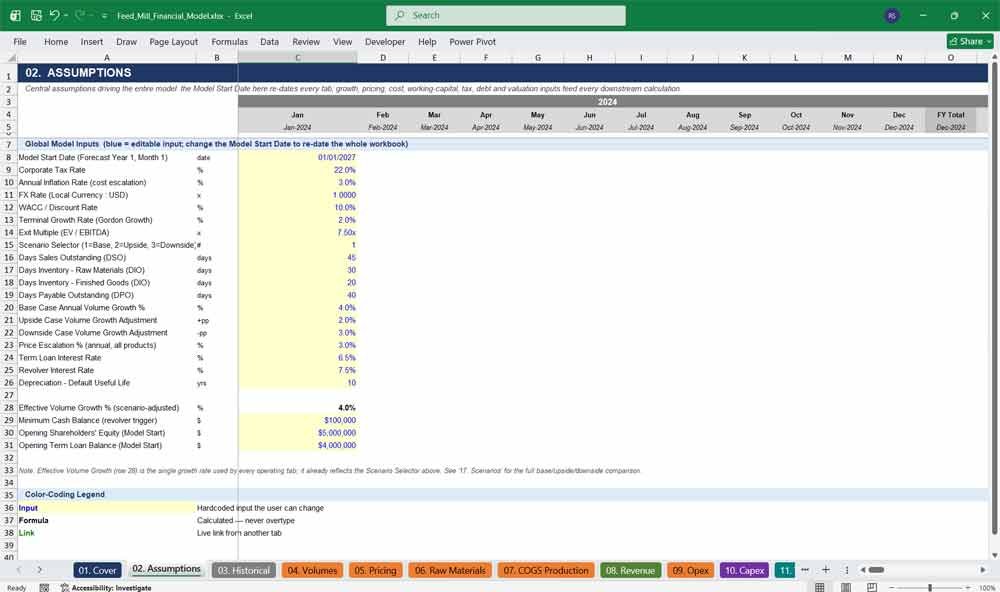
02. Assumptions
The Assumptions tab is the control center of this feed manufacturing Excel model. One editable Model Start Date re-dates every tab instantly, while centralized growth, inflation, tax, WACC, and working-capital-day inputs drive every forecast formula throughout the entire workbook.
- Single Model Start Date input re-dates the entire 13-year timeline automatically
- Centralized growth, pricing, inflation, tax, and WACC assumptions in one place
- Built-in scenario selector switches the whole model between Base, Upside, and Downside
- DSO/DIO/DPO working capital day assumptions drive every balance sheet forecast
Animal Feed Pricing & COGS
03. Historical
Review three years of historical financial performance on the Historical tab, combining two years of monthly detail with a summarized third year. Lenders and investors evaluating your animal feed business rely on clean, complete historical P&L, balance sheet, and cash flow data.
- Two years of monthly actuals plus one summarized annual year
- Full historical income statement, balance sheet, and cash flow statement
- Clearly flagged, editable input cells ready for your real company data
- The foundation every forecast tab in the model builds from
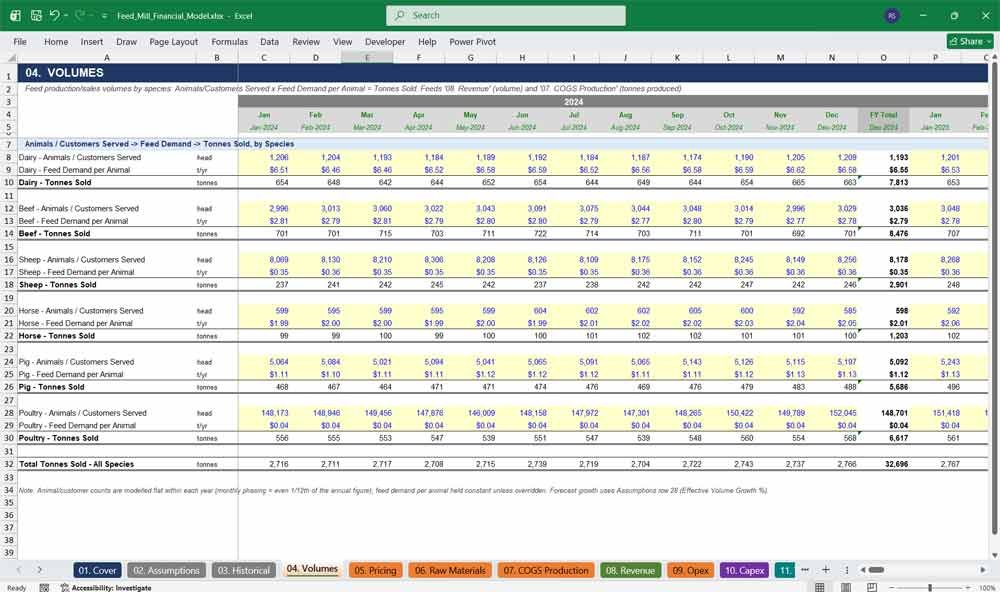
04. Volumes
The Volumes tab models feed production and sales by species: animals or customers served multiplied by feed demand per animal to calculate tonnes sold. This bottom-up volume build gives feed manufacturers a defensible, fully auditable basis for every revenue projection in the model.
- Six species/product lines: dairy, beef, sheep, horse, pig, and poultry
- Animals served x feed demand per animal = tonnes sold, by formula
- Fully formula-driven forecast tied directly to Assumptions growth rates
- Total feed volume rolls up automatically to drive revenue and production
05. Pricing
This Pricing tab sets selling price per tonne by species, annual price escalation, and the resulting product mix percentages. Feed manufacturers, brokers, and acquirers use this tab to stress-test pricing strategy and understand blended average selling price across the full product portfolio.
- Selling price per tonne modeled independently for every species
- Automatic annual price escalation linked to the Assumptions tab
- Product mix % showing each species’ share of total sales volume
- Feeds directly into the Revenue build with full transparency
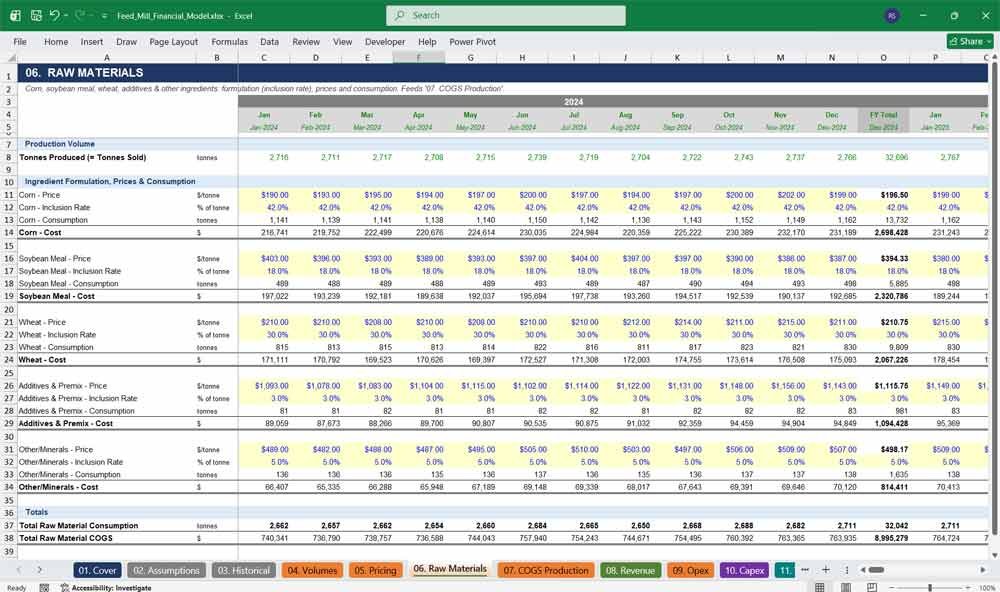
06. Raw Materials
Model corn, soybean meal, wheat, additives, and other key feed ingredients on this Raw Materials tab. Inclusion rates, ingredient pricing, and consumption tonnage combine to calculate total raw material cost — the single largest cost driver in any animal feed manufacturing business.
- Corn, soybean meal, wheat, additives & premix, and other minerals fully modeled
- Editable inclusion rate (%) and price per tonne for every ingredient
- Automatic consumption and cost calculations tied to production volume
- Inflation-linked ingredient pricing for realistic long-term forecasting
07. COGS Production
The COGS Production tab connects tonnes produced, ingredient consumption, and manufacturing conversion costs into a complete cost-per-tonne and gross profit build. This feed mill costing model gives operators and investors a clear, formula-driven view of unit economics and margin drivers.
- Complete build from tonnes produced through raw material and manufacturing cost
- Automatic cost-per-tonne calculation for pricing and benchmarking decisions
- Independent gross profit cross-check against the P&L tab
- Manufacturing (conversion) cost modeled separately from raw material cost
Animal Feed Manufacturer Financial Statements
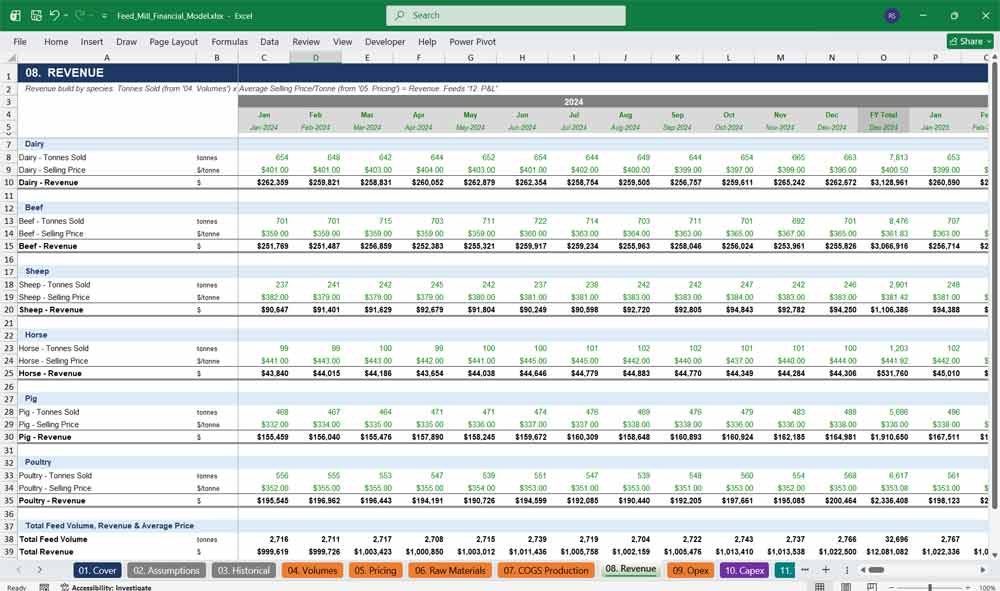
08. Revenue
This Revenue tab builds total sales by multiplying tonnes sold by average selling price for six species: dairy, beef, sheep, horse, pig, and poultry. Feed manufacturers and acquirers get a fully segmented revenue model with total volume, revenue, and blended price per tonne.
- Revenue build by species: tonnes sold x selling price per tonne
- Six product lines fully broken out and summed to total revenue
- Blended average selling price across all species calculated automatically
- Feeds directly into the integrated P&L with no manual re-entry
09. Opex
Forecast payroll, logistics, utilities, SG&A, maintenance, and other operating expenses on this Opex tab. Every category escalates with inflation automatically, giving feed manufacturing businesses a realistic, fully editable operating cost base for budgeting, fundraising, and acquisition due diligence.
- Six operating expense categories covering the full cost structure
- Automatic inflation escalation applied to every historical actual
- Fully editable input cells for your company’s real cost base
- Rolls up into total Opex feeding both the P&L and cash flow
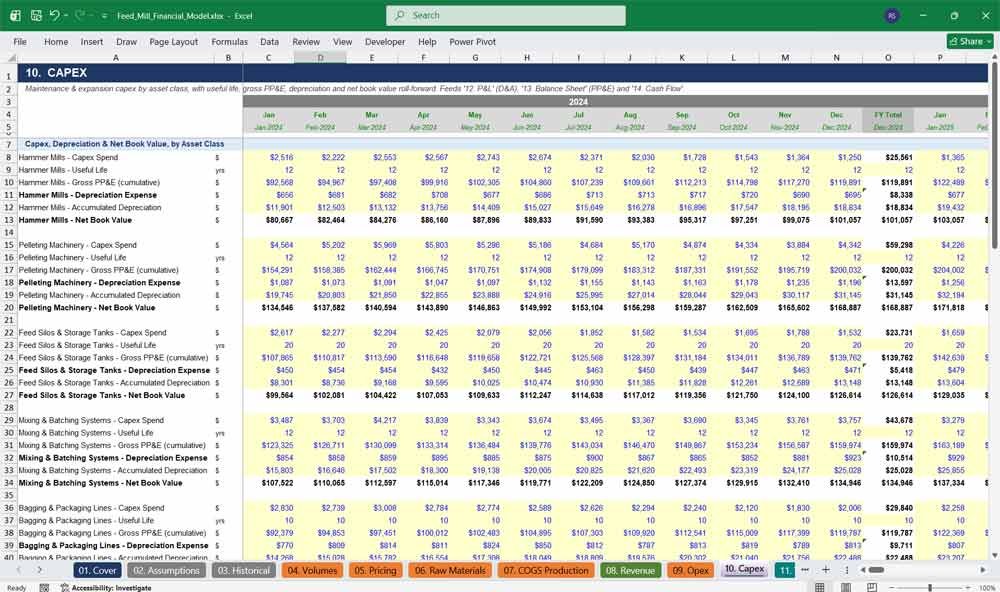
10. Capex
This Capex tab tracks maintenance and expansion capital spending across eleven equipment categories, from hammer mills and pelleting machinery to delivery vehicles and IT infrastructure. Depreciation, gross PP&E, and net book value roll forward automatically for every forecast period.
- Eleven capex categories covering the full feed mill asset base
- Automatic straight-line depreciation calculated by useful life
- Gross PP&E and accumulated depreciation roll forward every single period
- Feeds the balance sheet, cash flow, and DCF without manual work
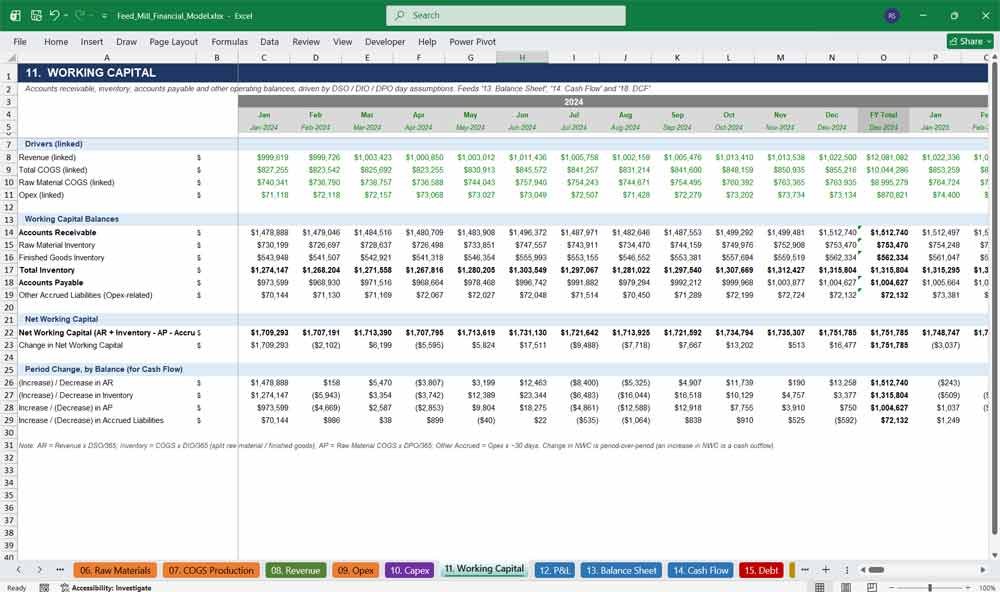
11. Working Capital
Model accounts receivable, inventory, accounts payable, and other operating balances using DSO, DIO, and DPO day assumptions. This Working Capital tab automatically calculates the cash impact of growth — a critical driver of free cash flow in any manufacturing business.
- AR, raw material inventory, finished goods inventory, and AP fully modeled
- Driven entirely by editable DSO/DIO/DPO day assumptions
- Automatic period-over-period change calculations feed the cash flow statement
- Net working capital tracked across every historical and forecast period
12. P&L
This fully integrated income statement pulls revenue, COGS, opex, D&A, interest, and tax from every operating tab into one clean P&L. Feed manufacturing investors and lenders get EBITDA, EBITDA margin, and net income for all thirteen historical and forecast years instantly.
- Fully linked income statement from Revenue all the way to Net Income
- Automatic EBITDA and EBITDA margin calculation for every period
- Thirteen years of history and forecast in one clean, scannable view
- Zero hardcoded results — every single figure is a live formula
13. Balance Sheet
The integrated Balance Sheet links cash, receivables, inventory, and PP&E against payables, debt, and equity for every period in this feed manufacturing model. A built-in balance check confirms assets always equal liabilities plus equity, exactly as a bankable model should.
- Fully integrated with Working Capital, Capex, Debt, and Cash Flow tabs
- Automatic shareholders’ equity roll-forward with retained earnings
- Built-in balance check confirms the model ties out in every period
- A genuinely bankable, lender-ready balance sheet structure
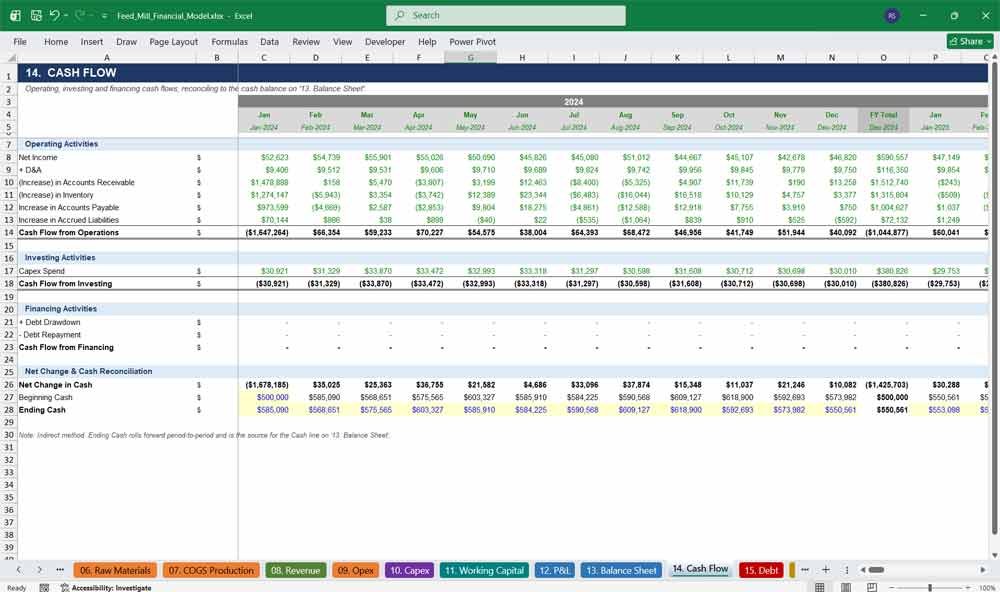
14. Cash Flow
This Cash Flow statement reconciles operating, investing, and financing activity into a clean ending cash balance for every historical and forecast period. Feed manufacturing owners and investors can see exactly how growth, capex, and debt decisions affect liquidity over time.
- Full indirect-method cash flow statement, start to finish
- Operating, investing, and financing activities clearly separated
- Automatic reconciliation to the Balance Sheet cash balance
- Beginning and ending cash rolls forward every period, error-free
15. Debt
Model term loan drawdowns, amortization, interest expense, and an available revolver facility on this Debt tab. Interest is always calculated on prior-period balances to avoid circular references, giving feed manufacturing buyers and lenders a clean, error-free debt schedule every time.
- Term loan and revolver facility fully modeled with amortization schedule
- Interest calculated on prior-period balances — zero circular references, guaranteed
- Editable interest rates, drawdown, and repayment assumptions
- Feeds directly into the P&L, Balance Sheet, and DCF automatically
An Animal Feed Supplier Key KPIs
16. Returns Valuation
Calculate EBITDA, unlevered free cash flow, equity IRR, and MOIC from a Year 0 investment through a Year 10 exit on this Returns Valuation tab. Private equity buyers and searchfund acquirers evaluating a feed manufacturing acquisition get investment-grade return metrics instantly.
- Equity cash flow schedule from initial investment through to exit
- Automatic IRR and MOIC calculation using Excel’s native functions
- Exit value driven by a fully editable exit EBITDA multiple
- Built specifically for private equity, search fund, and M&A use cases
17. Scenarios
Switch this entire feed manufacturing financial model between Base, Upside, and Downside cases with a single scenario selector. Every tab, from Volumes through the DCF, recalculates instantly, giving buyers and lenders a fast, transparent way to stress-test the business plan.
- One-click Base / Upside / Downside scenario switch
- The entire model recalculates automatically for whichever case is selected
- Summary table shows Year 1, Year 5, and Year 10 outcomes by case
- Ideal for lender sensitivity requirements and investment committee presentations
18. DCF
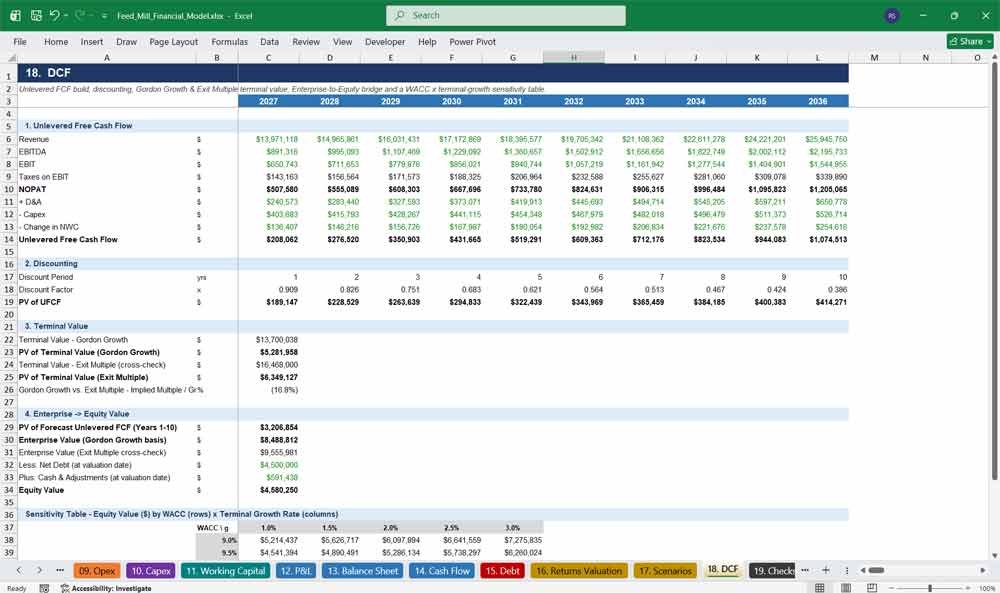
This DCF tab builds unlevered free cash flow, discounts it back at WACC, and calculates terminal value using both Gordon Growth and Exit Multiple methods. A built-in WACC x growth-rate sensitivity table gives feed manufacturing buyers a complete, audit-ready valuation range.
- Full unlevered free cash flow build from EBITDA through to UFCF
- Terminal value calculated two independent ways for cross-validation
- Enterprise-to-equity value bridge including net debt and cash adjustments
- Built-in 5×5 WACC x terminal growth rate sensitivity table
19. Checks
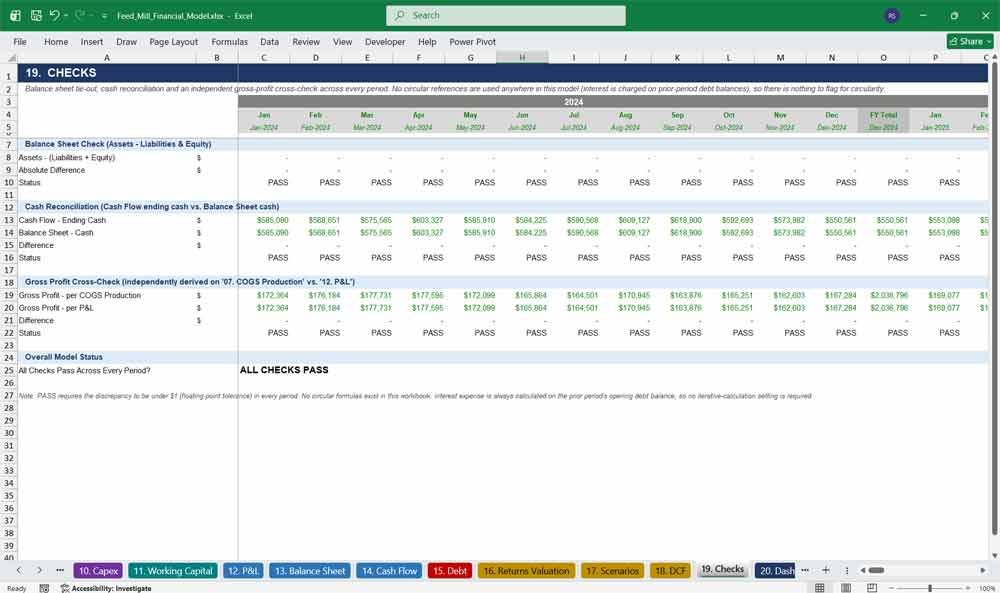
Every serious financial model needs a Checks tab, and this one verifies balance sheet integrity, cash reconciliation, and gross profit consistency across all ninety-plus periods. A single pass/fail flag confirms this feed manufacturing model ties out perfectly, period after period.
- Automatic balance sheet check across every historical and forecast period
- Cash flow independently reconciled against the Balance Sheet cash balance
- Independent gross profit cross-check computed on two separate tabs
- One clear PASS/REVIEW flag for instant model integrity confirmation
20. Dashboard
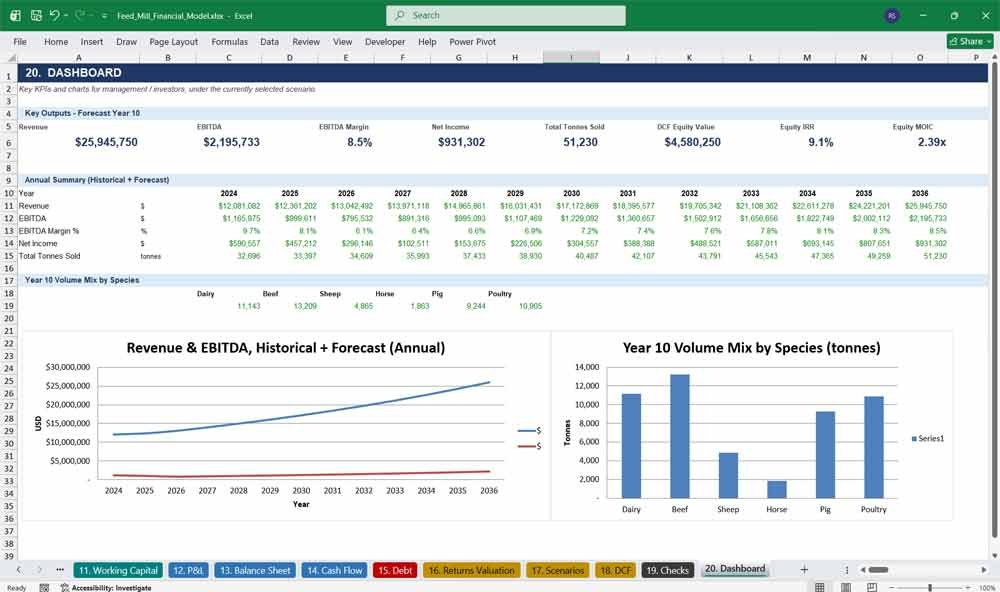
The Dashboard tab summarizes thirteen years of revenue, EBITDA, margin, and net income alongside built-in charts and a volume-mix visual. Feed manufacturing executives, investors, and lenders get a management-ready, presentation-quality overview without ever opening another tab in the workbook.
- Key KPI cards: revenue, EBITDA, margin, net income, IRR, and MOIC
- Built-in Revenue & EBITDA trend chart across all thirteen years
- Volume mix chart by species for the final forecast year
- Fully linked — updates automatically the instant any input changes
Why Buy This Animal Feed Model
Building a 20-tab, fully integrated animal feed manufacturing financial model from a blank workbook takes an experienced analyst dozens of hours — and that’s before you’ve stress-tested it for circular references or balance sheet errors. This template gives you the same bankable, audit-ready structure lenders and private equity investors expect — dynamic dates, complete formula transparency, a verified balance sheet, a full debt and working capital build, and an investor-ready DCF and returns analysis — ready to customize with your own numbers in minutes, not weeks. Whether you’re raising capital, evaluating a feed mill acquisition, preparing a lender submission, or simply planning your own feed manufacturing business, you’re buying back the time it takes to build a model from scratch, and starting from a version that’s already been checked, balanced, and stress-tested.
Animal Feed Mnaufacturing Frequently Asked Questions (Faq)
What software do I need to open and use this model?
The model is a standard .xlsx file built and tested in Excel. It uses only common, widely supported formulas (SUM, IF, IFERROR, SUMPRODUCT, IRR, INDEX/MATCH, and similar), so it also opens and recalculates correctly in Google Sheets and LibreOffice Calc — no special add-ins required.
Are the numbers in the model real, or do I need to enter my own?
Every figure — volumes, prices, ingredient costs, opex, capex, and historical financials — is an illustrative placeholder clearly marked with blue input formatting. The model is built to be re-populated with your own company’s numbers; once you do, every formula, statement, and output recalculates automatically.
Do I need advanced Excel skills to use this model?
No. Every cell you’re meant to edit is color-coded blue, every calculated cell is black, and every cross-tab link is green, so it’s always clear what’s safe to change. If you can type a number into a cell, you can drive this entire model.
Will the model still work if I change the start date, currency, or scenario?
Yes. Change the Model Start Date on the Assumptions tab and every date across all twenty tabs updates automatically. Flip the Base/Upside/Downside scenario selector and every tab from Volumes to the DCF recalculates instantly. All dollar figures can be repurposed for any currency.
Does this model include historical financials, or only a forecast?
Both. It includes three years of historical actuals (two years of monthly detail plus a summarized third year) alongside a ten-year forecast — five years of monthly detail followed by five years of annual detail — for thirteen years of coverage in total.
Can I actually use this for a real fundraising, lender, or acquisition process?
Yes. The model was built to the same standard used in lending and private equity review: zero circular references, a dedicated Checks tab that verifies the balance sheet ties out every period, and a full DCF and returns analysis suitable for investment committee or lender presentations.
Does the model check itself for errors?
Yes. The Checks tab independently re-derives the balance sheet, reconciles cash, and cross-checks gross profit across every single period in the model and returns a clear PASS/REVIEW status, so you always know the model is internally consistent before you present it.
Can I add or remove product lines, ingredients, or forecast years?
The model’s row and column structure can be extended or trimmed like any Excel workbook — copy a species, ingredient, or capex-category block and adjust the formulas to match. [Add any specifics on the level of customization support you provide.]
Is this model only for animal feed companies?
It was purpose-built for feed manufacturers, but the underlying structure — a volume-times-price revenue build, a raw-material-driven COGS build, and a full three-statement model with DCF — adapts readily to any manufacturing or processing business with a similar cost structure.
Final Notes on the Financial Model
This 10 Year Animal Feed Financial Model focuses on balancing capital expenditures with steady revenue growth from a diversified Livestock Nutrition product line. By optimizing operational costs, and power efficiency, and maximizing high-margin services, the models ensure sustainable profitability and cash flow stability.