
Telecoms Financial Model Template Excel
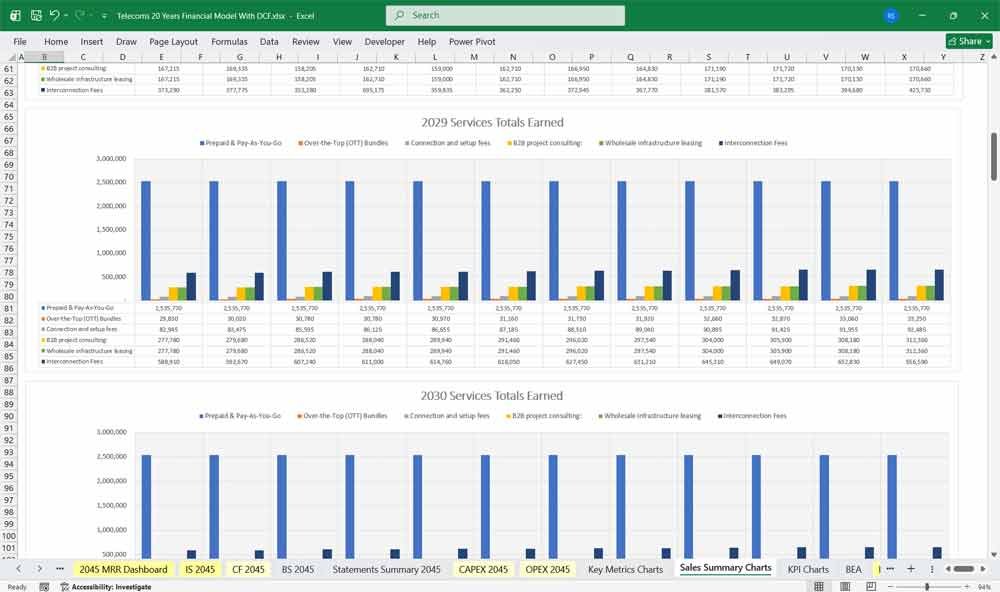
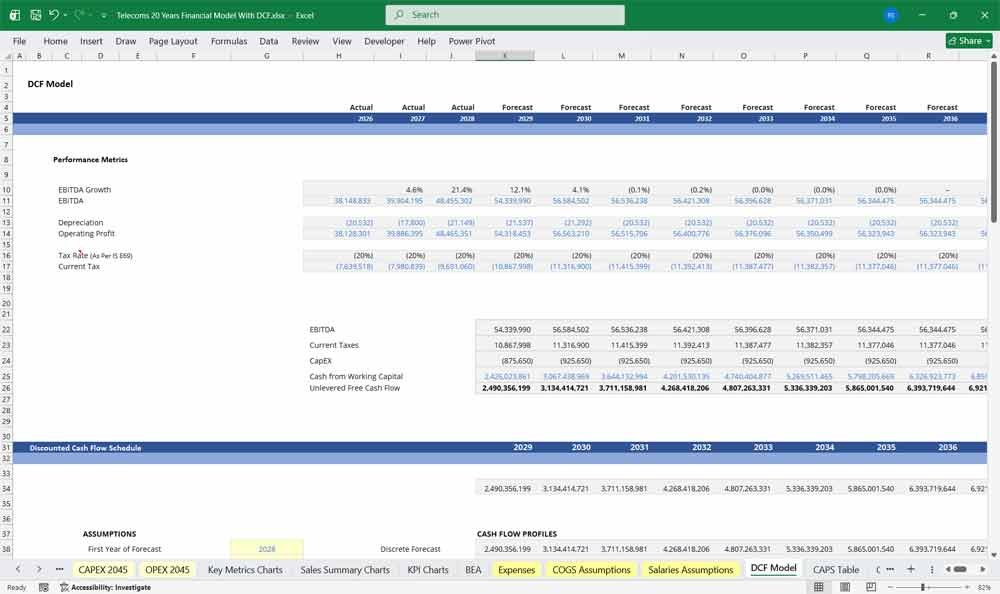
This 20-Year, 3-Statement Telecoms Financial Model Template Excel includes 6-tier subscription revenue streams, plus income from Prepaid & Pay-As-You-Go, Over-the-Top (OTT) Bundles, Connection and setup fees, Wholesale infrastructure leasing, etc. Cost structures, Discounted Cash Flow (DCF) with Terminal Value, Sensitivity Analysis, WACC, NPV, IRR, and financial statements to forecast the financial health of your Telecoms Company.
20-Year Financial Model for a Telecoms Company
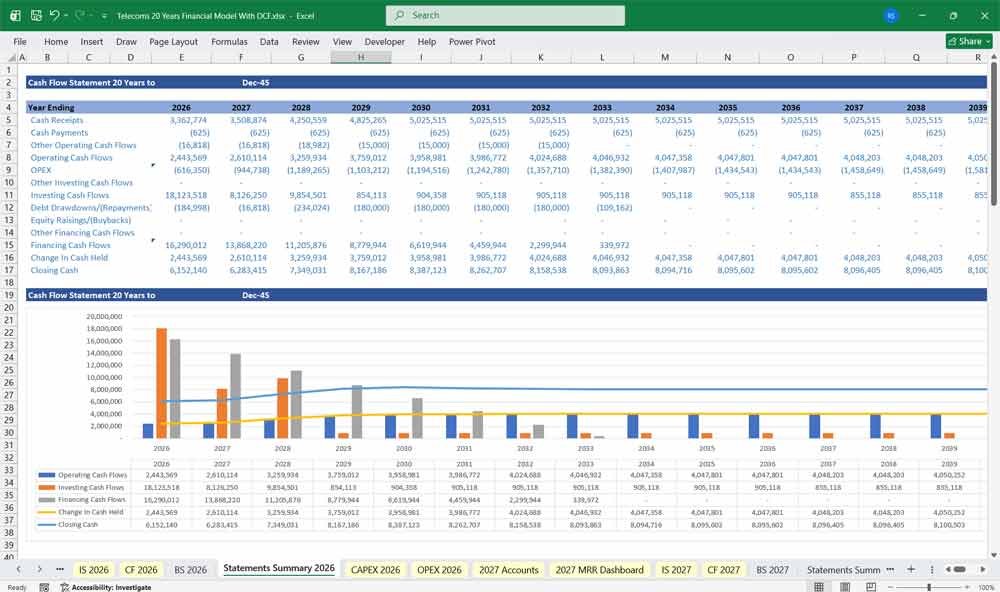
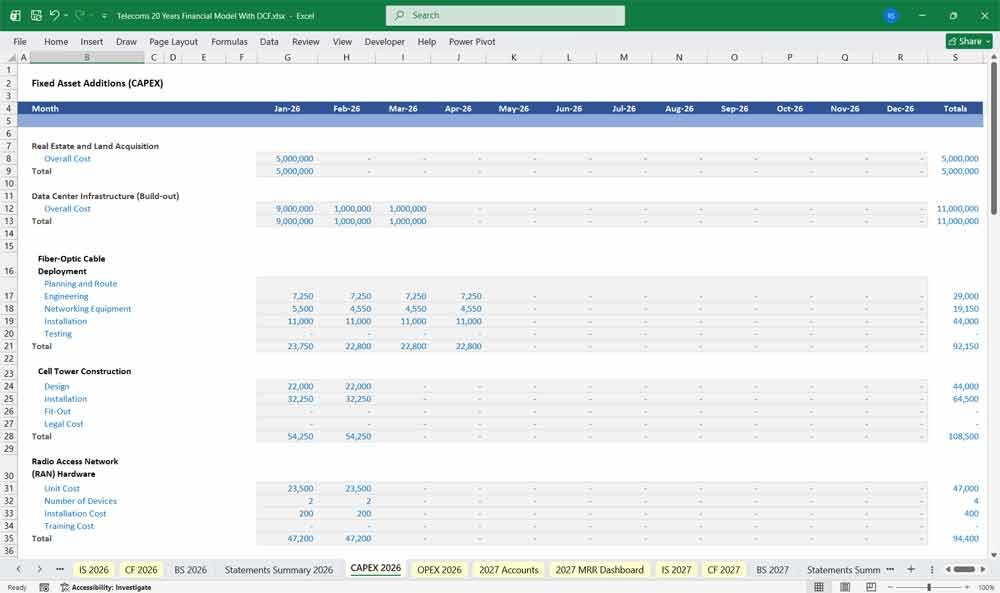
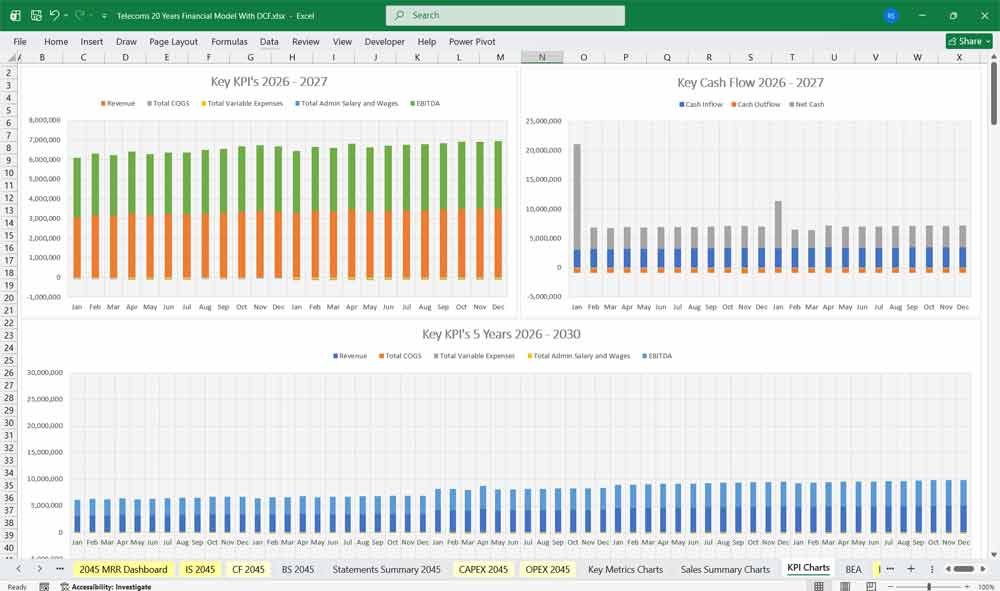
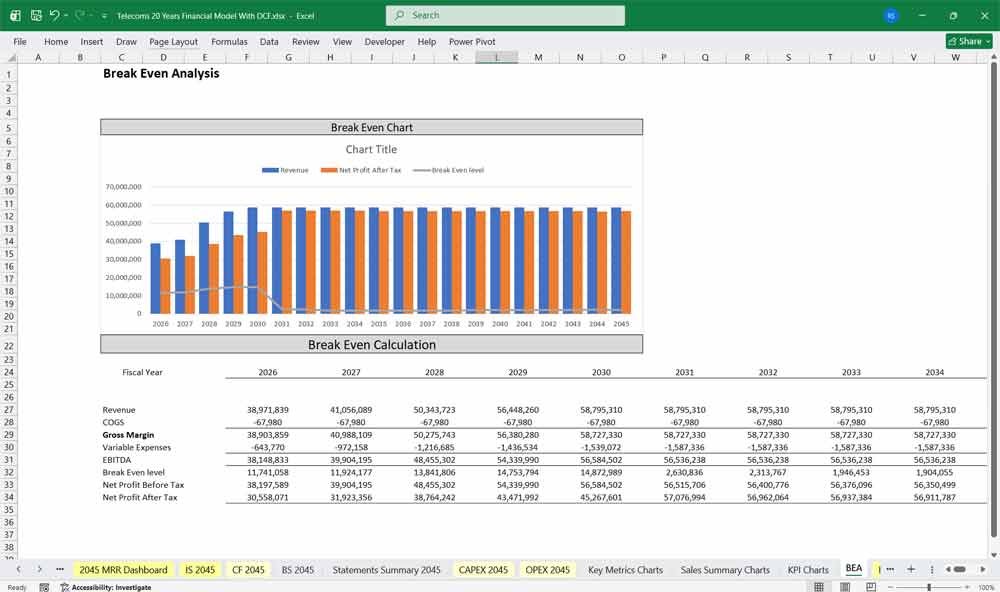
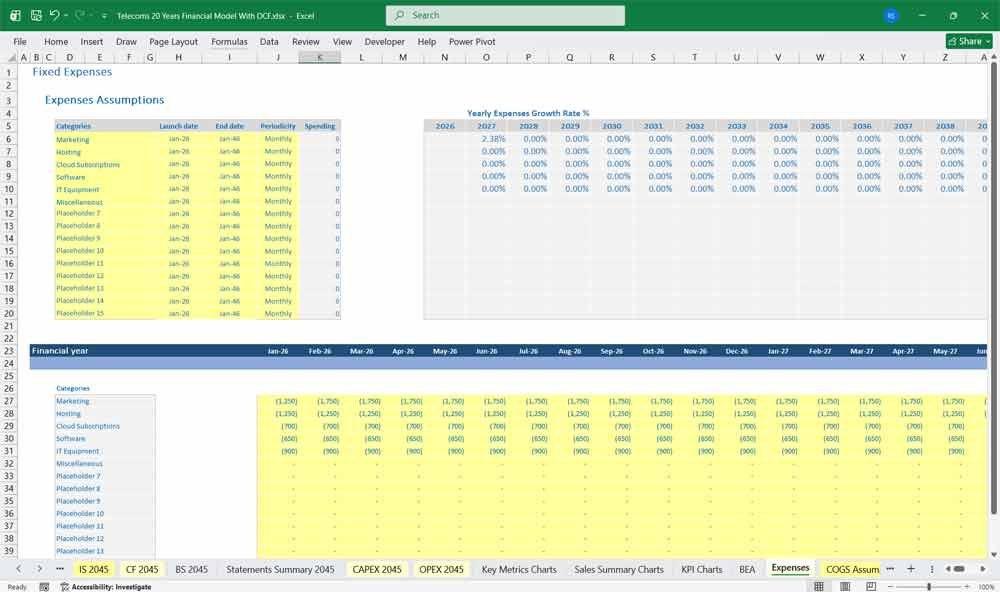
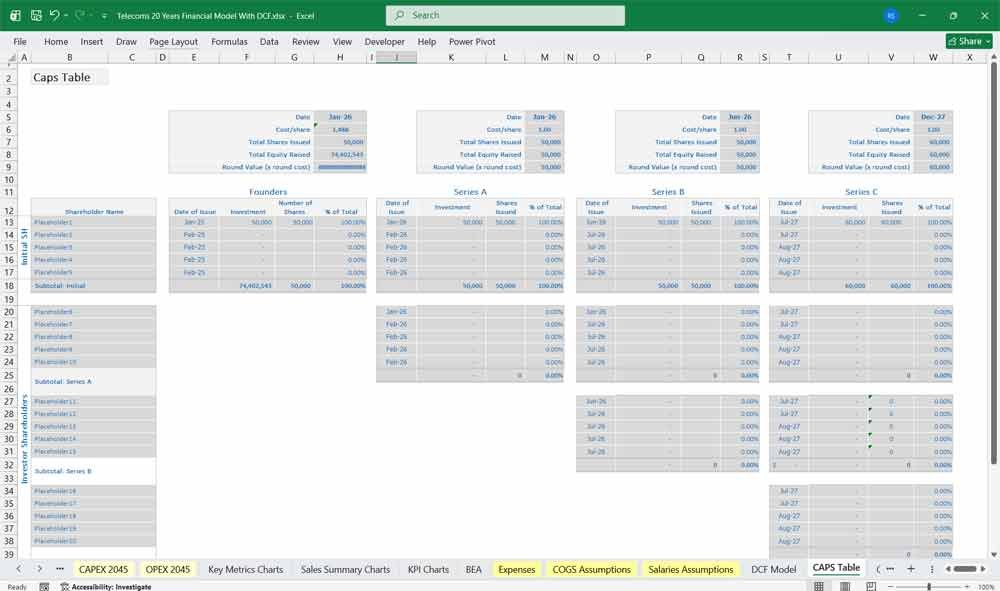
This very extensive 20 Year Telecoms Model involves detailed revenue projections, cost structures, capital expenditures, and financing needs. This model provides a thorough understanding of the financial viability, profitability, and cash flow position of your telecoms business. Includes: 20x Income Statements, Cash Flow Statements, Balance Sheets, CAPEX sheets, OPEX Sheets, Statement Summary Sheets, and Revenue Forecasting Charts with the revenue streams, BEA charts, sales summary charts, employee salary tabs and expenses sheets.
Revenue Model & Income Statement Architecture
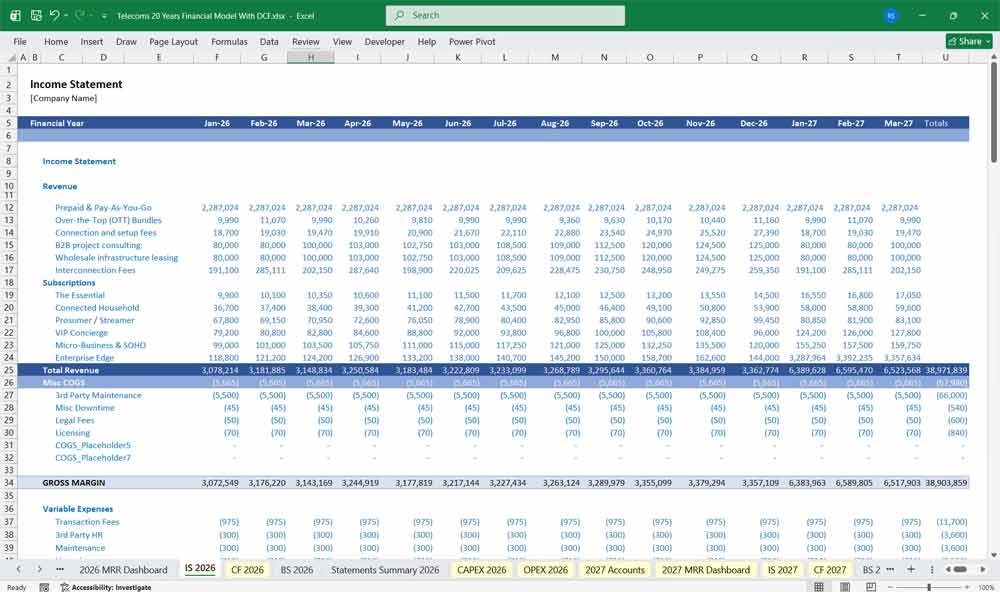
The income statement for a telecom operator drives off subscriber volumes, pricing tiers, and direct network operating expenses.
Subscriber Metrics & Top-Line Revenue:
Postpaid/Prepaid Consumer Subscriptions: Calculated per tier by multiplying total active subscribers by Average Revenue Per User (ARPU). This captures recurring monthly fees for voice, data, and messaging bundles.
Enterprise & Wholesale Revenue: Long-term contracts for Dedicated Internet Access (DIA), MPLS circuits, private 5G slicing, and wholesale roaming/traffic termination fees charged to other carriers.
Hardware & Equipment Sales: Revenue from selling or leasing consumer hardware (smartphones, routers, mesh systems) and enterprise networking gear. Often sold upfront or bundled into equipment installment plans (EIP).
Direct Operating Expenses (OpEx):
Cost of Goods Sold (COGS) / Network Operations: Interconnection fees paid to other carriers for routing off-net calls, spectrum licensing fees, tower lease rentals (cell site rents), and backhaul transit costs.
Equipment Cost of Sales: Wholesale purchase costs of devices and customer-premises equipment (CPE) sold to subscribers.
Operating Expenses & Overhead:
Sales & Marketing (Subscriber Acquisition Cost – CAC): Commissions, retail channel overhead, advertising, and promotional hardware subsidies used to attract new accounts.
General & Administrative (G&A): Corporate salaries, billing systems software, legal, regulatory compliance, and customer service operations.
Depreciation & Amortization (D&A): Massive non-cash expenses reflecting the rapid depreciation of physical telecom infrastructure (cell towers, fiber lines, switching gear) and the amortization of spectrum licenses.
Operating Income (EBIT) & Net Income:
Operating income represents core earnings before interest and taxes (EBIT). Subtracting net interest expense on heavy debt loads and corporate income tax yields the bottom-line Net Income.
Telecoms Company Cash Flow Statement
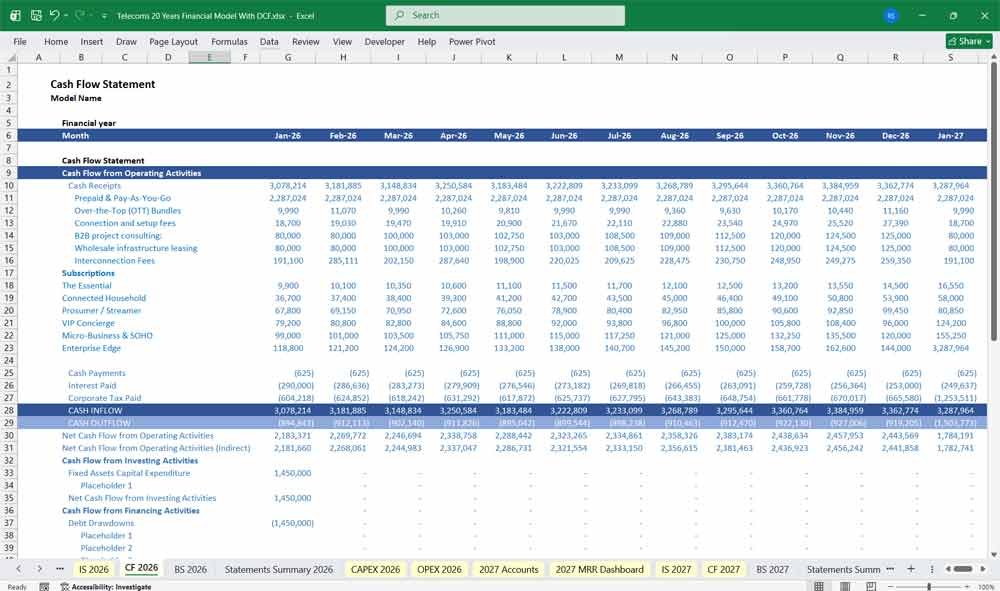
Telecoms are capital-intensive utilities; tracking cash conversion from operational revenue into network investment is critical for solvency.
Cash Flow from Operations (CFO):
Starts with Net Income and adds back non-cash expenses, most notably Depreciation & Amortization (which are exceptionally high in telecoms).
Adjusts for working capital changes: increases in accounts receivable (unpaid consumer and enterprise bills) consume cash, while increases in accounts payable (owed to tower operators and equipment vendors) provide short-term cash relief.
Accounts for changes in deferred revenue (advance payments for annual or multi-month plans).
Cash Flow from Investing (CFI):
Capital Expenditures (CapEx): The single largest cash outflow. Divided into Maintenance CapEx (keeping existing fiber and towers operational) and Growth/Expansion CapEx (rolling out 5G networks, laying new fiber-to-the-home, or acquiring new spectrum licenses at government auctions).
Proceeds from the sale of legacy infrastructure or tower asset monetization (e.g., sale-and-leaseback agreements of cell towers).
Cash Flow from Financing (CFF):
Reflects how the telecom funds its heavy infrastructure buildout. Includes cash inflows from issuing long-term corporate bonds, drawing on revolving credit facilities, or issuing equity.
Reflects cash outflows for principal debt repayments, lease liability payments under accounting standards for tower leases, and dividend distributions to shareholders.
Telecoms Company Balance Sheet Structure
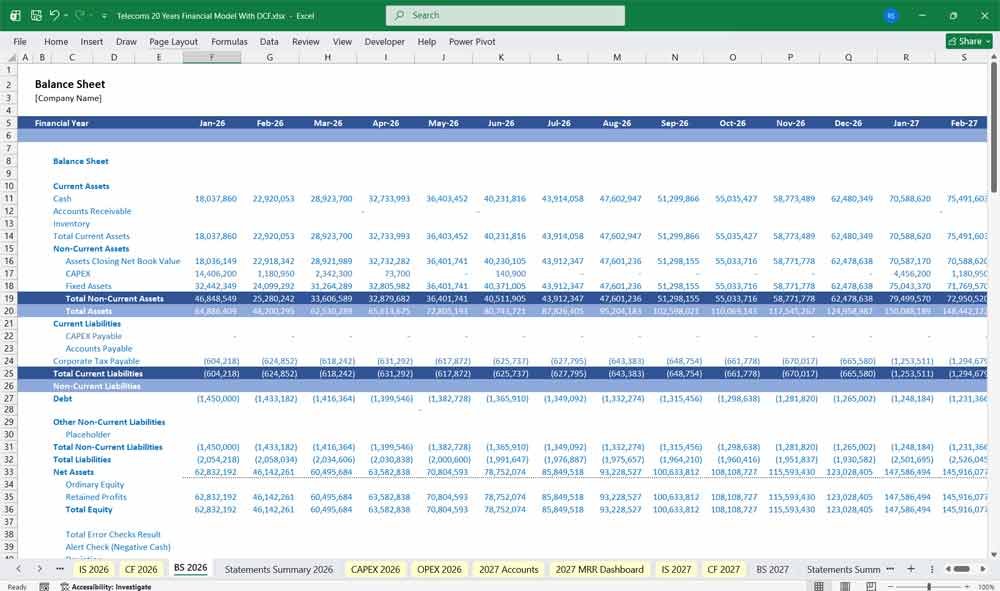
The balance sheet highlights the asset-heavy nature of the business alongside significant long-term financing obligations.
Assets:
Current Assets: Cash and cash equivalents, short-term investments, accounts receivable (net of bad debt provisions for unpaid customer bills), and inventory (unsold smartphones and network routers).
Non-Current / Fixed Assets: Property, Plant, and Equipment (PP&E), which includes core physical assets like fiber-optic cables, cell towers, data centers, switching centers, and customer-premises equipment.
Intangible Assets & Goodwill: Capitalized value of acquired spectrum licenses, software licenses, brand equity, and goodwill from historical mergers and acquisitions.
Liabilities:
Current Liabilities: Accounts payable to vendors, accrued interest, short-term portions of long-term debt, deferred revenue (billed but unearned subscription fees), and current lease liabilities.
Non-Current Liabilities: Long-term debt (bonds and institutional loans raised to fund network rollouts), long-term lease liabilities (recognizing long-term cell site and real estate leases), and deferred tax liabilities.
Shareholders’ Equity:
Common stock, additional paid-in capital, and retained earnings (cumulative net income minus paid dividends). Telecom balance sheets often display lower equity relative to debt due to the high leverage utilized to fund capital-intensive network builds.
Key Telecoms Industry-Specific Considerations
High Fixed Cost Base: Equipment-Comper Hardware with high depreciation.
R&D Intensity: Critical for staying competitive.
Quality & Legal Certification: Failure costs can be catastrophic.
Cyclicality & Diversification: Multi-agent systems
- Responsive & scalable services
- Regulatory Compliance
- Spectrum Management
- Critical Infrastructure Security
- Technology Convergence
A six-tier subscription architecture for a modern telecommunications company requires striking a balance between accessible entry points, feature-rich consumer bundles, premium lifestyle packages, and scalable B2B/enterprise offerings.
Tier 1: The Essential (Low-Cost / Entry-Level Consumer)
Designed for value-conscious consumers, fixed-income households, or secondary devices like smartwatches and basic tablets. This tier removes friction to capture budget-sensitive market share while securing baseline recurring revenue.
Core Connectivity: Capped or economy-speed domestic data (e.g., up to 50 Mbps broadband or throttled unlimited cellular data after a low priority threshold).
Voice & Messaging: Unlimited local standard voice minutes and standard SMS.
Customer Support: Digital-first, automated support (AI chatbot and community forums) with paid pay-per-incident phone support.
Value Proposition: Low monthly commitment with no long-term penalty locks.
Tier 2: The Connected Household (Standard / Mid-Tier Consumer)
The mass-market workhorse tier tailored for typical individuals and smaller households who need reliable connectivity for streaming, remote work, and everyday browsing without overpaying for enterprise-grade perks.
Core Connectivity: High-speed fiber broadband (e.g., 300 to 500 Mbps) or robust 5G mobile data with generous priority allowances (e.g., 50GB high-speed data).
Voice & Messaging: Unlimited domestic talk, text, and international messaging to select neighboring regions.
Hardware Perks: Discounted rental or inclusion of a mid-tier Wi-Fi 6 router.
Value Proposition: The optimal price-to-performance ratio for the average family, balancing speed and dependable uptime.
Tier 3: The Prosumer / Streamer (High-Performance Consumer)
Targeted at heavy data users, multi-device smart homes, competitive gamers, and remote professionals who demand zero-lag connections and maximum priority bandwidth during peak hours.
Core Connectivity: Gigabit symmetrical fiber broadband (1 Gbps+) or unlimited unthrottled 5G mobile data with priority network routing.
Add-on Ecosystem: Bundled digital subscriptions (e.g., streaming video, cloud storage, or cyber-security suites included at no extra cost).
Customer Support: Priority routing to domestic support queues with a reduced time-to-resolution SLA.
Value Proposition: Uncapped performance ensuring no buffering or throttling, paired with lifestyle digital perks.
Tier 4: The VIP Concierge (Ultra-Premium / Family Elite)
A lifestyle-oriented tier positioned for high-net-worth individuals or large multi-generational families who expect a white-glove service experience alongside top-tier multi-device connectivity.
Core Connectivity: Multi-gigabit broadband (2 Gbps+) with mesh Wi-Fi hardware included and optimized enterprise-grade routing for low latency.
Global Access: Complimentary international roaming packages across major global zones with no hidden daily fees.
Customer Support: Dedicated concierge service via a direct phone line or personal account manager, bypassing standard queues entirely.
Hardware Perks: Annual device upgrade credits or hardware insurance included natively.
Value Proposition: Total convenience and frictionless global connectivity backed by personalized human support.
Tier 5: The Micro-Business & SOHO (Small Office / Home Office)
Bridging the gap between consumer packages and corporate solutions, this tier addresses the unique demands of freelancers, digital creators, and small remote teams working from non-commercial spaces.
Core Connectivity: Business-grade fiber with symmetrical upload and download speeds, plus a guaranteed 99.9% uptime availability target.
Security & Networking: Built-in static IP address, enterprise-grade network firewall, and isolated guest Wi-Fi networks.
Business Tools: Integrated cloud collaboration licenses (e.g., business email domains, cloud phone system/VoIP extensions).
Customer Support: 24/7 dedicated small-business tech support with a 4-hour hardware replacement window.
Value Proposition: Professional-grade reliability and security features scaled down to a predictable monthly cost without enterprise complexity.
Tier 6: The Enterprise Edge (Custom / Large Scale B2B)
A fully modular, enterprise-grade architecture designed for medium-to-large businesses requiring bespoke networking, stringent security compliance, and dedicated infrastructure management.
Core Connectivity: Dedicated fiber lines (DIA – Dedicated Internet Access), SD-WAN integration, and private 5G campus slicing.
SLA & Reliability: Financially backed Service Level Agreements (SLAs) guaranteeing 99.999% uptime, jitter limits, and rapid fault resolution.
Scalability & Management: A centralized portal for provisioning lines, managing security policies, and tracking bandwidth utilization in real-time.
Customer Support: Assigned Enterprise Account Director and a dedicated tier-3 network engineering escalation team.
Value Proposition: Complete infrastructure control, guaranteed operational resilience, and custom integration with internal enterprise IT stacks.
20-Year Telecoms Company Financial Model Advantages
These 20-year financial models gives any Telecoms Company the ability to plan around long development lifecycles and extended horizons. In industries where development can span 20 years, and often exceed multiple decades, a long-term model ensures that capital investment decisions are aligned with the revenue and cash flow timelines they are meant to serve.
Value Your Telecoms Company With A DCF
Long-Term Valuation Through Discounted Cash Flow (DCF)
This 20-year DCF model values a telecoms company by forecasting free cash flows from mobile, broadband, data, and other telecommunications services, then discounting them to present value. Key drivers include subscriber growth, average revenue per user (ARPU), network usage, pricing, and operating costs. Significant capital expenditure on network infrastructure, including fibre and 5G, is also an important factor in determining long-term free cash flow.
Financing Risk and WACC
WACC represents the telecoms company’s blended cost of debt and equity financing and is used as the discount rate in the DCF model. Telecoms companies often have significant debt and capital requirements, making interest rates, leverage, regulatory risk, and network investment important factors in determining WACC. Stable subscriber bases and recurring revenues can help reduce perceived business risk and support a lower cost of capital.
Valuation Risk Through Sensitivity Analysis
Sensitivity analysis evaluates how changes in key assumptions affect the company’s valuation over the 20-year forecast period. Critical variables include subscriber growth, ARPU, operating margins, capital expenditure, terminal growth, and WACC. By testing scenarios such as slower customer growth, higher network investment, or increased financing costs, analysts can identify the most significant value drivers and assess the company’s resilience under different market conditions.
Final Notes on the Financial Model
These 20 Year Telecoms Company Financial Models focus on balancing capital expenditures with steady revenue growth from a diversified product line. By optimizing operational costs, and power efficiency, and maximizing high-margin services, this model ensures sustainable profitability and cash flow stability.
Download Link On Next Page
Download Link On Next Page