
Streaming Service Financial Model Template
The Streaming Service Financial Model is a professional Excel template built for subscription video-on-demand (SVOD), AVOD and hybrid streaming platforms. It combines 24 months of historical actuals with a 60-month monthly forecast and annual roll-ups. Founders, CFOs, investors and analysts can use it to plan subscriber growth, revenue, content investment and valuation in one fully linked workbook. It is suited to an OTT startup raising capital, an established streaming business preparing a budget, or an analyst valuing a media company.
Financial Model For A Streaming Service
At its core is a six-tier subscription engine covering Free, Ad-Supported, Basic, Standard, Premium and Ultra (Premium + Sports) plans. The model tracks gross subscriber adds, voluntary and involuntary churn, reactivations, free trial conversions, cohorts and the paid/free user split. These drivers flow into subscription, advertising, transactional, pay-per-view, licensing and partnership revenue. Key streaming KPIs are built in, including ARPU, CAC, LTV, the LTV to CAC ratio, CPM, fill rate, viewing hours and revenue per viewing hour.
Every line is formula-driven and dynamically dated. Change the start date on the Assumptions tab and every date, year label and escalation updates across the whole workbook. The three financial statements are fully integrated: Income Statement, Cash Flow and Balance Sheet. They are supported by content amortization, a debt schedule with an automatic revolver, a DCF and trading-multiples valuation, Base/Upside/Downside scenarios and a dedicated integrity-checks tab. The result is an investor-ready, lender-grade streaming business plan in Excel.
Tab-by-Tab Guide
01. Cover Summary
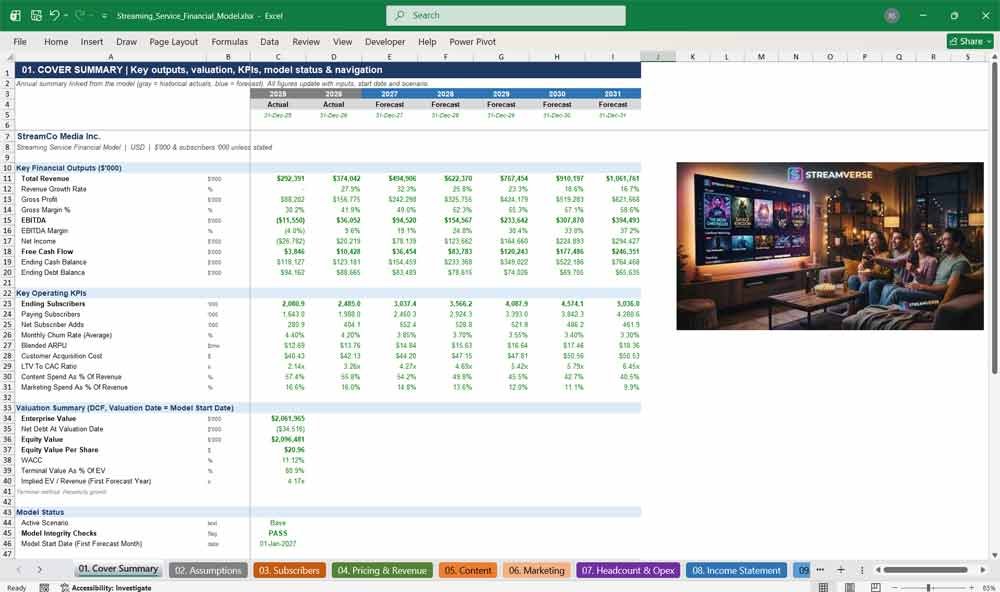
The Cover Summary gives investors and management a single-page dashboard of the streaming business. It shows annual revenue, EBITDA, free cash flow, subscribers, churn, ARPU and LTV to CAC. Alongside these sit DCF valuation outputs, the active scenario, the model check status and clickable navigation to every tab.
- Seven-year annual summary covering two historical years and five forecast years
- Key financial outputs: revenue, gross profit, EBITDA, net income, FCF, cash and debt
- Key KPIs: subscribers, paying users, churn, ARPU, CAC and LTV to CAC
- Valuation snapshot showing enterprise value, equity value and value per share
- Hyperlinked table of contents and a colour legend
02. Assumptions
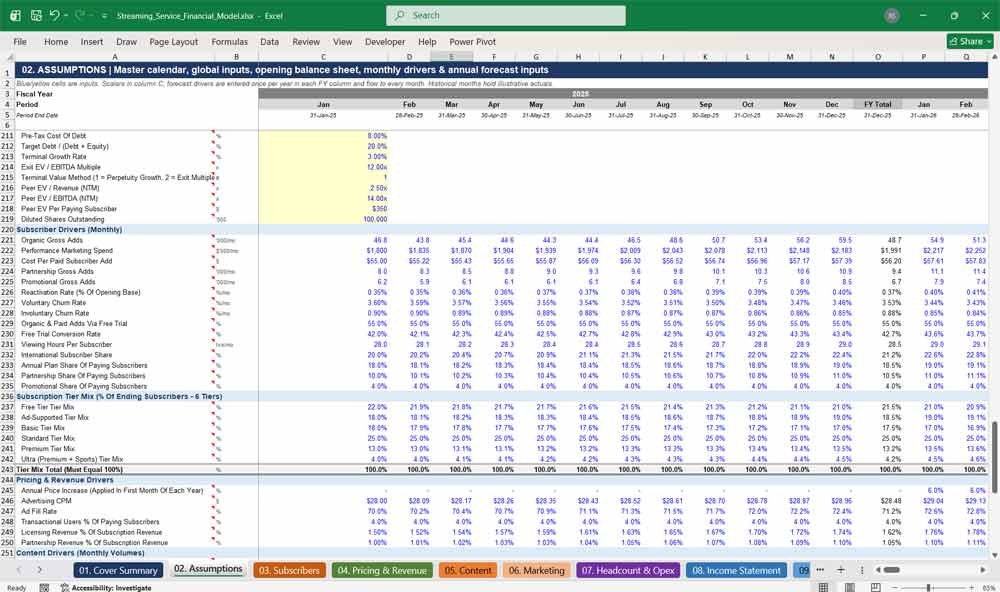
The Assumptions tab is the control centre of the streaming financial model. It holds the master start date, the opening balance sheet, pricing, churn, inflation, FX, tax, content, marketing, headcount, financing and valuation inputs. Annual forecast drivers are entered once per year and flow automatically to every month.
- One master start date re-dates the entire workbook
- Opening balance sheet that always balances
- Over 150 clearly labelled inputs, colour-coded blue and yellow
- Six-tier subscription mix with a 100% validation check
- Content, salary and general inflation indices plus FX and SOFR rate curves
Streaming Service Revenues
03. Subscribers
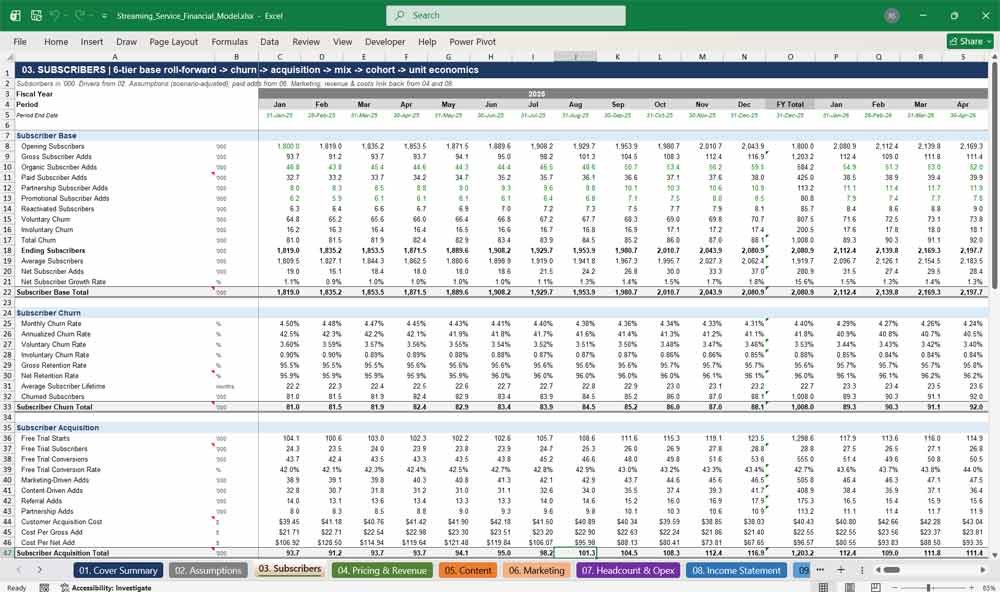
The Subscribers tab builds a monthly subscriber roll-forward across six subscription tiers. It covers organic, paid, partnership and promotional adds, reactivations, voluntary and involuntary churn, free trials, subscriber mix, cohort retention and unit economics. Together these give a complete view of subscriber growth and retention.
- Opening-to-ending subscriber base roll-forward
- Monthly and annualized churn, gross and net retention, and subscriber lifetime
- Free trial starts, conversions and acquisition attribution
- Paid vs free, monthly vs annual, and domestic vs international mix
- Cohort tracking, plus ARPU, LTV, CAC and LTV to CAC by subscriber
04. Pricing & Revenue
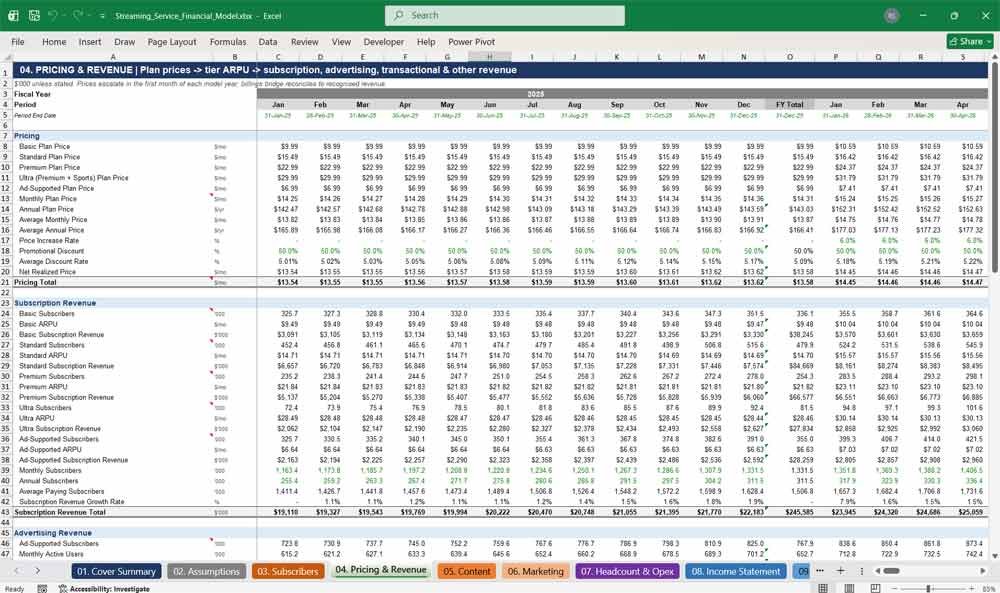
The Pricing & Revenue tab models plan prices, annual price increases, discounts and net realized price for each tier. It then builds subscription, advertising, transactional, pay-per-view, licensing, merchandise and partnership revenue. A gross billings bridge reconciles invoiced amounts to recognized net revenue.
- Tier-level pricing with automatic annual price escalation
- Tier subscribers, ARPU and subscription revenue
- AVOD revenue built from MAU, DAU, impressions, fill rate and CPM
- Transactional and pay-per-view revenue streams
- Revenue adjustments for discounts, refunds, chargebacks, sales tax and deferred revenue
05. Content
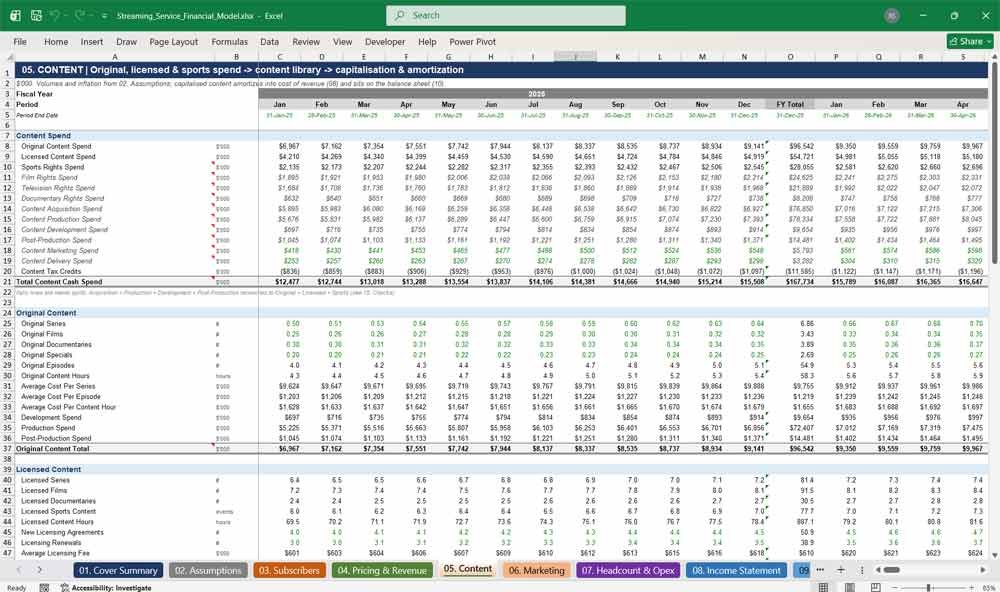
The Content tab plans original, licensed and sports content investment, which is the biggest cost driver for any streaming platform. It models release volumes, cost per episode, licensing deals, sports rights, production tax credits, the content library, accelerated content amortization and content ROI.
- Original series, films, documentaries and specials, with episodes and hours
- Licensing agreements, renewals, minimum guarantees and payment timing
- Sports rights fees, event production, distribution and sports viewing hours
- Content library titles, hours, content age and utilization
- Content asset capitalization, amortization, impairment and write-offs
06. Marketing
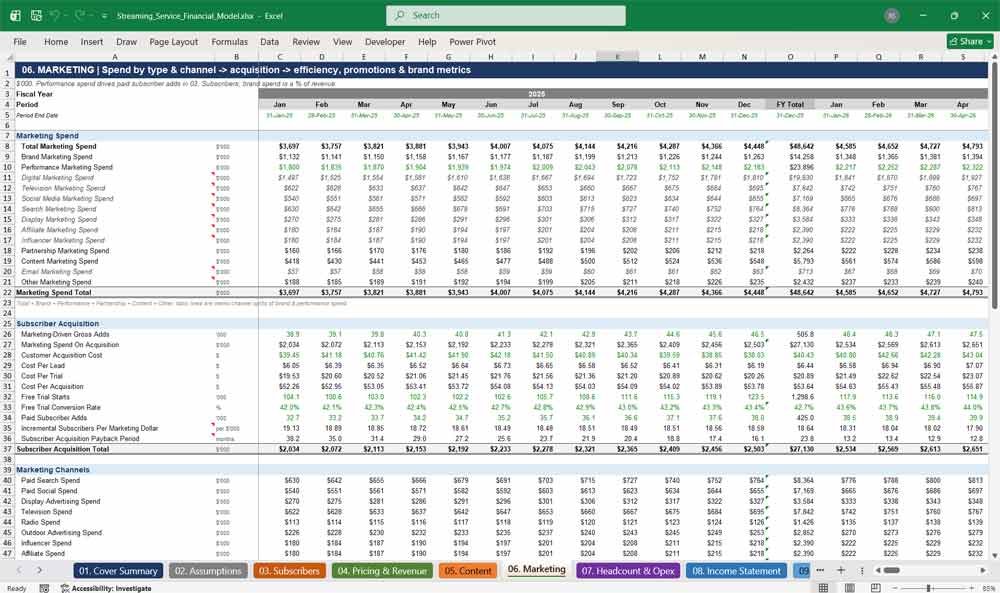
The Marketing tab links marketing spend directly to subscriber acquisition. Performance spend drives paid subscriber adds, while brand, partnership, content and promotional spend are modelled separately. Channel splits, CAC, cost per trial, payback period, marketing ROI and brand reach metrics complete the picture.
- Brand, performance, partnership, content and other marketing spend
- Twelve marketing channels that reconcile to total spend
- CAC, cost per lead, cost per trial and cost per acquisition
- LTV to CAC, CAC payback period and marketing ROI
- Free trial, promotional discount and brand impression metrics
Streaming Service Financial Statements
07. Headcount & Opex
The Headcount & Opex tab forecasts full-time employees and personnel cost by department. Customer service headcount scales automatically with subscribers. The tab also covers CDN streaming delivery, cloud hosting, data storage, payment processing, G&A, facilities and professional fees, together with a full fixed-asset depreciation schedule.
- Seven departments with salaries, benefits, salary inflation and stock-based compensation
- Volume-driven customer service headcount
- Technology, platform development and capitalized development costs
- CDN, cloud, storage, payment processing and support costs
- Fixed asset and software roll-forward with depreciation and amortization
08. Income Statement
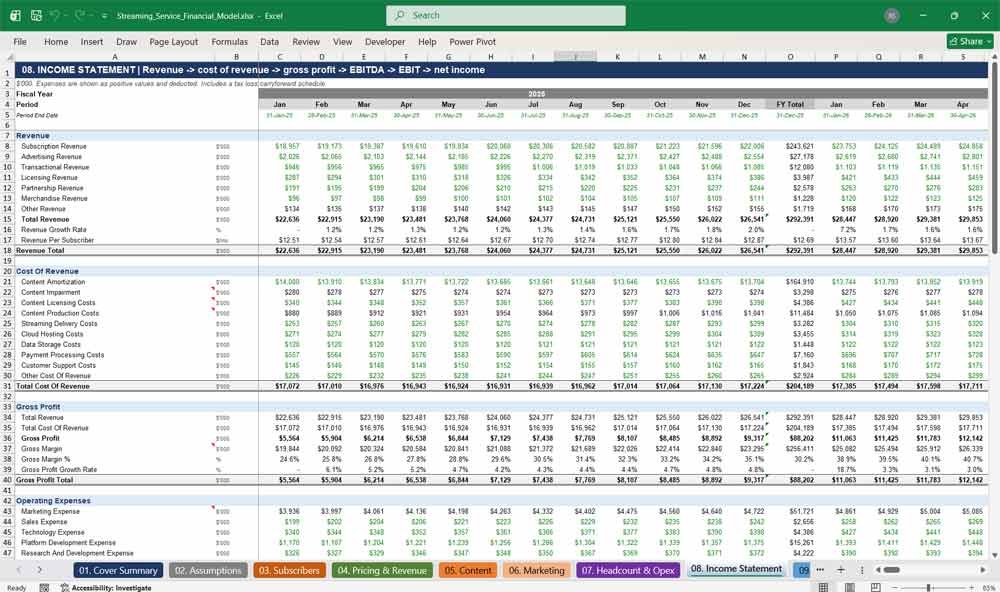
The Income Statement presents a monthly and annual streaming P&L. It runs from total revenue through cost of revenue, gross profit, operating expenses, EBITDA, adjusted EBITDA, EBIT, interest, FX and tax to net income. A tax-loss carryforward schedule is included so taxable profit is calculated correctly.
- Revenue by stream with growth and revenue per subscriber
- Cost of revenue including content amortization and delivery costs
- Gross margin, EBITDA, adjusted EBITDA and EBIT margins
- Interest income and expense, FX gain/loss and the effective tax rate
- Net operating loss (NOL) carryforward schedule
09. Cash Flow
The Cash Flow tab uses the indirect method to reconcile net income to operating cash flow. It separates content cash payments from capex and investing activities. Financing flows, free cash flow, cash conversion and the ending cash balance follow, and the ending cash feeds directly into the balance sheet.
- Cash flow from operations with working capital movements
- Content cash flow covering production, licensing and sports rights payments
- Capital expenditure by category, as a % of revenue
- Investing and financing cash flows, including debt, equity and leases
- Free cash flow, FCF margin, cash conversion and minimum cash
10. Balance Sheet
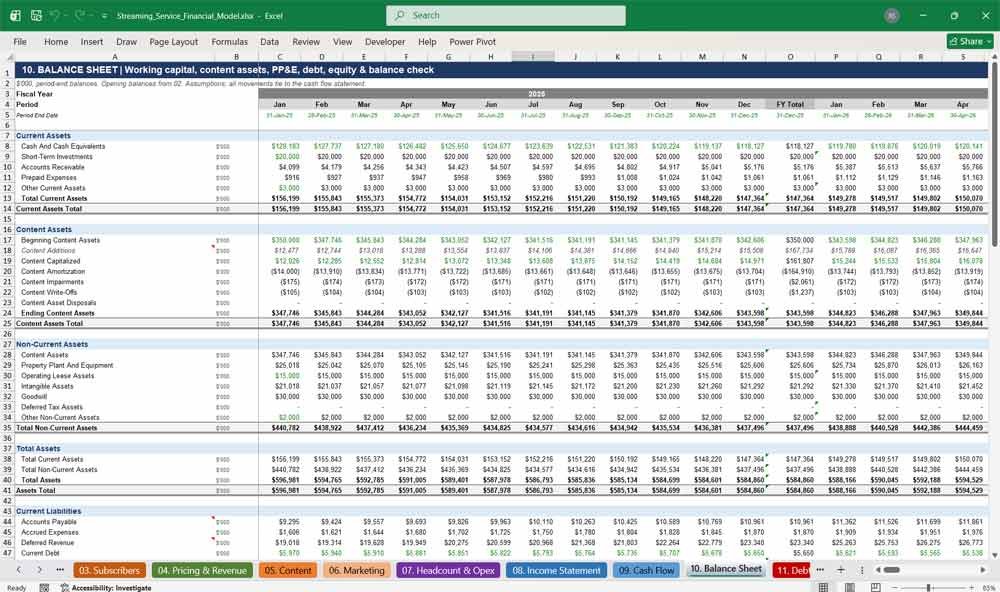
The Balance Sheet provides a fully integrated monthly balance sheet. It covers cash, receivables, content assets, PP&E, intangibles, goodwill, deferred revenue, content obligations, debt and shareholders’ equity. A working capital analysis and an automatic balance check confirm that assets equal liabilities plus equity in every period.
- Current and non-current assets and liabilities
- Content asset roll-forward and content obligations
- Debt summary linked to the debt financing schedule
- Working capital with DSO, DPO and the change in net working capital
- Balance sheet summary with an OK/ERROR check every period
11. Debt Financing
The Debt Financing tab models a term loan and a revolving credit facility. The revolver draws and repays automatically to maintain minimum cash. The tab covers SOFR-based interest, mandatory amortization, cash sweep, maturity, PIK interest, commitment fees and leverage metrics such as net debt to EBITDA and interest coverage.
- Term loan schedule with new issuance, amortization, sweep and maturity
- Automatic revolver with availability tracking
- Interest calculated on opening balances, so there are no circular references
- Weighted average interest rate and debt summary
- Net debt, LTM EBITDA, leverage and interest coverage ratios
Streaming Service Key Metrics
12. Valuation
The Valuation tab values the streaming business with a discounted cash flow model. It builds WACC, unlevered free cash flow, a perpetuity growth terminal value and an exit-multiple terminal value. EV/Revenue, EV/EBITDA and EV per subscriber trading multiples are added, and the results are summarized as an implied valuation range with sensitivity tables.
- WACC built from CAPM, beta, size premium and after-tax cost of debt
- Unlevered free cash flow with mid-year discounting
- Enterprise value, equity value and value per share
- Comparable-company multiples, including EV per paying subscriber
- WACC vs terminal growth and WACC vs exit multiple sensitivities
13. KPIs
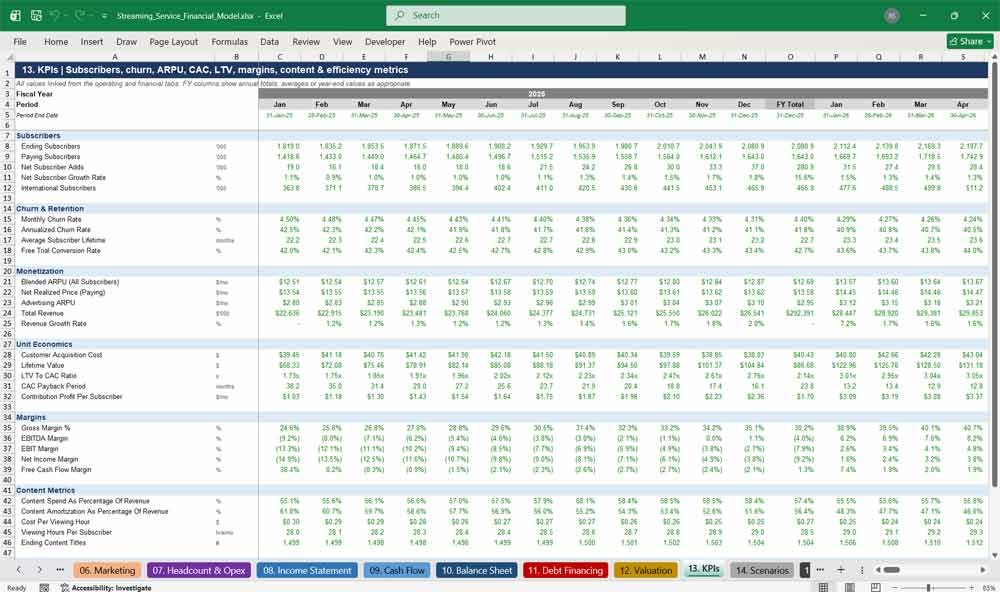
The KPIs tab gathers the most important streaming metrics on one monthly and annual timeline. These include subscribers, churn, ARPU, CAC, LTV, margins, content spend ratios, cost per viewing hour, marketing efficiency, headcount productivity and leverage. They are ready for board packs and investor updates.
- Subscriber growth, paying users and international mix
- Churn, retention, subscriber lifetime and trial conversion
- ARPU, net realized price and advertising ARPU
- Unit economics: CAC, LTV, LTV to CAC and payback
- Margin, content, marketing and leverage KPIs
14. Scenarios
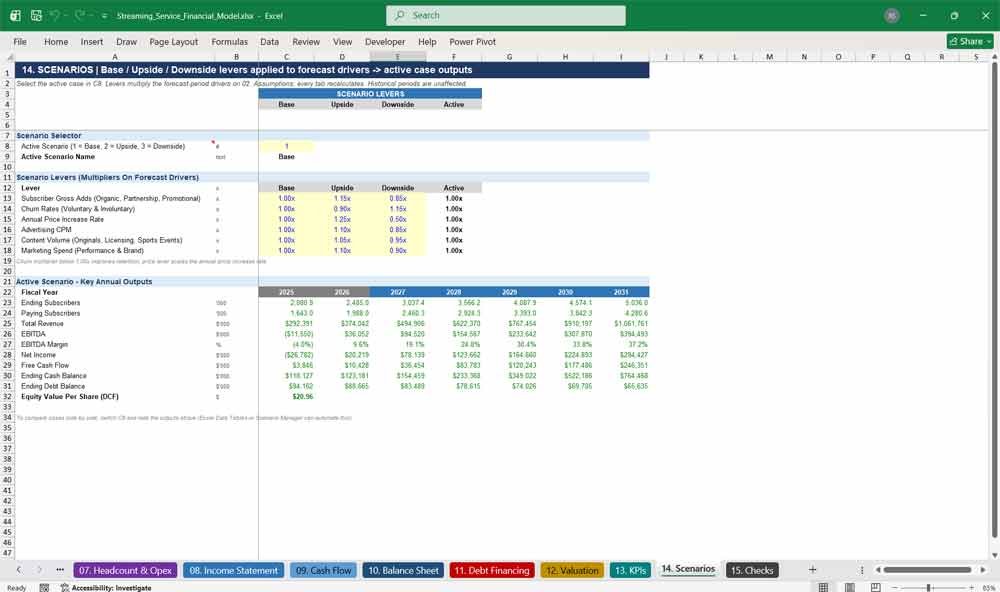
The Scenarios tab lets you switch the whole streaming financial model between Base, Upside and Downside cases with one cell. Editable multipliers adjust subscriber adds, churn, price increases, advertising CPM, content volume and marketing spend. A summary of the active case’s outputs updates instantly.
- One-click scenario selector covering Base, Upside and Downside
- Six editable scenario levers applied to forecast periods only
- Historical actuals stay unchanged
- Active-scenario outputs for subscribers, revenue, EBITDA, FCF, cash and debt
- Equity value per share for the selected case
15. Checks
The Checks tab provides model integrity testing for every month and year. It confirms that the balance sheet balances, cash ties out, subscriber mix reconciles, revenue bridges agree, content and marketing splits sum correctly, debt matches the schedule and cash never goes negative. Each period is flagged PASS or REVIEW.
- Sixteen automated integrity checks across the full timeline
- Balance sheet, cash flow and debt tie-outs
- Revenue, subscriber, content and marketing reconciliations
- Validation that input splits sum to 100%
- Overall model status linked to the Cover Summary
Why Buy This Model?
Building a three-statement streaming financial model from scratch can take weeks. This template gives you a complete, tested and investor-ready model straight away. It is designed specifically for subscription and ad-supported streaming businesses rather than adapted from a generic SaaS template. It captures the economics that matter in streaming: six subscription tiers, churn and retention, AVOD monetization, content capitalization and amortization, licensing obligations, sports rights, CAC and LTV.
The workbook contains more than 70,000 live formulas, with clear colour coding for inputs, calculations and links, and automated integrity checks. You can trust the numbers, present them confidently to investors, lenders or your board, and adapt the model to your own business by changing the inputs rather than rebuilding the logic.
Streaming Service Frequently Asked Questions (Faq)
Q: Who is this streaming financial model for?
A: It is built for founders and management teams of streaming platforms, OTT and SVOD startups, media investors, private equity and venture capital analysts, investment bankers and consultants. It suits anyone who needs a subscription video business plan, budget or valuation in Excel.
Q: Can I use it for an ad-supported (AVOD) or hybrid streaming service?
A: Yes. The model includes a Free ad-funded tier and a paid Ad-Supported tier. Advertising revenue is built from monthly active users, viewing hours, ad load, fill rate and CPM. You can run a pure SVOD, pure AVOD or hybrid model by adjusting the tier mix.
Q: What time period does the model cover?
A: It includes 2 years of monthly historical data and 5 years of monthly forecasts, with an annual total column for every year. That is 84 months in total, presented on a horizontal timeline.
Q: What happens if I change the start date?
A: Change the single Model Start Date on the Assumptions tab and every date, month label, fiscal-year heading and annual price escalation updates automatically across all 15 tabs. Fiscal years that don’t start in January are supported.
Q: Do I need advanced Excel skills to use it?
A: No. Inputs are clearly marked in blue on yellow cells, calculations are in black, and links between tabs are in green. You only change the input cells, and the rest of the model updates automatically. Cell comments explain the key assumptions and calculations.
Q: Are the three financial statements fully linked?
A: Yes. The Income Statement, Cash Flow Statement and Balance Sheet are fully integrated. The balance sheet balances in every month, and the Checks tab confirms it.
Q: How does the model handle content costs?
A: Original, licensed and sports content spend is capitalized as a content asset and amortized on an accelerated basis, as major streaming companies do. Licensing payments can be deferred into content obligations. Production tax credits, impairments and write-offs are also modelled.
Q: Can I model fundraising or debt?
A: Yes. You can enter equity raises, new term loans, share buybacks and acquisitions by year. A revolving credit facility draws and repays automatically to keep cash above your chosen minimum, and interest and leverage metrics are calculated for you.
Q: Does the model include a valuation?
A: Yes. The Valuation tab includes a full DCF with a WACC build, unlevered free cash flow, and both perpetuity-growth and exit-multiple terminal values. It also includes trading multiples (EV/Revenue, EV/EBITDA and EV per subscriber), an implied valuation summary and two sensitivity tables.
Q: Can I run different scenarios?
A: Yes. Select Base, Upside or Downside in one cell on the Scenarios tab. Each case adjusts subscriber growth, churn, pricing, ad CPM, content volume and marketing spend, and you can edit every multiplier.
Q: Are there any macros or circular references?
A: No. The model contains no macros and no circular references. It works in standard Microsoft Excel and recalculates cleanly.
Q: Can I change the number of subscription tiers or rename the plans?
A: You can rename plans and change their prices and mix percentages freely. The six-tier structure covers most streaming pricing strategies. You can set any tier’s mix to zero if you offer fewer plans.
Q: Is the sample data real?
A: No. The historical figures and assumptions are illustrative placeholders, so you can see how the model works straight away. Replace them with your own actuals and forecasts to produce your business plan.
Conclusions For The Financial Model
This Streaming Service Finance Model in Excel is essential for planning, forecasting, and securing investment. With detailed income projections, cash flow tracking, and balance sheet monitoring, they ensure the business maintains profitability and financial health.
Download Link On Next Page