
SEO Agency Financial Model Template & Growth Plan
Plan, price and grow your agency with confidence using our SEO Agency Financial Model Template, a fully integrated Excel workbook built specifically for search engine optimisation and digital marketing agencies. This 5-year monthly forecast connects client acquisition, recurring retainer revenue, team capacity, payroll, overheads and cash flow into one professional model, so you can see exactly how every decision affects revenue, profit and cash. Whether you run a growing SEO agency, are launching a new one, or are preparing for investors or a bank loan, this template gives you investor-ready SEO agency financial projections in minutes.
Financial model for an SEO Agency
At the heart of the model is a detailed client revenue build covering six client categories – small business, mid-market, enterprise, e-commerce, local SEO and international SEO – and twelve SEO service lines, from monthly retainers and technical SEO to link building, content marketing, audits and digital PR. A monthly MRR roll-forward tracks new client wins, churn, upsells, downgrades and annual price increases, while the sales and marketing funnel turns leads from fourteen marketing channels into new clients, calculating customer acquisition cost (CAC), client lifetime value (LTV) and CAC payback.
Everything flows into a complete three-statement financial model: income statement, cash flow statement and balance sheet, all linked and fully checked. Delivery headcount scales automatically with client workload, freelancers cover capacity gaps, and working capital, VAT, corporation tax, loans and dividends are modelled month by month. Change the start date once and every date updates across the workbook, switch between base, downside and upside scenarios, and use the KPI dashboard to track MRR, ARR, gross margin, EBITDA margin and cash runway at a glance.
What’s Inside the SEO Agency Financial Model
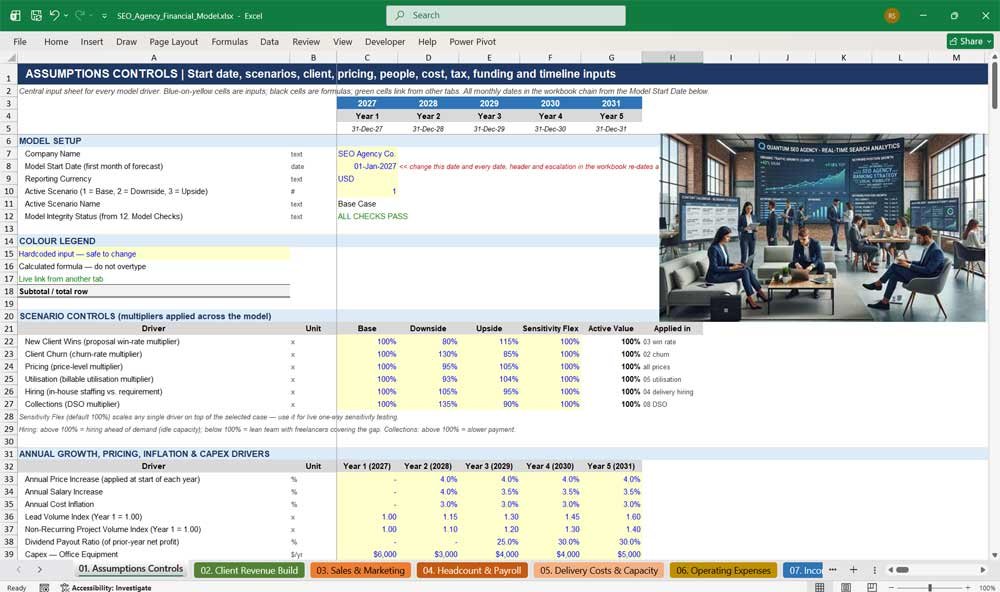
01. Assumptions Controls
The Assumptions Controls tab is the central input sheet for your SEO agency financial model. Set the start date, client numbers, retainer pricing, churn, salary increases, utilisation, inflation, payment terms, tax rates and scenario controls, and every tab updates automatically.
- One model start date drives every date, header and escalation in the workbook
- Starting clients, retainers, churn and new-win mix for six client categories
- Service mix by client category, project volumes and fees
- Hiring plan with dated hires, salaries, bonuses and employer costs
- Opening balance sheet, funding, tax, VAT and payment terms
- Scenario selector with base, downside and upside multipliers plus sensitivity flex
- Colour-coded inputs (blue on yellow), formulas (black) and links (green)
SEO Agency Revenues & Costs
02. Client Revenue Build
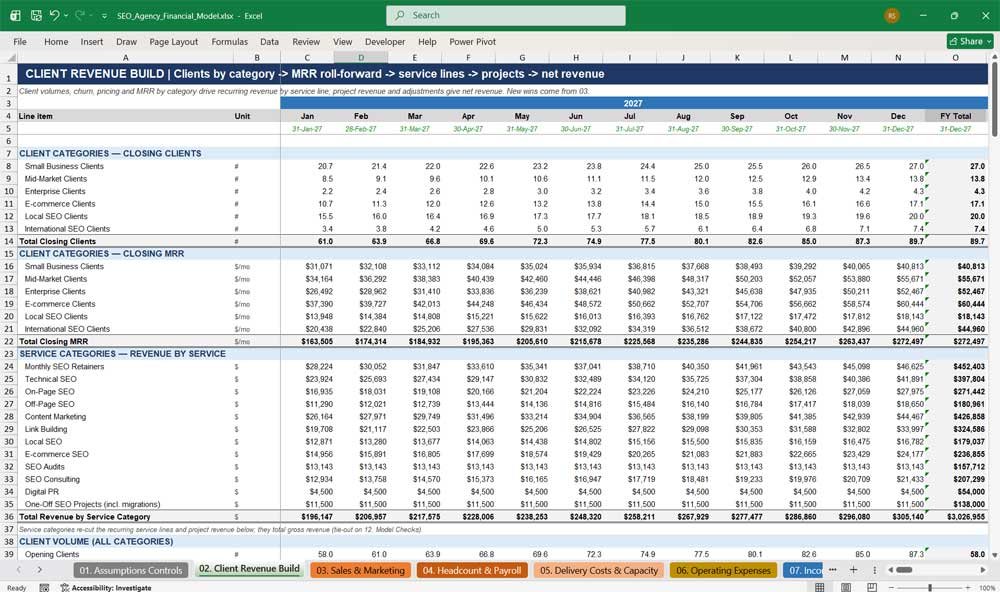
The Client Revenue Build forecasts SEO agency revenue across six client categories and twelve service lines. It models opening clients, new wins, churn, reactivations, upsells and price increases through a monthly MRR roll-forward, delivering recurring revenue, project revenue and net revenue.
- Six client categories, each with its own client and MRR roll-forward
- Twelve SEO service categories, from monthly retainers to digital PR
- Monthly recurring revenue (MRR) and annualised recurring revenue (ARR)
- Non-recurring revenue: SEO audits, one-off projects, website migrations and consulting
- Client churn, revenue churn, gross revenue retention and net revenue retention
- Discounts, credits and refunds flowing to net revenue
03. Sales & Marketing
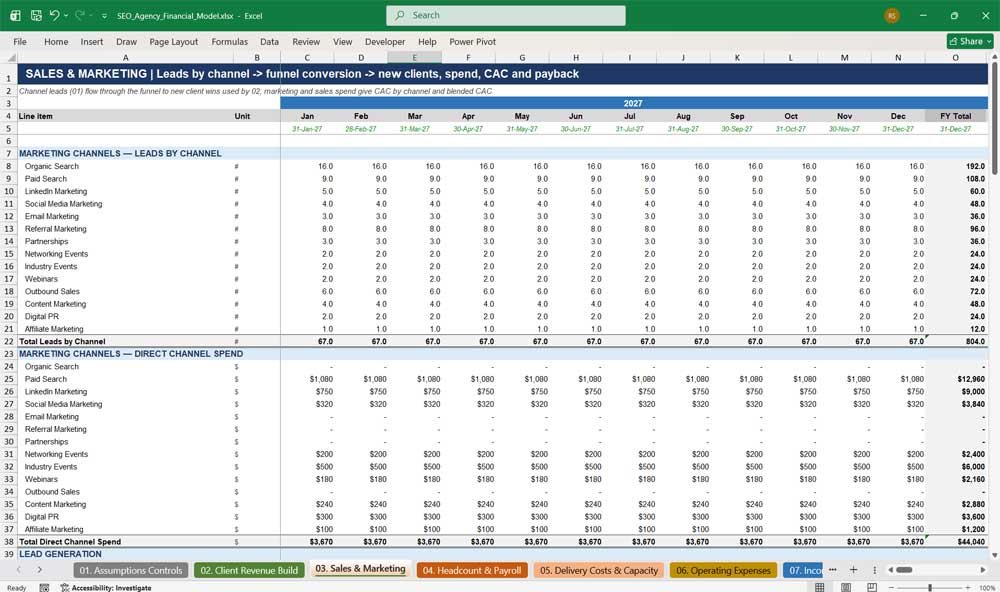
The Sales & Marketing tab tracks leads from fourteen marketing channels through a full sales funnel to new client wins. It calculates marketing and sales spend, cost per lead, customer acquisition cost (CAC) by channel, blended CAC and CAC payback period.
- Leads by channel: organic search, paid search, LinkedIn, referrals, events, outbound and more
- Funnel from website visitors to MQLs, SQLs, proposals and signed clients
- New clients and CAC attributed to each marketing channel
- Detailed marketing spend and sales spend, including commissions
- Marketing ROI, sales pipeline value, weighted pipeline and sales target achievement
- Upsell, cross-sell and expansion revenue tracking
04. Headcount & Payroll
The Headcount & Payroll tab builds your agency hiring plan role by role. Delivery staff scale automatically with client workload, while sales and management hires follow dated hiring plans, with salaries, employer taxes, pensions, benefits and bonuses calculated every month.
- Eighteen roles across delivery, sales and G&A / management
- Delivery FTE driven automatically by required delivery hours
- Account managers driven by clients per account manager
- Hires and departures tracked by department
- Salaries with annual salary increases, employer taxes, pensions, benefits and bonuses
- Payroll per FTE and payroll as a percentage of revenue
05. Delivery Costs & Capacity
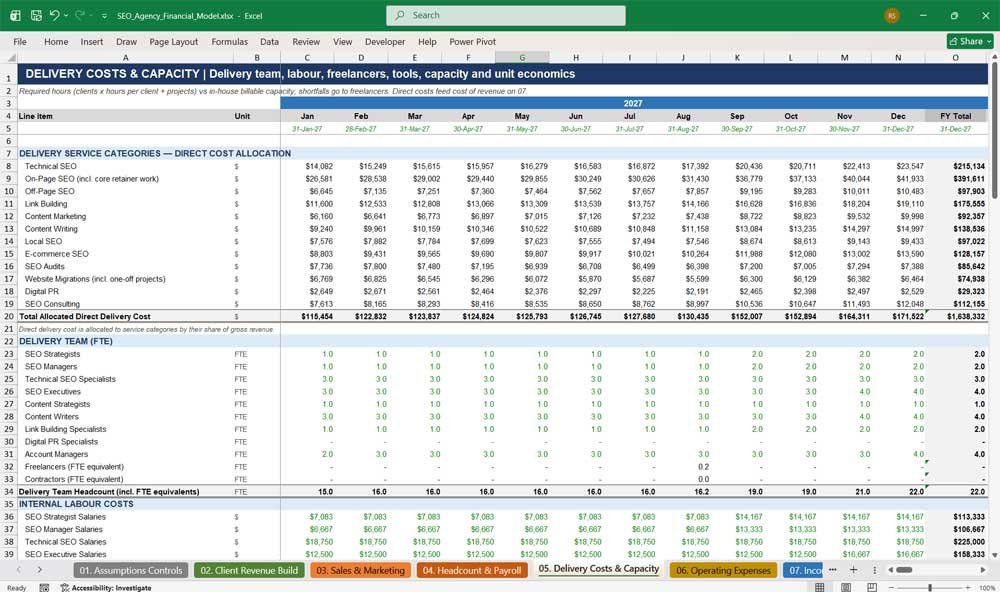
The Delivery Costs & Capacity tab compares the hours your clients need against your team’s billable capacity. Shortfalls flow to freelancers and contractors, alongside link building vendors, outsourced content and SEO software, giving delivery cost and gross margin per client.
- Required delivery hours by client size, plus project hours
- Billable utilisation, productive hours, leave, sickness and training
- Capacity utilisation, spare capacity and shortfall hours
- Freelancers, contractors, link building vendors, guest posts and white-label SEO
- SEO software and tools costed per client, per FTE or fixed
- Unit economics: delivery cost, gross profit and gross margin per client
- Direct delivery costs kept separate from overheads
06. Operating Expenses
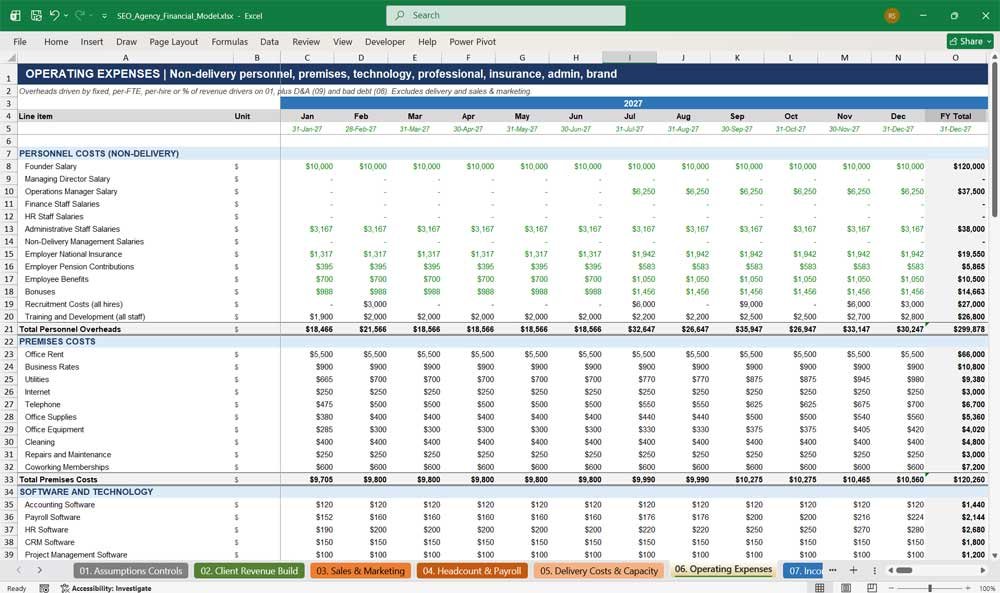
The Operating Expenses tab forecasts every agency overhead, from non-delivery salaries, rent and software to professional fees, insurance, administration and brand marketing. Each cost line can be fixed, per employee, per hire or a percentage of revenue, with annual inflation applied.
- Non-delivery personnel costs, recruitment and training
- Premises, software and technology, professional services and insurance
- General administration and brand / corporate marketing
- Depreciation, amortisation, bad debt and one-off costs
- Flexible cost drivers: fixed, per FTE, per hire or % of revenue
- Fixed versus variable cost analysis
SEO Agency Financial Statements
07. Income Statement
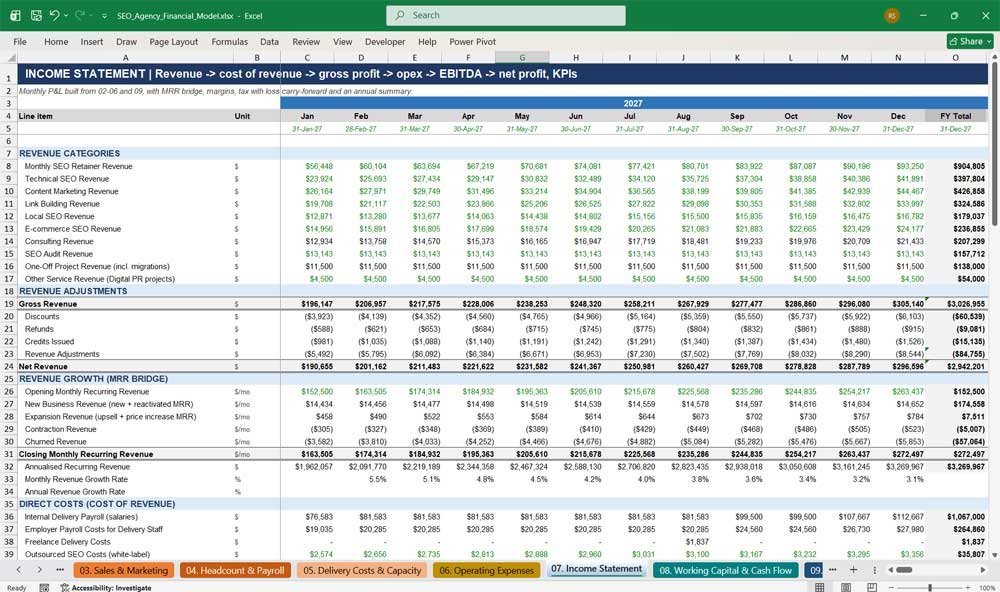
The Income Statement delivers a monthly and annual profit and loss for your SEO agency. It shows revenue by service, an MRR bridge, cost of revenue, gross profit, operating expenses, EBITDA, depreciation, interest, corporation tax with loss carry-forward and net profit.
- Revenue by service line with discounts, refunds and credits
- MRR bridge: new business, expansion, contraction and churn
- Gross profit and gross margin, EBITDA and EBITDA margin
- Corporation tax with tax losses carried forward
- KPIs including break-even revenue and break-even client count
- Annual summary of Year 1 to Year 5 revenue and EBITDA
08. Working Capital & Cash Flow
The Working Capital & Cash Flow tab turns profit into cash. It models client collections, receivables, supplier and payroll payments, VAT, corporation tax, loans and dividends, then tracks closing cash, monthly burn, cash runway, minimum cash reserve and funding requirements.
- Customer collections driven by payment terms and collection period
- Supplier payments, payroll payments, VAT and corporation tax timing
- Operating, investing and financing cash flows
- Closing cash versus minimum cash reserve
- Cash runway, peak funding requirement and break-even month
- Months of positive operating and free cash flow
09. Balance Sheet
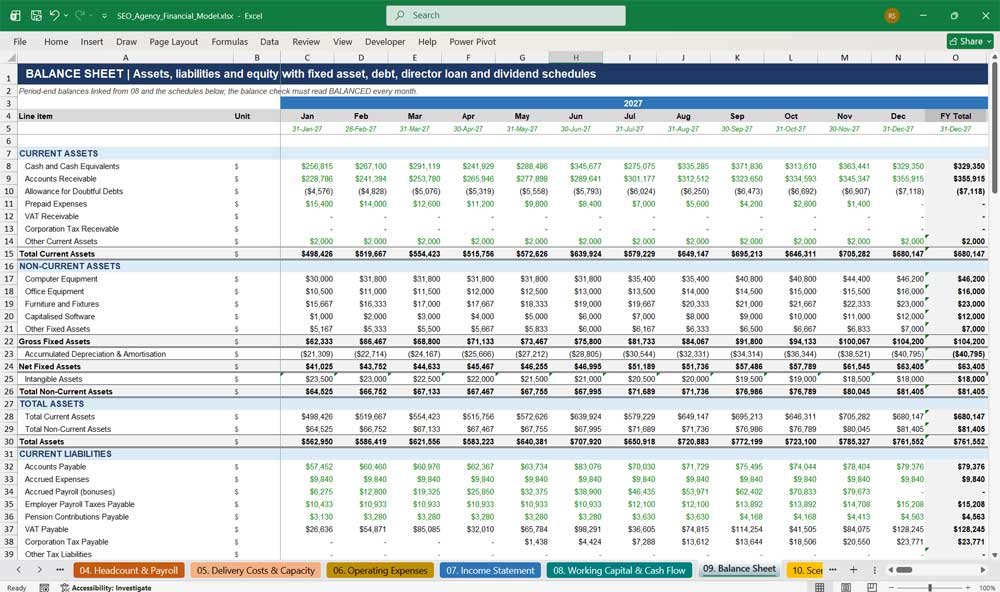
The Balance Sheet presents assets, liabilities and equity for every month of the forecast. Supporting schedules cover fixed assets and depreciation, the term loan, director loans and dividends, and a built-in balance check confirms the balance sheet balances every period.
- Monthly balance sheet with current and non-current assets and liabilities
- Fixed asset schedule with depreciation by asset class
- Term loan and director loan schedules
- Retained earnings and dividend schedule
- Working capital metrics: receivable days, payable days and net working capital
- Balance check that reads BALANCED every month
SEO Agency Key Financial KPIs
10. Scenarios & Sensitivity
The Scenarios & Sensitivity tab stress-tests your SEO agency forecast. Switch between base, downside and upside cases covering client wins, churn, pricing, utilisation, hiring and collections, compare results side by side, and see how each driver alone moves EBITDA and cash.
- Base, downside and upside cases controlled from one selector
- Six key business risk drivers with editable multipliers
- Live outputs by year for the active scenario
- Side-by-side scenario comparison of revenue, EBITDA, clients and cash
- One-way sensitivity table showing the impact of each driver
- Snapshot check that flags when results need refreshing
11. KPI Dashboard
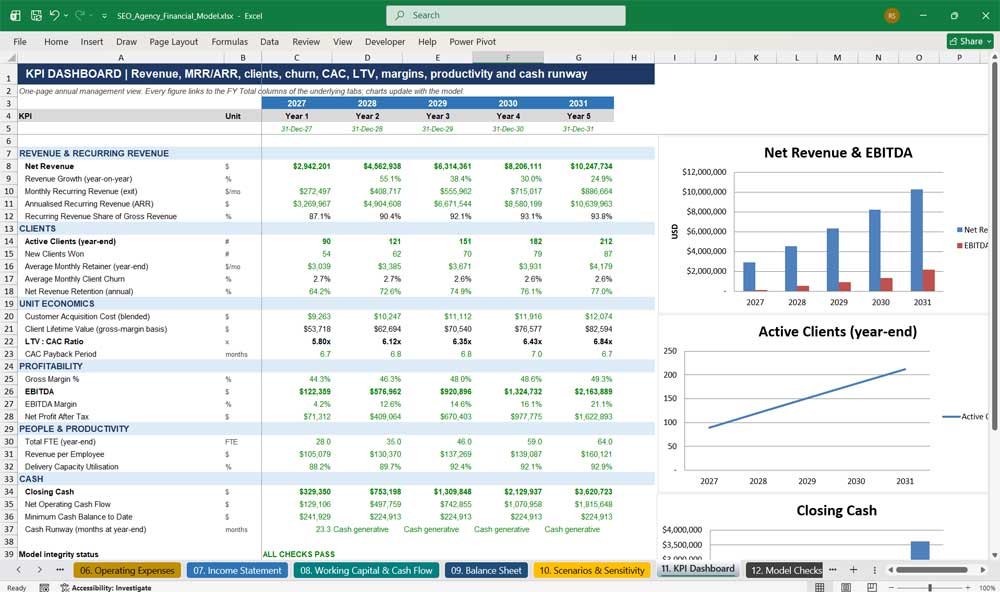
The KPI Dashboard gives a one-page management view of your agency’s performance. Track revenue, MRR, ARR, active clients, average retainer, churn, CAC, client lifetime value, LTV to CAC, gross margin, EBITDA margin, revenue per employee and cash runway, with charts.
- Five-year annual KPI summary on a single page
- Revenue, MRR, ARR and recurring revenue share
- Client numbers, average retainer, churn and net revenue retention
- CAC, LTV, LTV:CAC ratio and CAC payback
- Charts for revenue and EBITDA, active clients and closing cash
- Model integrity status and active scenario displayed
12. Model Checks
The Model Checks tab confirms your financial model works correctly. It tests that the balance sheet balances, cash reconciles, client counts are consistent, financial statements link properly and inputs are valid, returning a clear PASS or REVIEW result for every period.
- Balance sheet, cash roll-forward and retained earnings checks
- Client count and MRR consistency checks
- Revenue, cost of revenue, opex and payroll tie-outs between tabs
- Input validation for client mix, service mix and delivery shares
- PASS / REVIEW result for every month and year
- Overall model status shown on the Assumptions tab and KPI Dashboard
Why Buy This Model
Building an SEO agency financial model from scratch takes weeks and one broken formula can undermine the whole forecast. This template gives you a professionally structured, fully linked Excel model designed around how SEO agencies actually make money: recurring retainers, client churn, team capacity and cash timing. Every number traces back to a clear input, delivery hiring scales automatically with client demand, and twelve integrity checks confirm the three financial statements balance and reconcile every month. Change the start date and the whole model re-dates itself; switch scenarios and instantly see the impact on profit and cash. Whether you need SEO agency financial projections for a bank loan, investor pitch, business plan, pricing review or hiring decision, this model saves you time, reduces errors and gives you numbers you can confidently present.
SEO Agency Financial Model Frequently Asked Questions
Who is this SEO agency financial model for?
It is built for SEO agency owners, founders launching a new agency, digital marketing agencies offering SEO services, and the accountants, consultants and investors who advise them. If your revenue comes mainly from monthly retainers and SEO projects, the model fits your business.
Do I need financial modelling experience to use it?
No. All inputs sit on one tab and are colour-coded blue on yellow, so you know exactly which cells to change. Formulas and links are protected by clear colour coding, and the Model Checks tab tells you immediately if anything is out of balance.
Can I enter my own clients, pricing and costs?
Yes. You can set starting clients, retainers, churn and new-win mix for each of the six client categories, plus service mix, project fees, lead volumes, salaries, hiring dates, overheads, payment terms, tax rates and your opening balance sheet. The figures supplied are illustrative examples for you to replace.
What time period does the forecast cover?
Five years, modelled monthly, with an annual total column for each year. Years run 2027 to 2031 by default, but you can change the start date and every date, header and year label updates automatically.
Does it include a full three-statement model?
Yes. The income statement, cash flow statement and balance sheet are fully linked, and the balance sheet is checked to balance every month. Supporting schedules cover working capital, fixed assets, depreciation, loans, director loans, tax, VAT and dividends.
How does the model decide when I need to hire?
Delivery staff scale automatically with the hours your clients need, based on hours per client, client size and billable utilisation. Account managers are driven by clients per account manager. Sales and management roles follow the hire dates you set on the Assumptions tab.
What happens if my team doesn’t have enough capacity?
Any shortfall between required hours and in-house billable hours is covered by freelancers and contractors at the hourly rates you choose, so the extra cost appears in your cost of revenue and gross margin.
Can I model different scenarios?
Yes. Choose base, downside or upside from a single selector to adjust client wins, churn, pricing, utilisation, hiring and collections. You can also flex any single driver to run your own sensitivity tests and compare results on the Scenarios & Sensitivity tab.
Will it show how much funding I need?
Yes. The cash flow tab tracks closing cash against your minimum cash reserve and calculates cash runway, peak funding requirement, additional funding required and the months of positive operating and free cash flow. You can add a term loan, director loan or equity investment on the Assumptions tab.
Which KPIs does the model calculate?
Revenue, MRR, ARR, active clients, average retainer, client churn, net revenue retention, CAC, client lifetime value, LTV:CAC ratio, CAC payback, gross margin, EBITDA margin, revenue per employee, capacity utilisation and cash runway, all summarised on the KPI Dashboard.
The model is in USD. Can I use it for another currency?
Yes. Simply enter your figures in your own currency; the calculations work the same way. Currency symbols are shown through cell number formatting, which you can change in Excel to £, € or any other currency.
I’m not VAT registered. Does that matter?
No. Set the VAT rate to 0% on the Assumptions tab and VAT is removed from billing, supplier costs and cash flow. Employer payroll tax, pension and corporation tax rates are all editable too, so you can match your local rules.
Is the model suitable for banks and investors?
Yes. It follows a professional lender-style layout with colour-coded inputs, a consistent monthly timeline, linked financial statements, a balance check and a dedicated Model Checks tab, which is what banks, investors and advisers expect to see.
Does it use macros?
No. The model contains no macros or VBA. It is built entirely with standard Excel formulas, so it is transparent, easy to audit and safe to open.
Which version of Excel do I need?
The model is designed for Microsoft Excel on Windows or Mac and uses standard functions such as SUMPRODUCT, INDEX, EOMONTH and IFERROR, so any modern version of Excel will work.
Final Note On The Financial Model
This financial model will help the SEO agency plan for growth, manage cash flow, and make informed business decisions. It can also be used to attract investors or secure financing.
Download Link On Next Page