
Pharmaceutical Financial Model Template
This Pharmaceutical Manufacturer Financial Model is a fully-integrated, formula-driven Excel template built for analysts, investors, and finance teams who need a realistic, audit-ready valuation tool for a specialty pharma company. Spanning 15 interconnected tabs and a 20-year horizon — five years of monthly historical financials plus a 15-year forecast — this pharma financial model walks every dollar from unit-level product revenue through manufacturing costs, operating expenses, and the three core financial statements, all the way to a fully-built discounted cash flow (DCF) valuation. Whether you’re modeling drug launches, patent-cliff erosion, biosimilar competition, or manufacturing capacity constraints, this Excel financial model template gives you a battle-tested framework you can adapt to any branded, generic, or biologics manufacturer.
Financial Model for a Pharmaceutical Manufacturer
Unlike template libraries that start and end with the income statement, this pharmaceutical financial model is built bottom-up: individual product revenue drivers (units, batches, net pricing, discounts and rebates) flow into a manufacturing cost build that ties capacity and utilization directly to COGS, which then rolls into a fully linked three-statement model — Income Statement, Balance Sheet, and Cash Flow Statement — with a non-circular debt schedule, automatic cash sweep, and revolver mechanics. Every historical figure, projected assumption, and calculated output is a live Excel formula, so changing a single input — growth rate, WACC, discount rate, launch timing — recalculates the entire model instantly, including the DCF valuation and sensitivity tables.
This financial model template is ideal for equity research analysts, investment bankers, private equity associates, corporate development teams, MBA and finance students, and pharmaceutical executives who need a defensible valuation model without building one from scratch. Use it to practice DCF valuation, benchmark a real or hypothetical pharma manufacturer, prepare for interviews and case studies, support fundraising and M&A discussions, or simply learn how patent expirations, generic competition, and capacity expansion decisions flow through to enterprise value and equity value per share. Download the pharmaceutical company valuation model today and start building your own scenario analysis in minutes.
Why Buy This Model
Building a pharmaceutical financial model from scratch can take days or weeks — sourcing realistic assumptions, wiring a non-circular 3-statement structure, and getting a balance sheet to actually balance across a 15-year forecast is notoriously difficult to get right. This model does the hard work for you: a fully reconciled, error-free, formula-driven Excel template with zero hardcoded outputs, a realistic bottom-up product revenue build, and a complete DCF valuation with sensitivity analysis, all organized into 15 clearly labeled, color-coded, professionally formatted tabs. Whether you’re preparing for an interview, building an investment thesis, teaching a modeling course, or valuing a real pharma manufacturer, you’re getting a template that’s already been stress-tested for formula integrity — so you can spend your time on analysis and decision-making, not debugging spreadsheet errors.
Tab-by-Tab Content
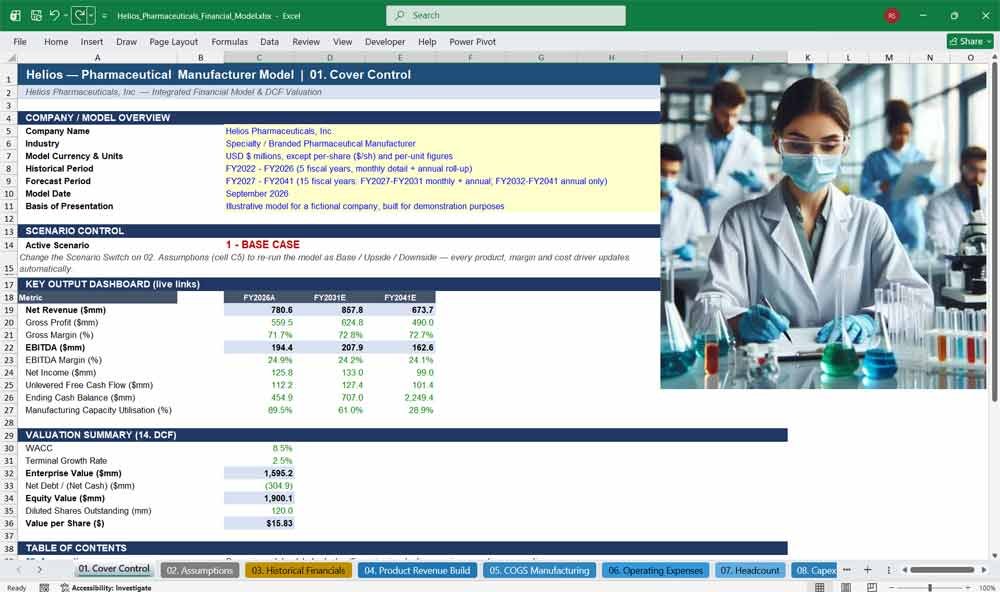
01. Cover Control
The Cover Control tab is your model’s command center — a live dashboard summarizing company overview, key financial outputs, and DCF valuation results, plus a one-click scenario switch and hyperlinked table of contents for instant navigation across all 15 tabs of this pharma financial model.
- One-click Base / Upside / Downside scenario switch that recalculates the entire model
- Live dashboard of revenue, EBITDA, free cash flow, and valuation
- Hyperlinked table of contents for instant tab navigation
- Company overview and model methodology summary at a glance
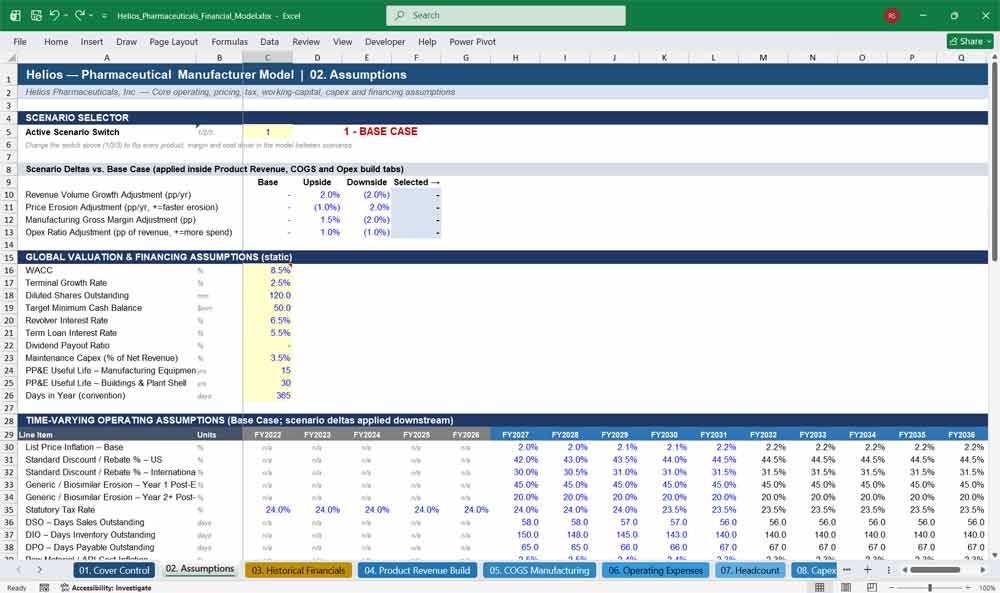
02. Assumptions
The Assumptions tab centralizes every driver in the model — pricing inflation, discount rates, tax rates, working capital days, cost inflation, and scenario deltas — so you can stress-test the pharmaceutical financial model’s revenue, margin, and valuation outputs by changing a handful of clearly labeled input cells.
- Single source of truth for every forecast driver
- Built-in Base / Upside / Downside scenario toggle
- Editable WACC, terminal growth rate, and share count
- Time-varying assumptions for pricing, discounts, and cost inflation
Pharmaceutical Manufacturer Expenses
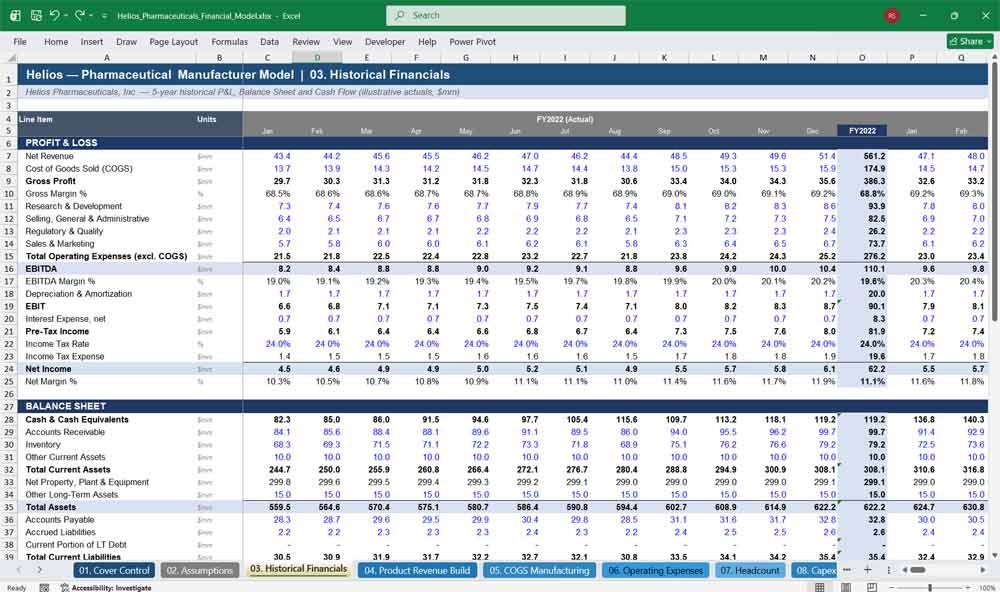
03. Historical Financials
Five years of fully reconciled monthly historical financials — Income Statement, Balance Sheet, and Cash Flow — anchor this pharma manufacturer model in realistic, internally consistent data, giving you a credible historical base from which every forecast assumption and growth trajectory is built and benchmarked.
- 60 months of historical Income Statement, Balance Sheet, and Cash Flow data
- Fully reconciled — balance sheet ties to the penny every period
- Realistic seasonality, margin trends, and working capital dynamics
- Serves as the calibration base for every forecast tab
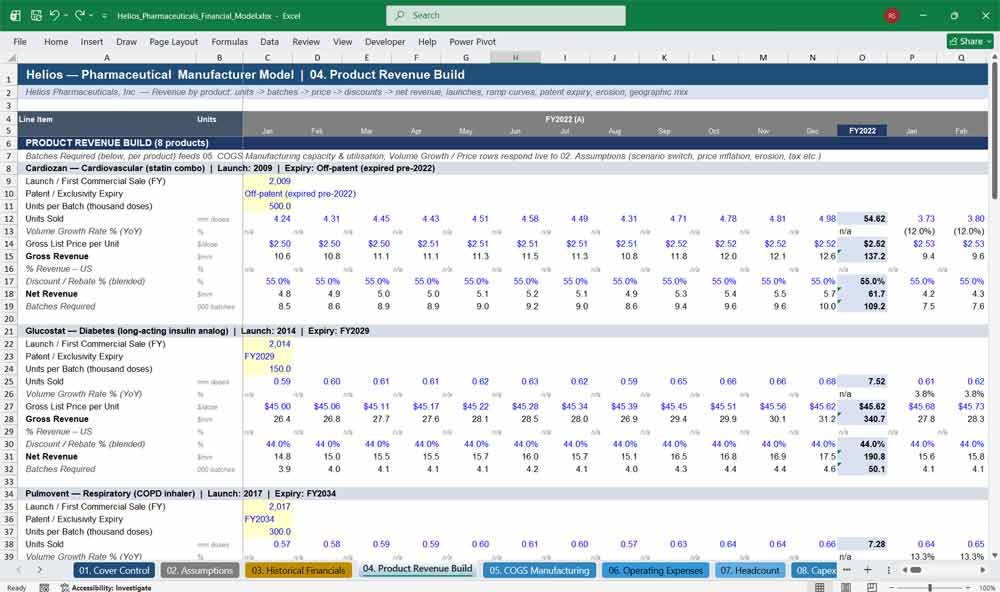
04. Product Revenue Build
The Product Revenue Build is the engine of this pharmaceutical financial model — eight individually modeled products with unit volumes, batch sizes, pricing, discounts, geographic mix, launch ramps, patent expiry, and biosimilar erosion curves, giving you a true bottom-up, product-level revenue forecast rather than a single top-line growth assumption.
- 8 individually modeled products with distinct launch and patent-expiry timing
- Patent-cliff and biosimilar/generic erosion curves built into each product
- New product launch ramp-up curves and regulatory approval timing
- US vs. international pricing, discount, and rebate modeling
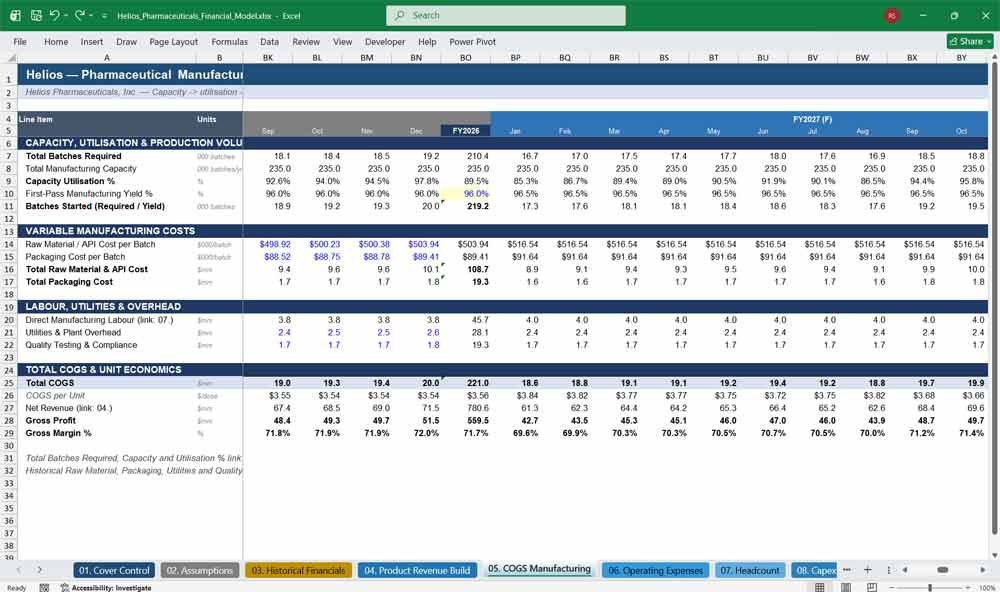
05. COGS Manufacturing
This tab links manufacturing capacity and utilization directly to cost of goods sold, modeling raw materials, packaging, labor, utilities, and quality costs per batch — so gross margin isn’t a static assumption but a real output of production volume, batch economics, and plant capacity constraints.
- Capacity-to-utilization-to-COGS chain, not a static margin assumption
- Per-batch raw material, packaging, utilities, and quality cost build
- Fully linked to manufacturing headcount and plant capacity tabs
- Gross margin calculated dynamically from real production economics
06. Operating Expenses
R&D, SG&A, Regulatory & Quality, and Sales & Marketing expenses are each modeled as a percentage of net revenue with year-by-year assumption flexibility, giving this pharma financial model realistic opex scaling as the product portfolio grows, matures, and eventually contracts through the forecast period.
- Separate R&D, SG&A, Regulatory & Quality, and Sales & Marketing build
- Opex ratios flex independently by year and by scenario
- Fully reconciled to historical actuals for a seamless transition to the forecast
- Editable cost ratios for quick sensitivity testing
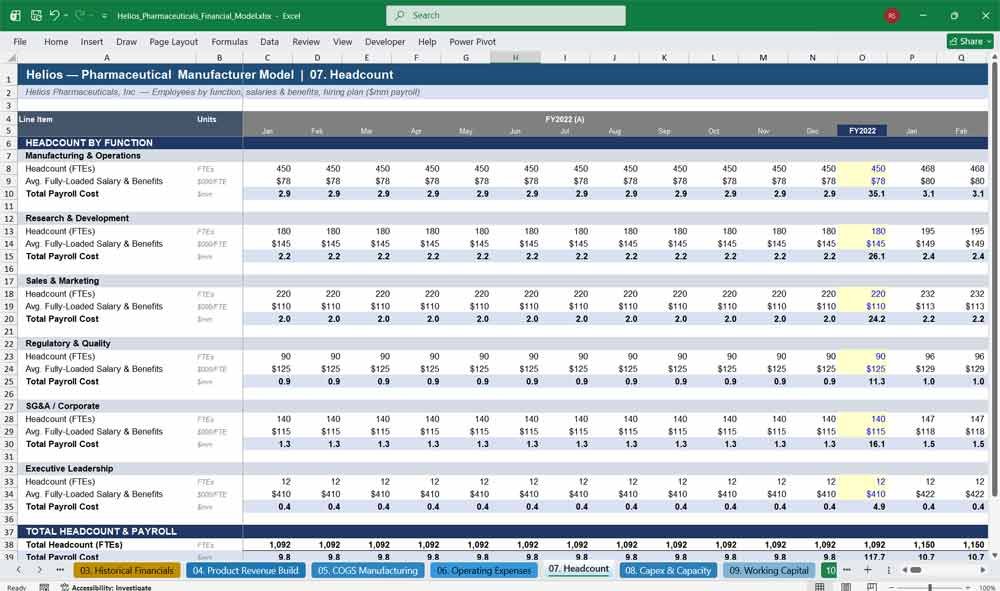
07. Headcount
The Headcount tab drives payroll costs across six functions — manufacturing, R&D, sales & marketing, regulatory, SG&A, and executive — using realistic productivity and revenue-based ratios, so staffing costs scale credibly with production volume and company growth rather than as a disconnected top-down guess.
- Headcount and payroll modeled across 6 distinct functions
- Manufacturing headcount tied directly to production batch volume
- Salary inflation assumptions applied year over year
- Fully integrated with the P&L and COGS build
08. Capex & Capacity
Track manufacturing capacity, plant expansion capital expenditures, and the full depreciation and net PP&E roll-forward in one place — this tab models a second-plant expansion with a realistic ramp schedule, so capacity constraints and growth capex decisions flow straight into COGS and free cash flow.
- Two-plant capacity model with a realistic expansion ramp schedule
- Maintenance, expansion, and growth capex modeled separately
- Full Net PP&E and depreciation roll-forward
- Capacity utilization status flags (OK / Near Capacity / Shortfall)
Pharmaceutical Manufacturer Financial Statements
09. Working Capital
Accounts receivable, inventory, and accounts payable are modeled using industry-typical days outstanding (DSO, DIO, DPO), converting revenue and COGS forecasts into realistic working capital balances and cash flow impacts — a critical, often-overlooked driver of free cash flow in capital-intensive manufacturing businesses like pharma.
- DSO / DIO / DPO-driven working capital build
- Direct link to cash flow statement’s working capital changes
- Editable days-outstanding assumptions by year
- Fully reconciled to historical working capital balances
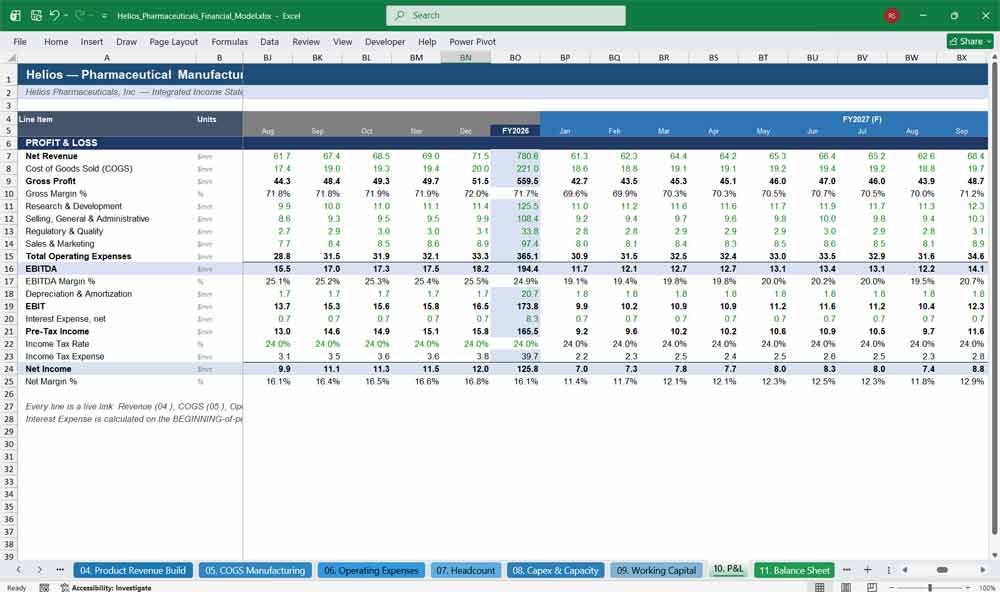
10. P&L
A fully integrated income statement pulls every line — revenue, COGS, opex, D&A, interest, and taxes — directly from the underlying build tabs, giving you a clean, auditable P&L that flows automatically from operational drivers rather than hardcoded projections, ready for FY2027–FY2041 scenario analysis.
- Every line item links to its source build tab — zero hardcoded inputs
- Revenue through net income, fully formula-driven
- EBITDA, EBIT, and margin metrics calculated automatically
- Instantly recalculates under any scenario or assumption change
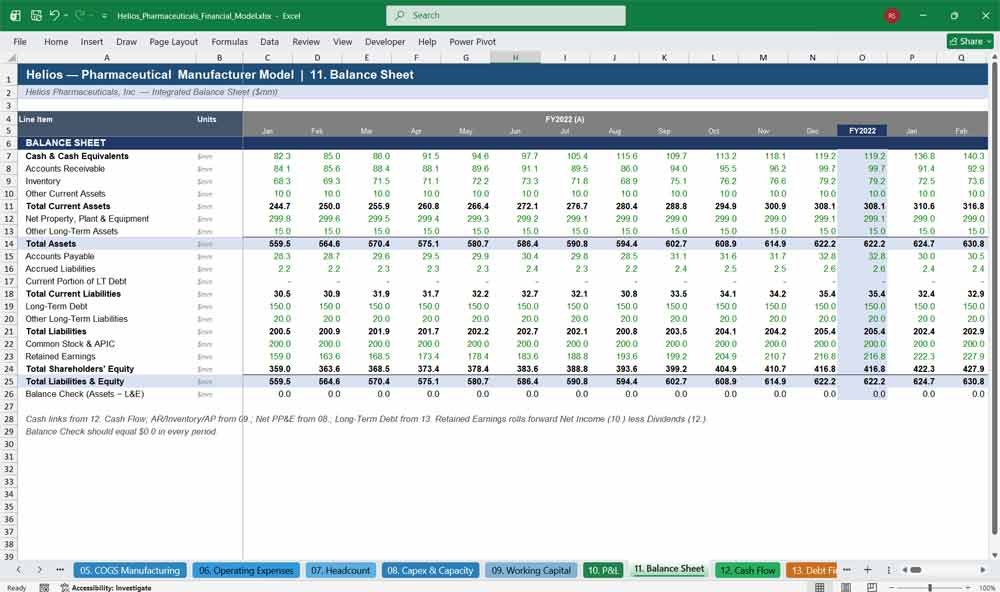
11. Balance Sheet
A fully integrated balance sheet — cash, receivables, inventory, PP&E, debt, and equity — balances to zero in every single period across the entire 15-year forecast, giving you a rare, truly non-circular, error-free 3-statement pharmaceutical financial model you can trust and build on with confidence.
- Balances to $0.00 in every one of 140 modeled periods
- Fully linked to cash flow, debt, and working capital tabs
- Retained earnings roll-forward tied directly to net income and dividends
- Built with a non-circular formula structure — no iterative calculation needed
12. Cash Flow
This tab converts net income into levered and unlevered free cash flow, integrating working capital changes, capital expenditures, and financing activity into one clean cash flow statement — the direct feeder into the DCF valuation tab and a critical output for lenders, investors, and management alike.
- Levered and unlevered free cash flow calculated automatically
- Feeds directly into the DCF valuation tab
- Full reconciliation of beginning to ending cash balance
- Historical and forecast cash flow on one consistent format
13. Debt Financing
A realistic, non-circular debt schedule calculates interest expense on beginning-of-period balances and models an automatic cash sweep and revolver mechanic — debt pays down when cash is abundant and draws a revolver when it’s tight — exactly how a real credit facility behaves in practice.
- Non-circular interest expense calculation — no Excel iterative calc required
- Automatic cash sweep pays down debt with excess cash
- Revolver draw mechanic covers any cash shortfall automatically
- Fully linked to the cash flow statement and balance sheet
Assumptions and Drivers for a Pharmaceutical Manufacturer
14. DCF
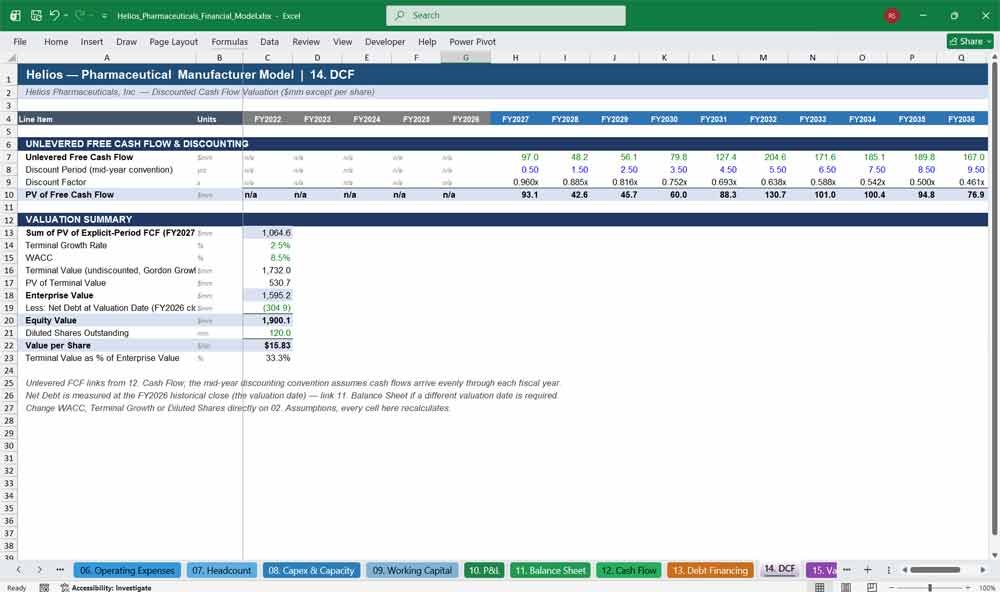
The DCF tab is the valuation heart of this pharma financial model — unlevered free cash flow, WACC, mid-year discounting, Gordon Growth terminal value, enterprise value, net debt, and equity value per share, all fully formula-driven and instantly responsive to any assumption or scenario change you make.
- Full DCF build: UFCF, WACC, terminal growth, and mid-year discounting
- Automatic enterprise value to equity value bridge
- Editable WACC, terminal growth, and share count assumptions
- Value-per-share output updates instantly with any model change
15. Valuation Sensitivity
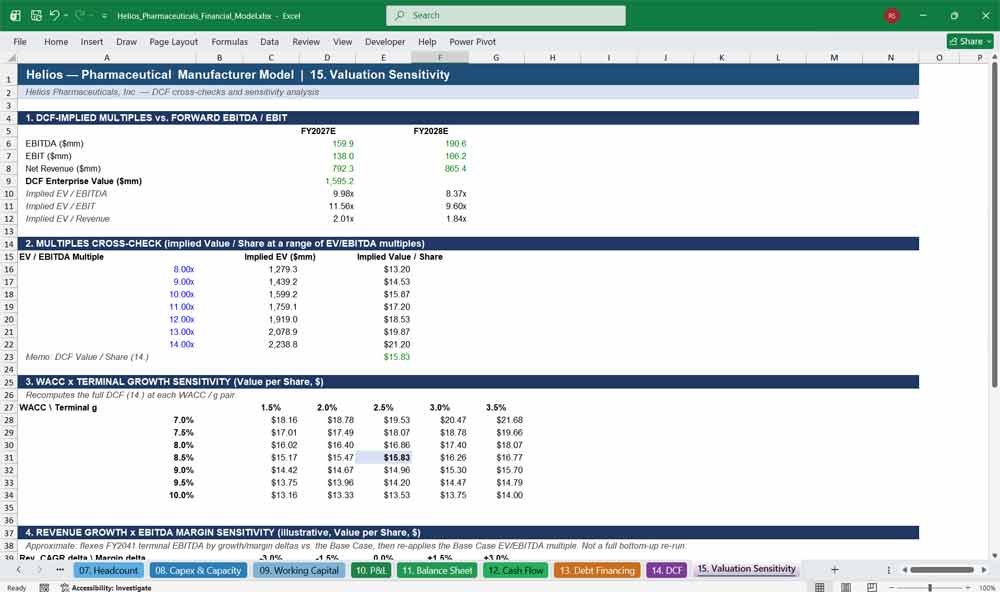
Stress-test your valuation from every angle — a WACC-by-terminal-growth sensitivity grid, an EV/EBITDA and EV/EBIT multiples cross-check, a revenue-growth-by-margin sensitivity table, and a probability-weighted scenario summary — giving decision-makers a defensible valuation range instead of a single point estimate.
- Live WACC x terminal growth valuation sensitivity grid
- EV/EBITDA, EV/EBIT, and EV/Revenue multiples cross-check
- Revenue growth x EBITDA margin sensitivity table
- Probability-weighted downside / base / upside scenario summary
Value Your Pharmaceutical Manufacturing With A DCF
DCF: Valuing the Lifecycle and the “Patent Cliff”
This 15-year Discounted Cash Flow (DCF) is a valuation method used to estimate the intrinsic value of a pharmaceutical company by forecasting its future cash flows and discounting them back to their present value. In the pharmaceutical industry, DCF models typically incorporate revenue projections from approved drugs, expected launches from the development pipeline, patent expiration timelines, and R&D spending. Because pharmaceutical firms often have long development cycles and high upfront research costs, the DCF approach helps investors evaluate whether the future cash flows from successful drug commercialization justify the current investment.
WACC: Pricing Regulatory Hurdles and Clinical Binary Risk
The Weighted Average Cost WACC represents the average rate of return that a pharmaceutical company is expected to pay its investors, including both equity holders and debt providers. It is used as the discount rate in a DCF model because it reflects the overall risk and capital structure of the company. For pharmaceutical firms, WACC may be influenced by factors such as regulatory risk, patent protection, R&D uncertainty, and market competition. A higher perceived risk in drug development or approval processes can increase the cost of capital, which lowers the present value of projected cash flows.
Valuation Sensitivity: Stress-Testing Pricing and “PTRS”
Valuation sensitivity is used in pharmaceutical financial modeling to assess how changes in key assumptions impact the company’s valuation. Since drug development outcomes, regulatory approvals, pricing pressures, and market adoption rates can vary significantly, analysts test scenarios where variables such as revenue growth, R&D success rates, or WACC change. This analysis helps investors and management understand the range of possible valuations and identify which factors have the greatest influence on the company’s financial outlook.
Pharmaceutical Manufacturer Frequently Asked Questions
Is Helios Pharmaceuticals a real company?
No. Helios Pharmaceuticals, Inc. is a fictional, illustrative company created specifically for this model. All product names, financial figures, and assumptions are synthetic and built to reflect realistic industry dynamics — you’re free to rename the company and replace the assumptions with your own or a real company’s data.
Can I use this model to value a real pharmaceutical company?
Yes. The structure — product-level revenue build, manufacturing capacity and COGS, integrated 3-statement model, and DCF — is designed to be adapted to any branded, generic, or biologics manufacturer. Simply replace the historical actuals and forecast assumptions with your target company’s data, and every formula will recalculate automatically.
Do I need any add-ins or special software to open this file?
No. This is a standard .xlsx file built entirely with native Excel formulas — no macros, VBA, or add-ins required. It opens in any recent version of Microsoft Excel (2007 or later) as well as Google Sheets and LibreOffice Calc, though Excel is recommended for full formatting fidelity.
How far out does the forecast go?
The model includes 5 years of historical monthly financials (FY2022–FY2026) and a 15-year forecast (FY2027–FY2041) — the first 5 forecast years are modeled monthly with annual roll-ups, and the remaining 10 years are modeled annually, giving you both near-term granularity and a full long-term valuation horizon.
Is there a scenario or sensitivity analysis built in?
Yes. A Base / Upside / Downside scenario switch on the Assumptions tab flips every growth, margin, and cost driver in the model with a single click, and the Valuation Sensitivity tab includes a WACC x terminal growth grid, a multiples cross-check, a revenue growth x margin grid, and a probability-weighted scenario summary.
Will the formulas break if I change an assumption?
No — that’s the whole point. Every calculated cell in the model is a live formula, not a hardcoded number, so changing any input (growth rate, WACC, pricing, discount rate, launch year, etc.) flows through the entire model automatically, all the way to enterprise value and value per share.
How do I know the model actually balances?
The Balance Sheet ties to within a fraction of a rounding cent in every single one of the model’s 140 historical and forecast periods — this was verified exhaustively, column by column, before publishing. You won’t run into the common “plug” errors or circular reference warnings that plague many downloadable financial models.
What currency and units does the model use?
All figures are presented in USD, in $ millions, except per-share values (shown in dollars and cents) and per-unit manufacturing figures. You can adapt the currency and units to your own reporting requirements by editing the Assumptions tab and number formats.
Is this suitable for someone learning financial modeling, or only for professionals?
Both. The model is fully transparent — every formula is visible and traceable, and the color-coding (blue = input, black = formula, green = cross-tab link) makes it easy to follow the logic. It’s a strong learning tool for students and early-career analysts, and detailed enough for professional use by experienced finance teams.
What’s included when I purchase?
You’ll receive the complete Excel workbook (.xlsx) with all 15 tabs, fully built out and formula-linked, including the historical financials, product revenue build, cost and capacity build, integrated 3-statement model, debt schedule, DCF valuation, and sensitivity analysis — ready to open, explore, and customize immediately.
Final Notes on the Financial Model
Financial model for a Pharmaceutical Manufacturer
- Scenario Analysis: Create best-case, base-case, and worst-case projections.
- Break-even Analysis: Determine the sales volume required to cover fixed & variable costs.
- Sensitivity Analysis: Assess how changes in raw material costs, pricing, or demand impact profitability.
This structured model helps a pharmaceutical manufacturing company address a broad market spectrum, offering the right balance between cost, production capacity, and support.
Download Link On Next Page