
Drone Manufacturing Financial Model Template (2026 Excel)
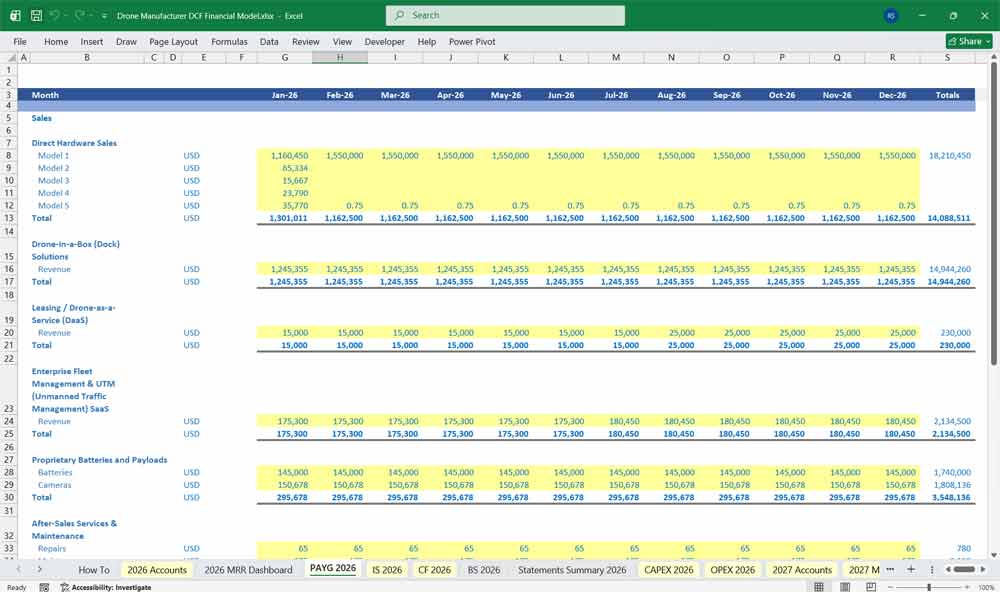
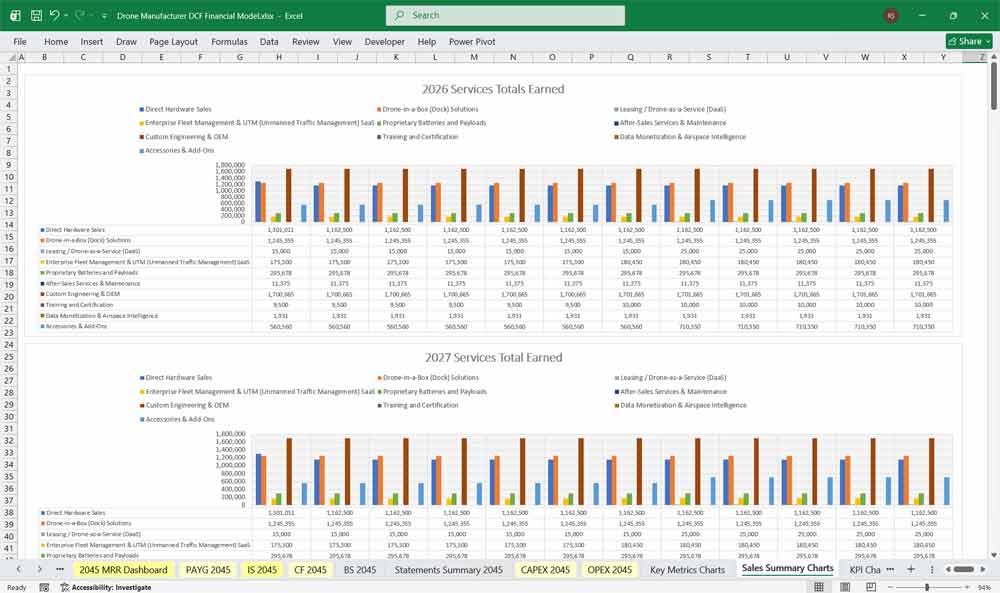
This 20-Year, 3-Statement Drone Manufacturing Financial Model Template (2026 Excel) includes revenue streams from Direct Hardware Sales, Drone-in-a-Box (Dock) Solutions, Leasing / Drone-as-a-Service (DaaS), Enterprise Fleet Management & UTM (Unmanned Traffic Management) SaaS, etc. Cost structures, Discounted Cash Flow (DCF) with Terminal Value, Sensitivity Analysis, WACC, and financial statements to forecast the financial health of your drone manufacturing.
20-Year Financial Model for a Drone Manufacturing
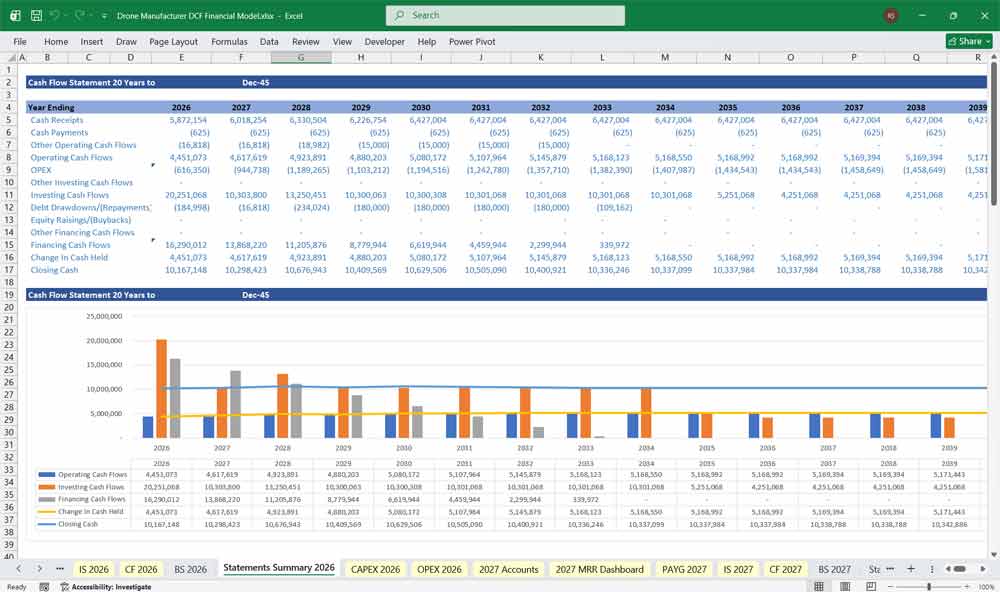
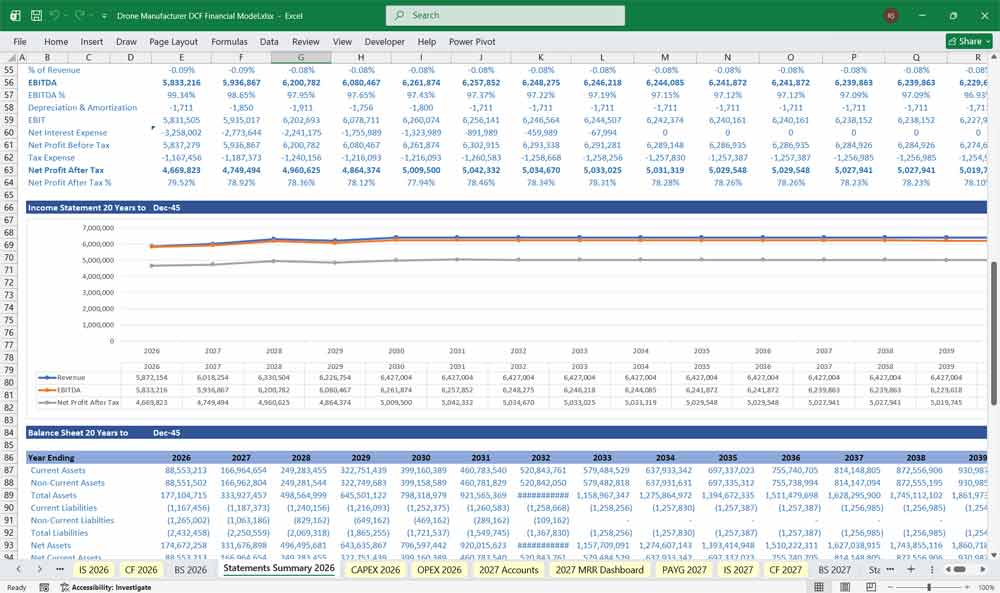
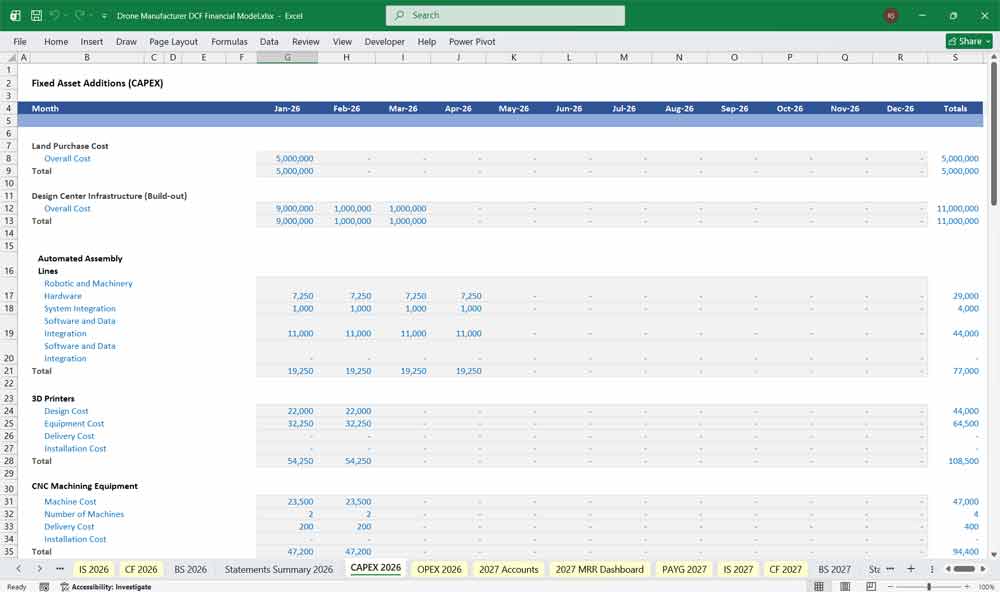
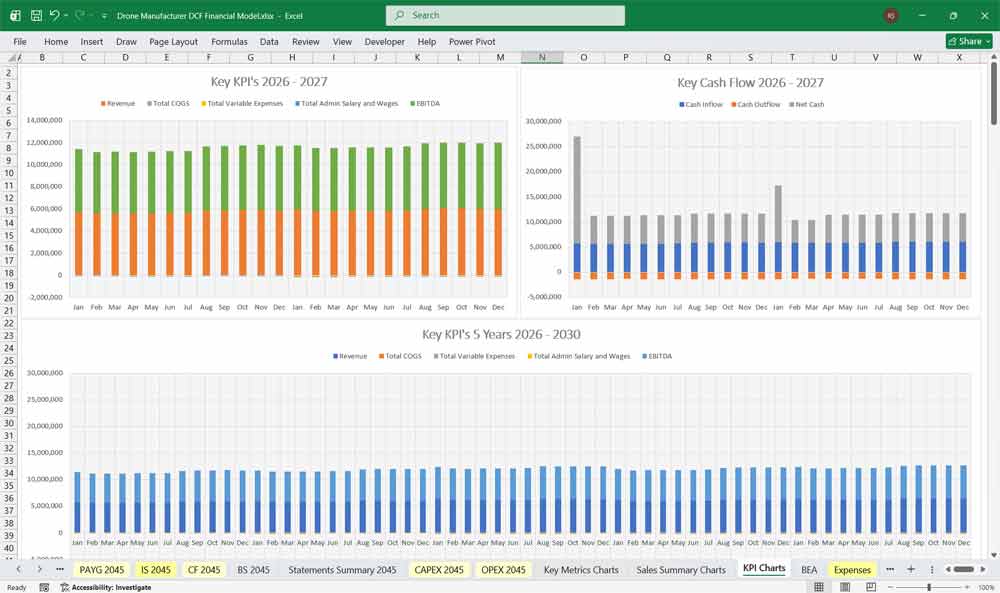
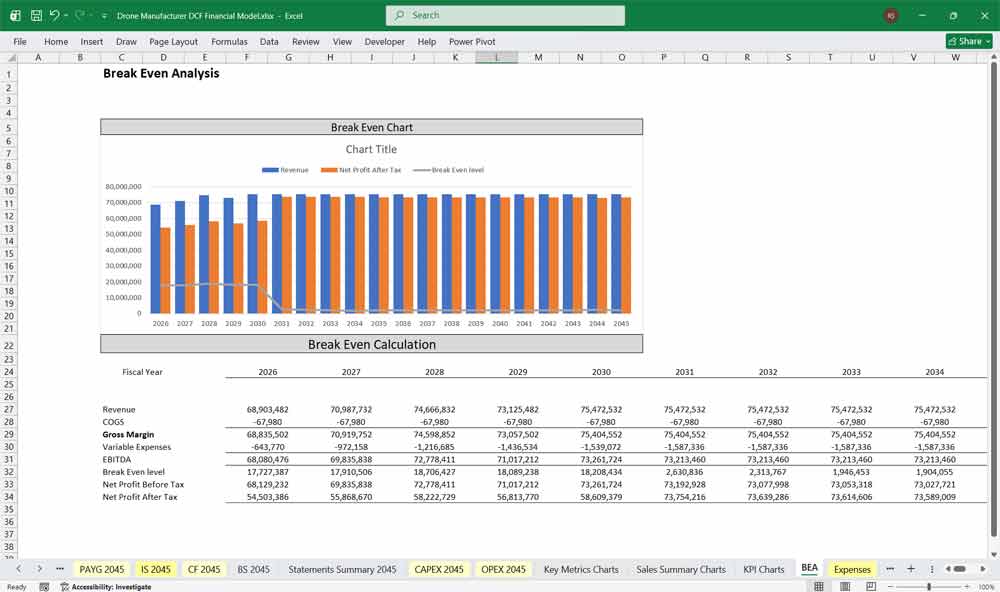
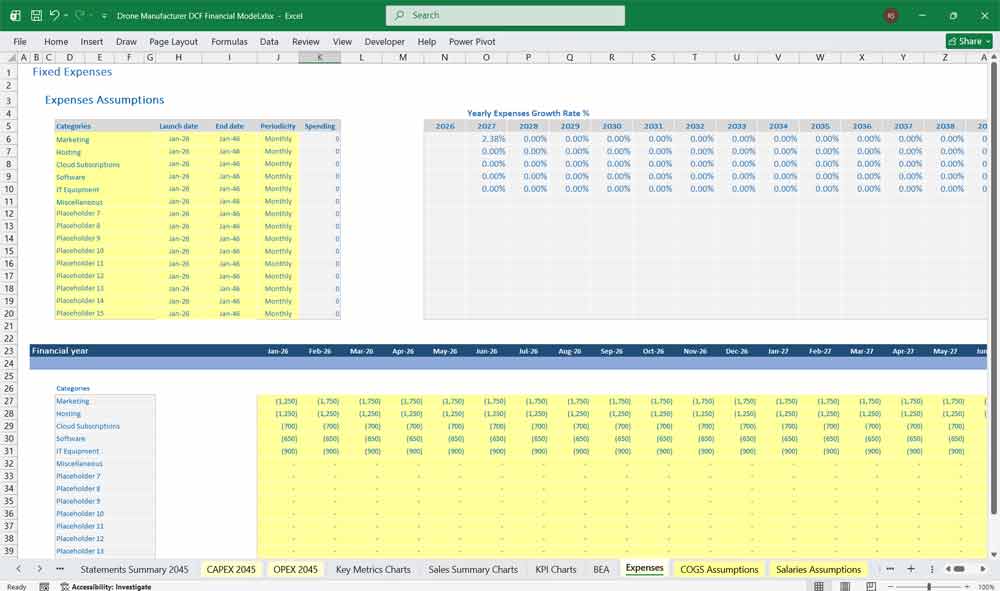
This very extensive 20 Year Drone Manufacturing Model involves detailed revenue projections, cost structures, capital expenditures, and financing needs. This model provides a thorough understanding of the financial viability, profitability, and cash flow position of your manufacturing company. Includes: 20x Income Statements, Cash Flow Statements, Balance Sheets, CAPEX sheets, OPEX Sheets, Statement Summary Sheets, and Revenue Forecasting Charts with the revenue streams, BEA charts, sales summary charts, employee salary tabs and expenses sheets.
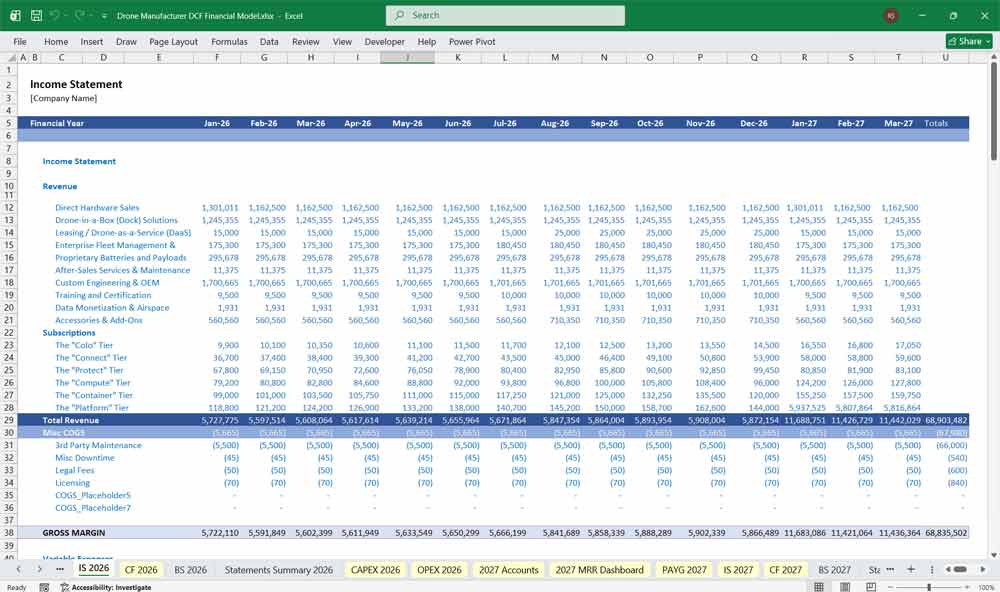
Income Statement (Profit & Loss)
The Income Statement forecasts revenue, costs, and profitability over time (typically 5–10 years). Key sections:
Revenue
Hardware Sales – Drones (consumer, prosumer, enterprise), docking stations, batteries, propellers, payloads (cameras, sensors). Recognized at point of delivery (or shipment for e-commerce).
Software & Services – Subscription fees for flight planning, data analytics, fleet management, cloud storage. Recognized ratably over the subscription period.
Maintenance, Repair & Overhaul (MRO) – Paid repairs, spare parts, extended warranties, and care plans.
Drone-in-a-Box (Dock) Solutions – Selling autonomous docking stations (drone ports) combined with hardware and software..
Custom & Contract Revenue – Defense or government R&D contracts, custom OEM builds. Recognized over time using percentage-of-completion.
Cost of Goods Sold (COGS)
Direct Materials – Batteries (often the largest cost), motors, flight controllers, GPS modules, camera sensors, plastics/carbon fiber, circuit boards.
Direct Labor – Assembly line wages, quality control, test pilots.
Manufacturing Overhead – Factory rent, utilities, depreciation of production equipment (3D printers, SMT lines, injection molding machines).
Freight & Logistics – Inbound shipping of components, outbound shipping to customers.
Software COGS – Cloud hosting costs (AWS/Azure), third-party mapping APIs, customer support salaries.
Gross Profit & Gross Margin
Gross Profit = Revenue – COGS.
Gross Margin (typically 30–50% for hardware, 70–85% for software). Consumer drones have lower margins; enterprise/defense and software have much higher margins.
Operating Expenses (OpEx)
Research & Development (R&D) – Salaries of engineers, prototype materials, flight testing, regulatory certification costs (FAA, EASA), patent filings. Typically 15–25% of revenue for a tech-driven manufacturer.
Sales & Marketing (S&M) – Digital ads (Google, YouTube), trade shows (CES, AUVSI), channel partner commissions, B2B sales team salaries, demo units, brand sponsorships.
General & Administrative (G&A) – Executive salaries, legal, accounting, office rent, IT, insurance (product liability, cyber), quality assurance.
Customer Support – Help desk, warranty replacements, repair center staff.
Other Income/Expenses
Interest Expense – Interest on debt (equipment loans, working capital line of credit).
Interest Income – Cash from investor funding held in money market accounts.
Foreign Exchange (FX) Gains/Losses – The company buys components in multiple currencies (e.g., Japanese batteries, Chinese motors) and sells globally.
Gain on Sale of Assets – Selling older manufacturing equipment or demo fleets.
Net Income (Bottom Line)
EBIT (Earnings Before Interest & Taxes) = Gross Profit – OpEx.
EBT (Earnings Before Tax) = EBIT – Interest Expense + Interest Income.
Net Income = EBT – Corporate Income Tax (assuming tax loss carryforwards in early years). Early-stage drone manufacturers often show net losses for 2–4 years due to heavy R&D and low initial volumes.
Drone Manufacturing Cash Flow Statement
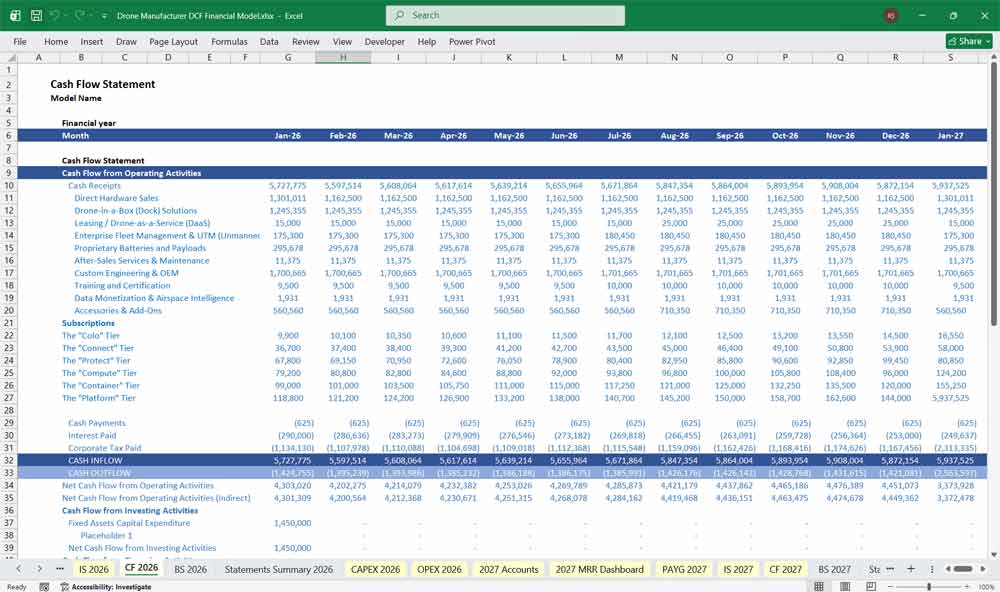
The Cash Flow Statement reconciles net income to actual cash movement, critical for a capital-intensive manufacturer. It has three sections:
Cash Flow from Operating Activities
Starts with Net Income (which may be negative early on), then adjusts for non-cash items and working capital changes:
Add back non-cash expenses:
Depreciation & Amortization (from factory equipment, molds, software capitalization).
Stock-based compensation (if paying engineers with equity).
Provision for warranty claims (accrued but not yet paid).
Changes in Working Capital:
Accounts Receivable (A/R) – B2B customers (utilities, government) often pay on 60–90 day terms. An increase in A/R consumes cash.
Inventory – A major cash drain. Drone manufacturers must stock hundreds of SKUs (batteries, motors, frames). Building inventory before sales consumes cash.
Accounts Payable (A/P) – Extending payment terms with component suppliers (e.g., 60 days) provides cash.
Deferred Revenue – Customers paying annually upfront for software subscriptions increases cash but is not yet recognized as revenue.
Net Cash from Operations – Often negative in early years as inventory builds and R&D spend is high, turning positive once scale and subscriptions grow.
Cash Flow from Investing Activities
Capital Expenditures (CapEx) – Cash outflows for:
Production equipment (pick-and-place machines for circuit boards, drone assembly robots).
Tooling & molds for plastic/carbon fiber frames.
Test chambers, wind tunnels, flight cages.
Leasehold improvements for factory or R&D lab.
Computer hardware & servers.
Capitalized Software Development – Costs to build the proprietary flight software platform (treated as an intangible asset).
Purchase of IP or Acquisitions – Buying a smaller AI or sensor startup.
Proceeds from Sale of Equipment – Selling old demo drones or manufacturing machines.
Cash Flow from Financing Activities
Equity Issuance – Cash from venture capital, angel investors, or an IPO (public offering). Common for high-growth drone startups.
Debt Issuance – Term loans for factory expansion, equipment financing, or working capital line of credit.
Lease Financing – Cash from sale-leaseback of equipment or property.
Dividends (if public) – Rare for growth-phase manufacturers.
Share Repurchases – Usually not until very mature.
Net Cash Change & Beginning/Ending Cash
Sum of the three sections gives the net increase or decrease in cash.
Added to beginning cash balance to get ending cash. Lenders/investors monitor this closely – a drone manufacturer must maintain at least 6–12 months of runway.
Drone Manufacturing Balance Sheet (Statement of Financial Position)
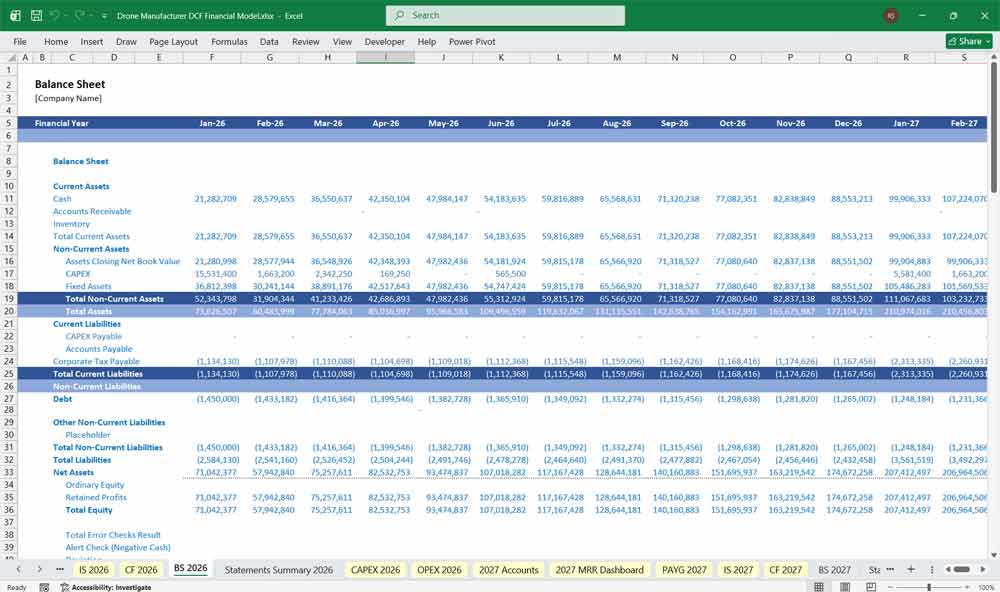
The Balance Sheet shows the company’s assets, liabilities, and equity at a point in time (typically quarter-end or year-end). The model ensures the equation holds: Assets = Liabilities + Shareholders’ Equity.
Assets
Current Assets (convertible to cash within 1 year)
Cash & Cash Equivalents – Operating accounts, short-term treasuries. The buffer for R&D and production.
Accounts Receivable (A/R) – Unpaid invoices from enterprise/government customers. Often high in B2B drone sales.
Inventory – Broken down into:
Raw materials (batteries, chips, frames).
Work-in-progress (partially assembled drones on the production line).
Finished goods (ready-to-ship drones).
Consumables (extra batteries, propellers, chargers).
Prepaid Expenses – Insurance premiums paid upfront, trade show deposits, prepaid cloud hosting.
Short-term Investments – If excess cash is parked in liquid securities.
Non-Current Assets (long-term)
Property, Plant & Equipment (PP&E) – Net of accumulated depreciation. Includes factory building, assembly lines, test equipment, office furniture.
Right-of-Use (ROU) Assets – If the company leases factory space or distribution centers (under ASC 842/IFRS 16).
Intangible Assets – Patents, trademarks, proprietary software platforms, customer lists (from acquisitions).
Goodwill – Arises if the manufacturer acquires another company for more than the fair value of its net assets.
Capitalized Software Development – Internal costs for flight software that meet capitalization criteria (e.g., after technological feasibility).
Liabilities
Current Liabilities (due within 1 year)
Accounts Payable (A/P) – Amounts owed to component suppliers (battery cells, motor windings, camera sensors).
Accrued Expenses – Salaries payable, accrued interest, utilities, warranty reserve (estimated future repairs).
Deferred Revenue – Cash collected for annual software subscriptions or prepaid service contracts not yet earned.
Short-term Debt – Current portion of term loans or working capital lines.
Current Lease Liabilities – The portion of factory lease payments due within 12 months.
Non-Current Liabilities (due after 1 year)
Long-term Debt – Bank loans for factory expansion or equipment purchases (e.g., 5-year term loan).
Long-term Lease Liabilities – Remaining lease payments for facilities beyond one year.
Deferred Tax Liabilities – Temporary differences between book and tax accounting (e.g., accelerated depreciation for tax purposes).
Shareholders’ Equity
Common Stock – Par value of shares issued to founders and investors.
Additional Paid-In Capital (APIC) – The excess over par value paid by VCs and public market investors. This is usually large for a well-funded drone manufacturer.
Accumulated Deficit (or Retained Earnings) – Cumulative net income minus any dividends. Most drone startups have an accumulated deficit from years of R&D and pre-profit operations.
Treasury Stock (if any) – Shares repurchased by the company.
Other Comprehensive Income – Foreign currency translation adjustments (for global sales offices) and unrealized gains/losses on marketable securities.
Advantages Of A 20 Year Model For A Drone Manufacturer
A 20-year financial model provides a critical long-range perspective on asset replacement cycles and Capital Expenditure (CapEx). For a drone manufacturer, expensive machinery like CNC mills and automated assembly lines have multi-year lifespans, while proprietary patents and flight software have long amortization periods. By extending the model two decades out, leadership can visualize the “lumpy” cash outflows required for major hardware refreshes and ensure the company maintains a capital reserve to upgrade its factory floor without compromising day-to-day operations.
A 20-year horizon is essential for mapping the transition from high-growth hardware sales to a stable, recurring revenue ecosystem. In the early years, a manufacturer typically relies on the volatile “one-time” sale of airframes; however, over 20 years, the model can accurately forecast the compounding value of “Drone-as-a-Service” (DaaS) contracts, software subscriptions, and maintenance cycles. This long-term view helps investors see the ultimate path to high-margin stability, proving that the business isn’t just a gadget maker but a sustainable platform provider.
This two-decade model allows for strategic alignment with evolving global regulations and infrastructure shifts. The drone industry is heavily dependent on FAA/EASA milestones, such as the full integration of Beyond Visual Line of Sight (BVLOS) flight and the eventual rollout of Urban Air Mobility (UAM) networks. A 20-year model provides the “runway” to plan for these tectonic shifts, allowing the manufacturer to align its R&D spending today with the projected regulatory environment of the 2030s and 2040s, ensuring the company remains relevant as the airspace matures.
6 Tier Subscription Model For A Drone Manufacturer
Tier 1: Free (Hobbyist / Basic Pilot)
Target Audience: Recreational flyers, students, first-time drone buyers, open-source enthusiasts.
Included Features:
Basic flight planning and manual waypoint navigation (no automation).
Local-only flight logs (no cloud storage).
Standard geofencing compliance (no custom zones).
Access to public user forums and basic knowledge base.
Manual firmware updates (user must download and install).
1 device connection (one drone per account).
7-day rolling flight data retention on device only.
Basic telemetry (battery level, GPS signal, altitude) displayed in real time.
Monetization Intent: Capture user data (with consent) for aggregated flight pattern insights, upsell to paid tiers via in-app prompts, and build brand loyalty. No direct revenue, but reduces customer acquisition cost (CAC) for higher tiers.
Tier 2: Core (Prosumer / Enthusiast)
Target Audience: Serious hobbyists, real estate photographers, small-scale farmers, content creators.
Included Features (all of Tier 1 plus):
Cloud Storage: 50 GB for flight logs, photos, and 4K video backups.
Automated Flight Modes: Orbit, waypoint missions, follow-me, and vertical tower inspection (pre-programmed).
Live Streaming: 720p live feed to social media or private web portal.
Basic Analytics: Flight summary reports (distance flown, battery cycles, max altitude).
Geofencing Override Request: Submit digital requests for temporary unlocks (e.g., near airports).
2 Device Connections: Link up to two drones to the same account.
Email Support: 48-hour response time, business hours only.
Firmware Auto-Updates: Over-the-air (OTA) updates when connected to Wi-Fi.
Key Upsell Hook: Users who fly more than 10 hours/month see prompts to upgrade to Tier 3 for advanced mapping.
Tier 3: Professional (Commercial Operator)
Target Audience: Licensed drone pilots, surveying firms, roof inspectors, public safety (police/fire), small construction companies.
Included Features (all of Tier 2 plus):
Cloud Storage: 500 GB with team sharing folders.
Advanced Mapping & 3D Modeling: Generate orthomosaics, digital elevation models (DEMs), and 3D point clouds directly from captured images (no third-party software needed).
Multi-Flight Stitching: Automatically stitch together data from multiple flights over days/weeks.
Thermal & Multispectral Analytics: Basic temperature spot analysis (for thermal payloads) and NDVI (Normalized Difference Vegetation Index) for agriculture.
Flight Log Compliance: Export logs in CSV/JSON for regulatory audits (FAA Part 107, EASA).
5 Device Connections: Manage a small fleet.
Priority Support: 24-hour response, 7 days a week.
API Access (Limited): Read-only access to flight data for integration with third-party dashboards.
Commercial Differentiator: Users can generate professional deliverables (maps, inspection reports) without additional software licenses, making the subscription cost recoverable per client project.
Tier 4: Fleet Manager (Small-to-Medium Enterprise)
Target Audience: Security companies with 5–20 drones, mid-sized construction firms, agricultural cooperatives, utility inspection teams.
Included Features (all of Tier 3 plus):
Centralized Fleet Dashboard: Real-time view of all drones’ locations, battery status, maintenance alerts, and pilot assignments.
Mission Planning Console: Assign automated missions to specific drones from a single web interface.
Drone-in-a-Box (Dock) Integration: Manage autonomous charging, takeoff, and landing schedules for up to 5 docks.
Role-Based Access Control (RBAC): Assign permissions (admin, pilot, viewer, maintainer) to team members.
Automated Compliance Reports: Generate weekly/monthly reports for insurance, safety audits, or regulatory bodies.
Geofencing as a Service: Pre-load custom geofences (e.g., no-fly zones around school hours, customer property boundaries).
20 Device Connections (expandable).
Advanced API (Read/Write): Trigger missions, download logs, and push alerts to third-party dispatch software (e.g., Salesforce, SAP).
Phone Support: 4-hour response, 24/7 hotline for mission-critical failures.
Revenue Driver: Enterprise customers pay for operational efficiency – replacing manual pilot tracking and separate mapping tools with a single pane of glass.
Tier 5: Enterprise (Large Organization / Government)
Target Audience: National police departments, military units, electric utilities with 50+ drones, oil & gas majors, airport authorities.
Included Features (all of Tier 4 plus):
Unlimited Cloud Storage with 10-year retention (audit-ready).
On-Premises or VPC Deployment: The manufacturer’s software runs inside the customer’s private cloud or air-gapped network for data sovereignty.
Real-Time Collaboration: Multiple users can view live feeds, annotate, and control missions simultaneously (for command centers).
AI-Powered Anomaly Detection: Automatically flag cracks in power lines, heat anomalies in solar panels, or unauthorized vehicles in restricted zones.
Advanced RBAC with Audit Trails: Every action (mission start, data download, setting change) is logged with user ID and timestamp.
Priority Geofencing Bypass: Pre-approved waivers for sensitive airspace (with regulatory coordination).
Multi-Site Management: Manage fleets across different cities or countries from one console.
Dedicated Account Manager & On-Site Training: Quarterly business reviews and in-person pilot certification.
SLA (Service Level Agreement): 99.9% uptime for cloud services, 1-hour critical issue response, 4-hour hardware replacement (for subscribed drones under warranty).
Monetization: High-touch sales, multi-year contracts, and professional services fees for integration. Often bundled with custom hardware (e.g., ruggedized drones for military use).
Tier 6: Autonomous Operations (Full Automation / Drone-as-Infrastructure)
Target Audience: Large-scale logistics (delivery networks), port authorities, smart cities, mining operations, agricultural giants (10,000+ acres).
Included Features (all of Tier 5 plus):
Fully Autonomous Swarm Coordination: Simultaneous control of 100+ drones with collision avoidance and dynamic rerouting.
Beyond Visual Line of Sight (BVLOS) Module: Pre-approved flight corridors, detect-and-avoid logic, and remote pilot override (minimal human intervention).
Predictive Maintenance: AI predicts motor/battery failures before they happen, automatically scheduling drones for service.
Dynamic Airspace Integration: Real-time negotiation with UTM (Unmanned Traffic Management) systems like Skyward or AirMap.
Automated Payload Swap & Battery Swap: Integration with robotic ground stations for continuous 24/7 operations.
Mission Marketplace: Customers can buy/sell drone capacity on the manufacturer’s exchange (e.g., a logistics company selling excess delivery slots to a medical supply firm).
Blockchain Flight Logs: Tamper-proof records for regulatory or insurance claims.
Revenue Share Opportunities: The manufacturer takes a percentage of any revenue generated by autonomous missions (e.g., delivery fees, inspection contracts).
24/7 On-Site Support Team: Manufacturer embeds technicians at customer location.
Unique Revenue Model: Instead of a fixed monthly fee, the manufacturer monetizes outcomes – every takeoff, every kilometer flown, or every package delivered generates a micro-transaction. This aligns incentives: the manufacturer only makes money when the customer makes money from automation.
Valuing Your Drone Manufacturing With A DCF
Discounted Cash Flow (DCF): Valuing the “Software-with-Wings” Moat
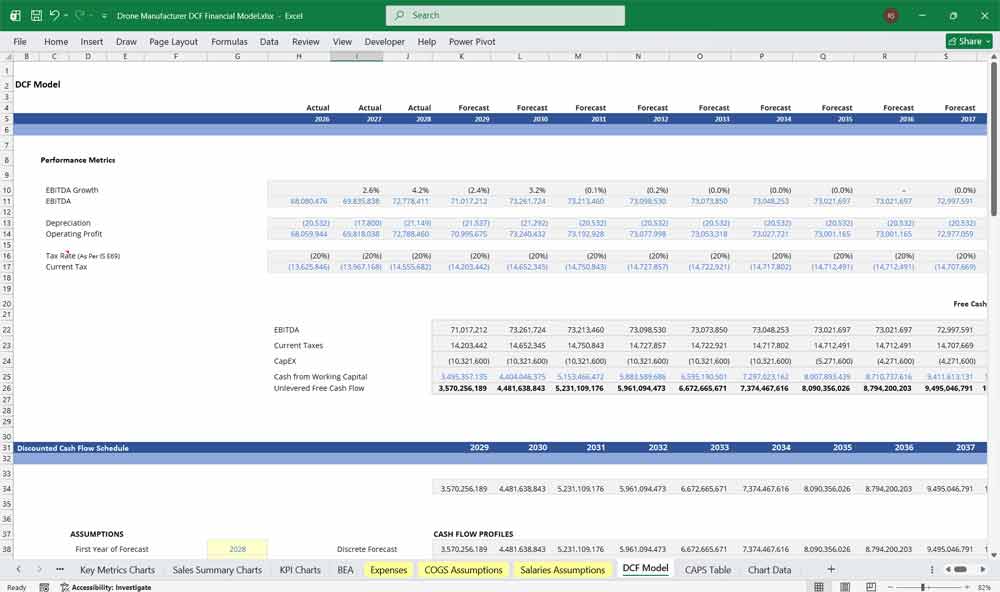
This 20-year Discounted Cash Flow (DCF) analysis for a drone manufacturer, the valuation is a race between high-octane R&D spending and the scaling of high-margin fleet management software. The model projects cash flows from the initial hardware sale (the “box”) and the recurring revenue from autonomous flight subscriptions and data analytics. Unlike traditional aerospace, the “CapEx” here includes specialized robotic assembly lines and heavy investment in proprietary computer vision. Over two decades, the DCF must account for rapid product obsolescence cycles, where the Terminal Value assumes the company evolves from a simple hardware builder into an indispensable “aerial OS” for logistics, agriculture, or defense.
WACC: Pricing “Innovation Beta” and Regulatory Turbulence
The Weighted Average Cost of Capital (WACC) for a drone manufacturer typically sits in a high-risk bracket of 11% to 15%, reflecting its status as a high-growth tech hardware play. Because the industry moves at a “silicon speed,” these firms often struggle to secure low-cost, long-term debt—nobody wants to lien a factory for a drone model that might be a paperweight in three years—making the Cost of Equity the dominant driver. In the 2026 market, the discount rate must price in a significant “Regulatory Beta”; the risk that new FAA or EASA flight restrictions could grounded entire product lines overnight. This high WACC ensures that future “sky-high” earnings are appropriately “punished” for the extreme technical and geopolitical volatility of the drone space.
Sensitivity Analysis: Stress-Testing “BOM” Spikes and Flight Bans
For a drone manufacturer, Sensitivity Analysis is the primary tool for measuring the “payload-to-profit” ratio. Analysts use sensitivity tables to see how a 15% spike in the Bill of Materials (BOM)—specifically specialized sensors, lithium-ion batteries, or AI chips—impacts the unit gross margin. The model must also stress-test “Regulatory No-Fly Zones”; if a key geographic market (like the EU or the US) imposes strict data-sovereignty or hardware-origin rules, the resulting loss in volume can crater the valuation. By identifying the break-even point for Annual Unit Sales versus R&D Burn, the sensitivity analysis reveals whether the company is a scalable aerospace titan or a niche hobbyist brand vulnerable to the next supply chain shock.
Final Notes on the Financial Model
This 20 Year Drone Manufacturer Financial Model focuses on balancing capital expenditures with steady revenue growth from a diversified product line. By optimizing operational costs, and power efficiency, and maximizing high-margin services, the models ensure sustainable profitability and cash flow stability.