
Solar + BESS Financial Model Template
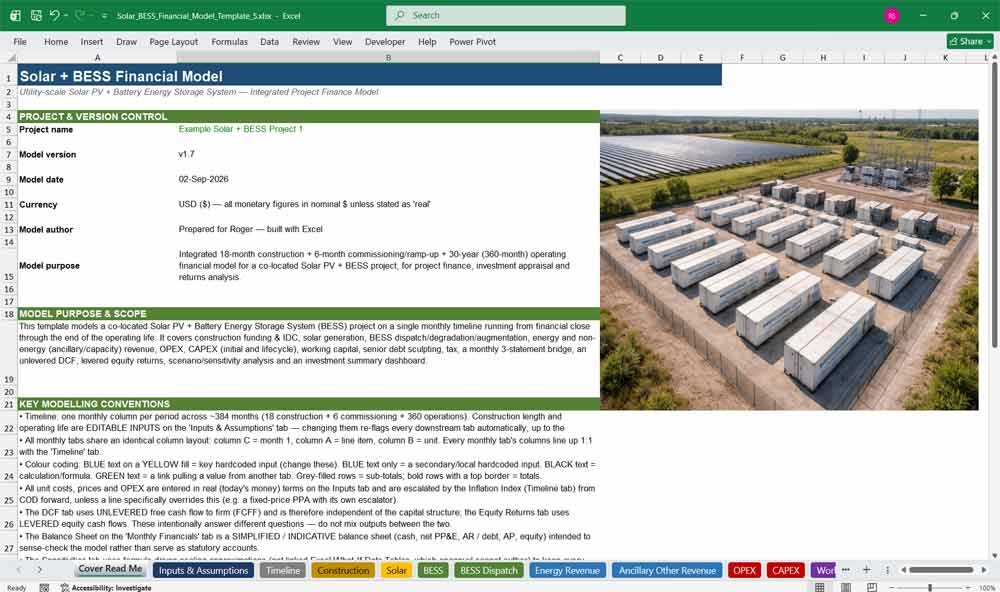
Build, analyse and defend the investment case for utility-scale solar and battery energy storage projects with this fully integrated Solar + BESS Financial Model Template in Excel. Designed for project finance, investment analysis and renewable energy modelling, the template provides a transparent monthly financial model covering construction, commissioning and a full 30-year operating life.
20-Year Financial Model for Solar + BESS Financial Model Template
This Solar and Battery Storage Financial Model is built for developers, investors, lenders, consultants, asset managers and renewable energy professionals who need to assess project economics, financing and returns. Model solar generation, BESS capacity and degradation, CAPEX, OPEX, energy and ancillary revenues, debt financing, tax, cash flow, project IRR, equity IRR and NPV — all within one interconnected Excel workbook.
Whether you are evaluating a utility-scale solar project, standalone BESS, or co-located Solar + BESS project, this Excel financial model gives you a structured starting point for project valuation and investment analysis. With editable assumptions, monthly calculations, BESS dispatch, debt sculpting, DCF valuation, equity returns, scenario analysis and automated model checks, you can quickly test different project structures and investment cases.
Solar + BESS Financial Model — Key Features
- 384-month monthly financial model covering 18 months of construction, 6 months of commissioning and 30 years of operations.
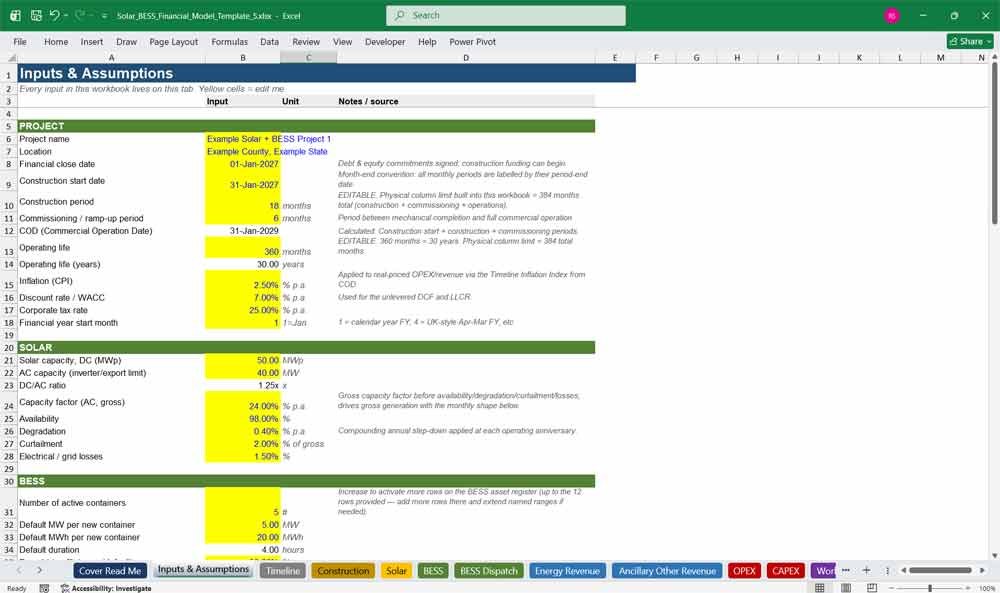
- Fully editable project timeline, including construction period, commissioning period, COD and operating life.
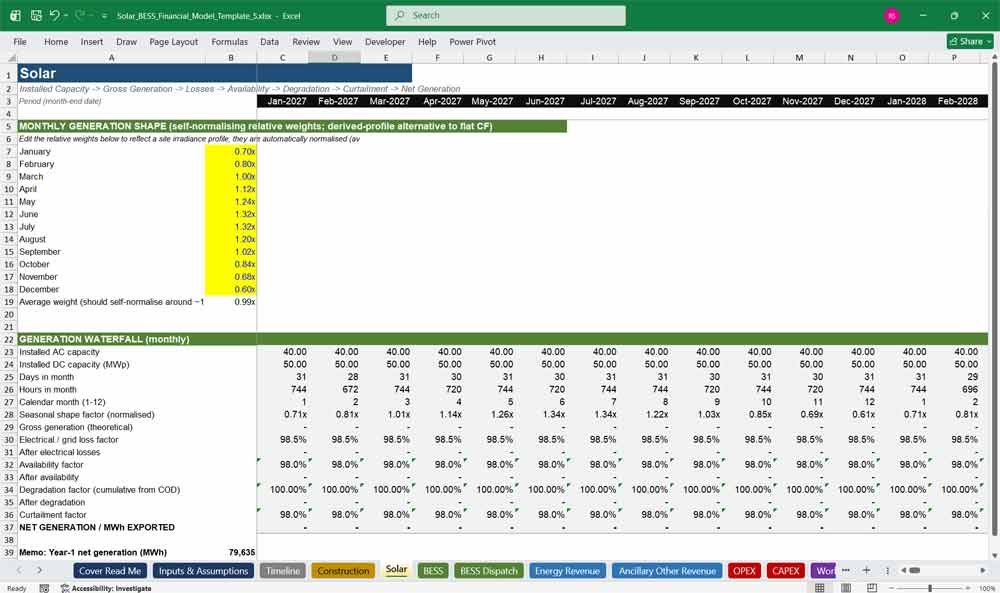
- Integrated Solar PV model covering generation, seasonality, degradation, availability, curtailment, losses, DC/AC ratio and inverter clipping.
- Flexible BESS asset register allowing individual battery containers to be added or removed.
- Container-level BESS assumptions including MW, MWh, efficiency, degradation and augmentation schedules.
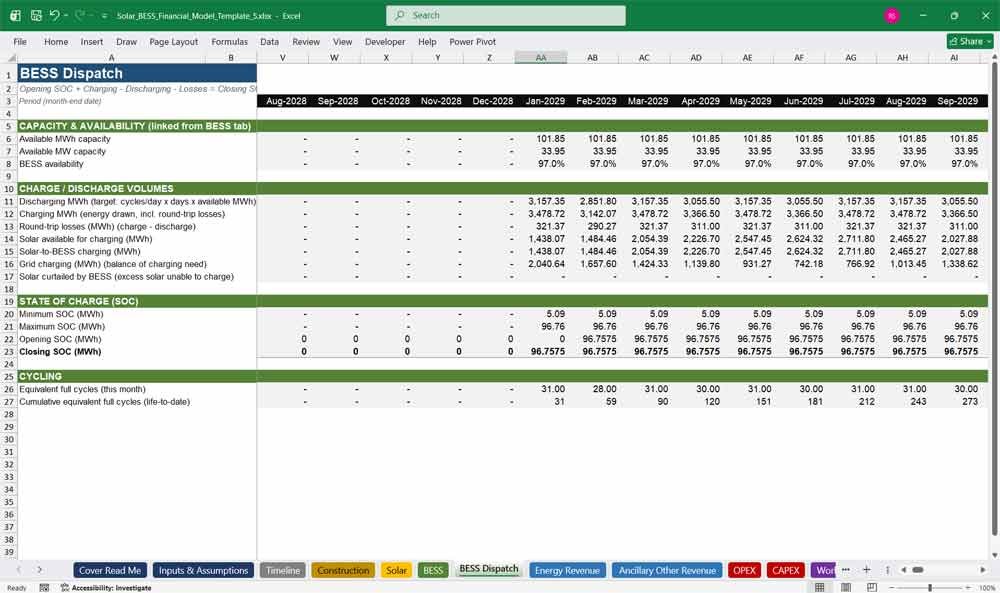
- BESS dispatch model covering charging, discharging, state of charge, losses and equivalent full cycles.
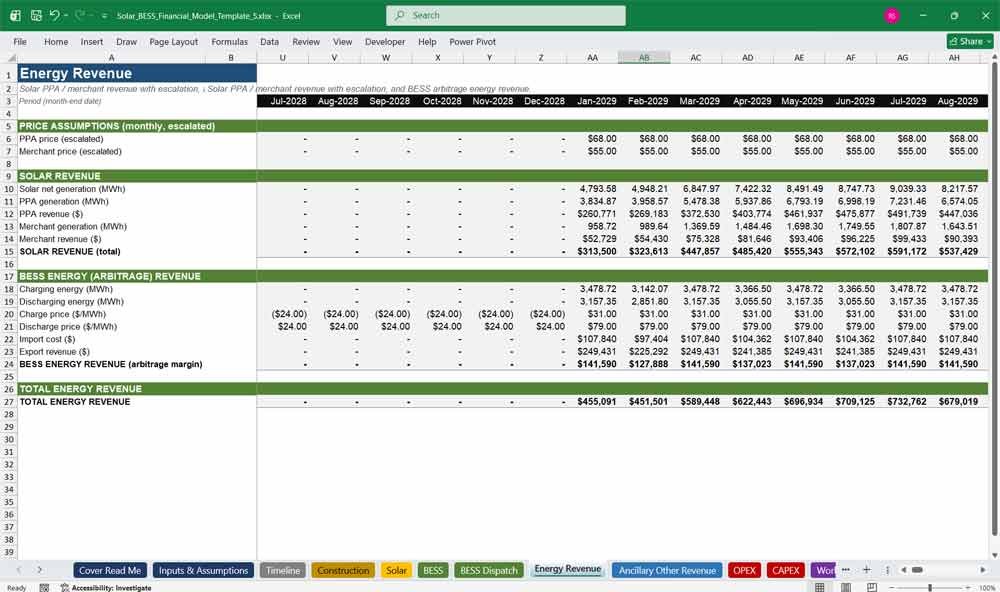
- Energy revenue model for PPA, merchant power and BESS arbitrage revenue.
- Ancillary revenue modules for capacity payments, frequency response, balancing and other grid services.
- Detailed CAPEX model covering solar, BESS, grid connection, EPC, contingency and lifecycle battery CAPEX.
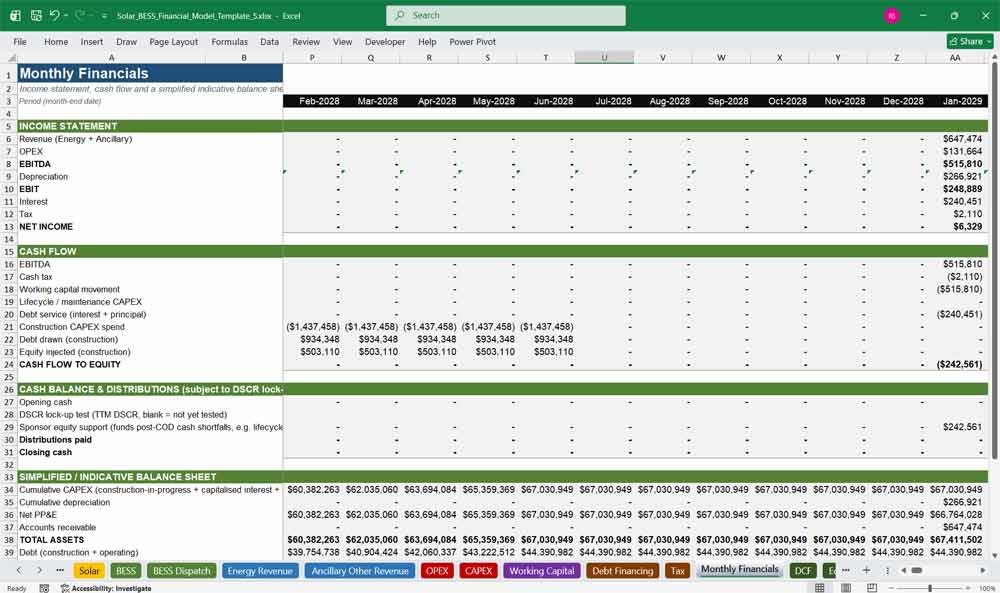
- Construction funding schedule with monthly CAPEX phasing, debt drawdowns, equity injections and capitalised interest.
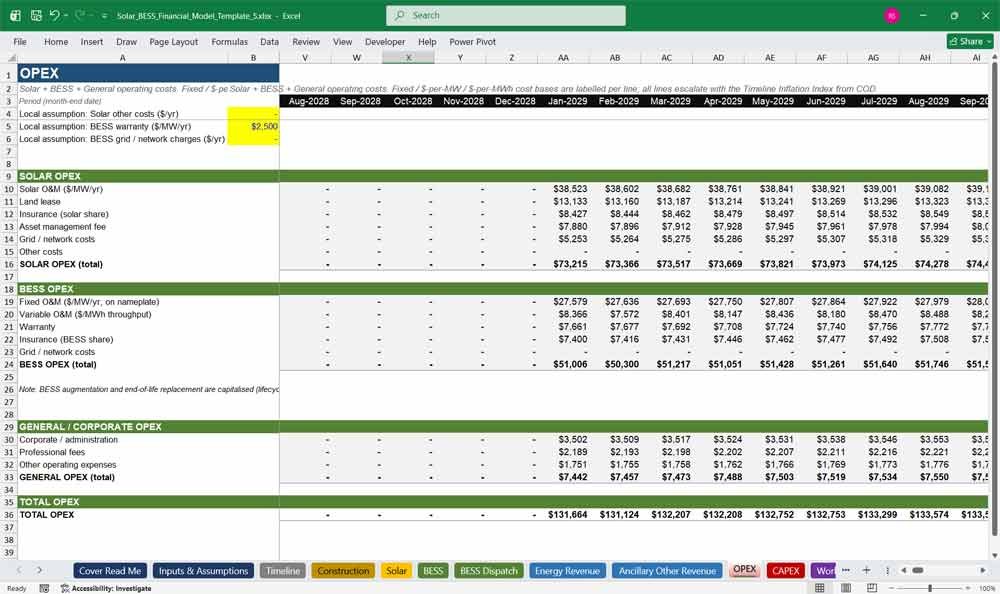
- Detailed OPEX model covering solar and BESS O&M, insurance, land lease, asset management and grid costs.
- Working capital schedule using editable DSO and DPO assumptions.
- Project debt model with debt sculpting, interest, principal repayment, DSCR and LLCR calculations.
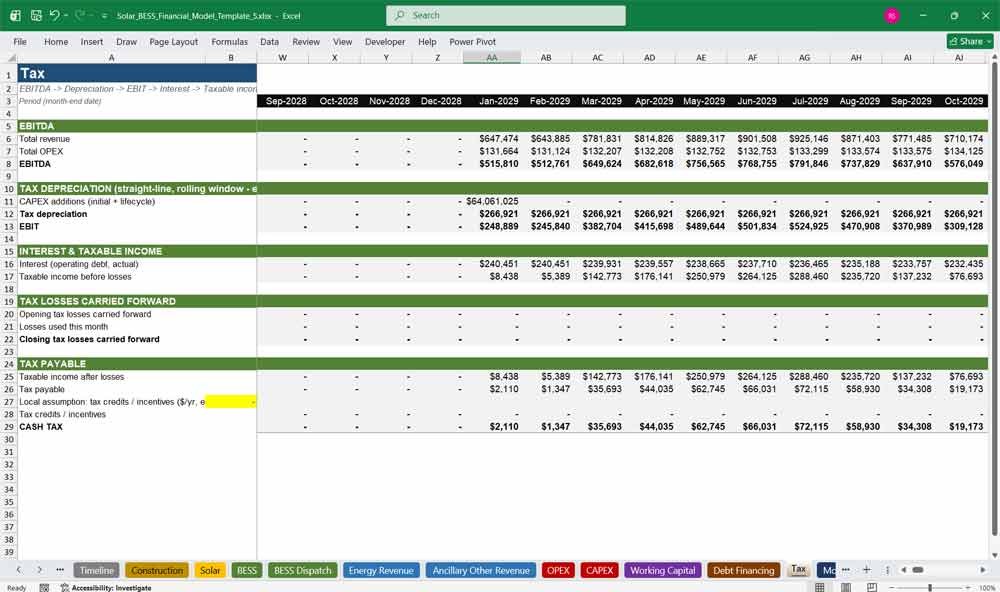
- Tax model covering depreciation, tax losses and cash tax payable.
- Monthly three-statement financial model including income statement, cash flow and balance sheet.
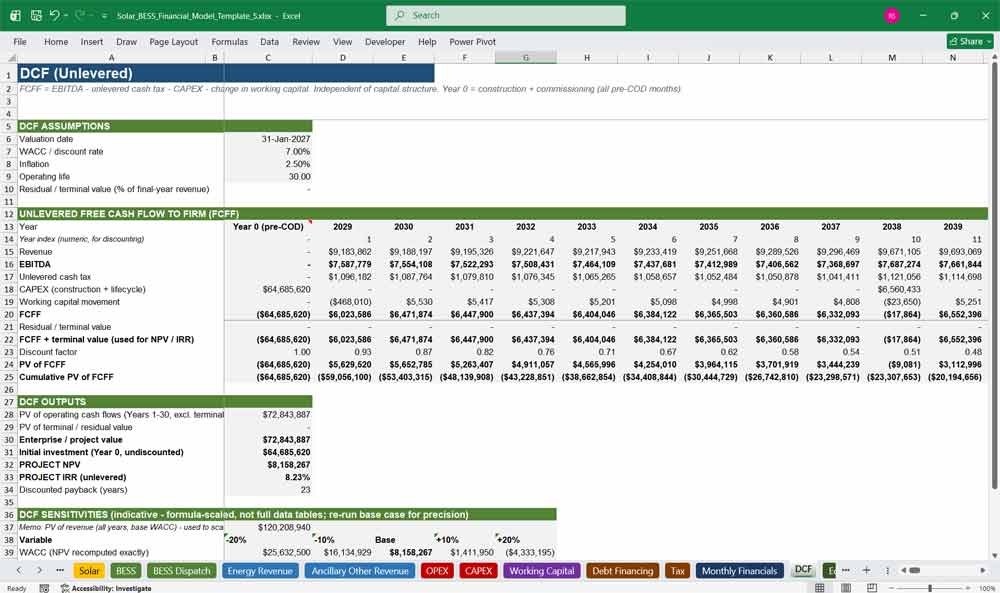
- Dedicated unlevered DCF valuation with Project NPV, Project IRR and discounted payback.
- Dedicated Equity Returns analysis calculating Equity IRR, Equity NPV and equity multiple.
- Scenario and sensitivity analysis covering Downside, Base and Upside cases.
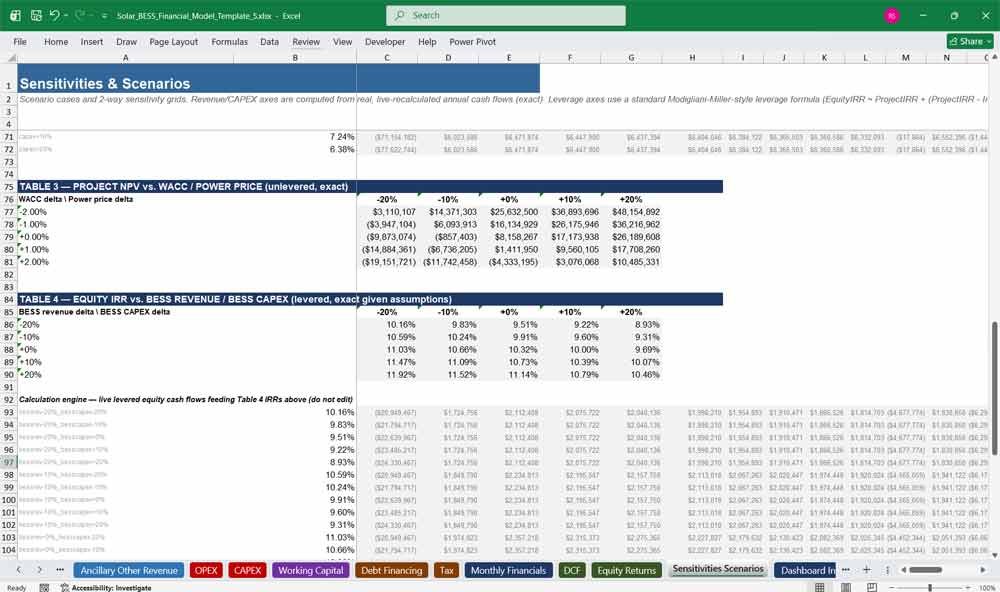
- Live two-way sensitivity tables for power price, CAPEX, leverage and WACC.
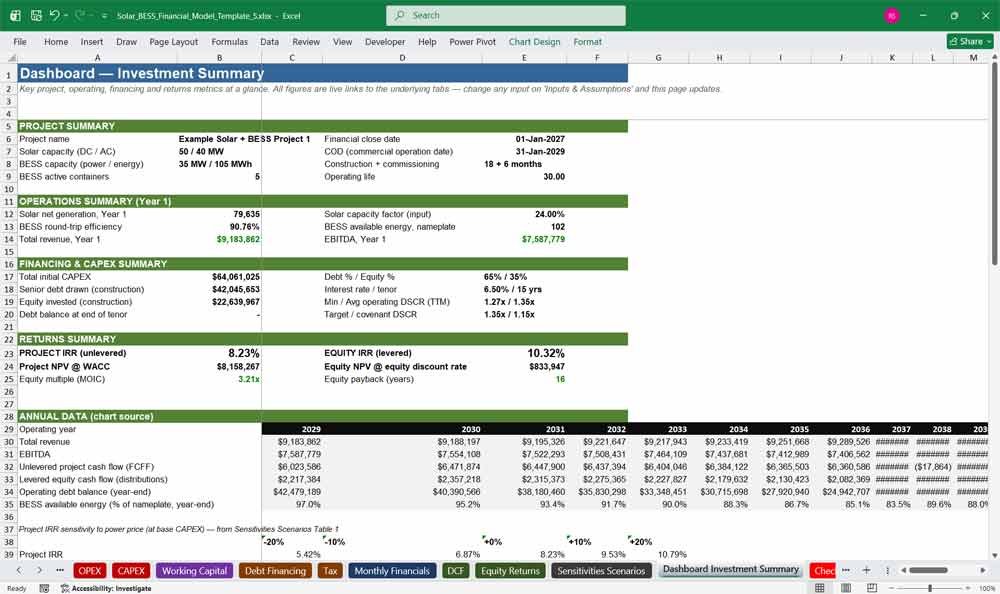
- Investment Dashboard summarising project, operational, financing and return metrics.
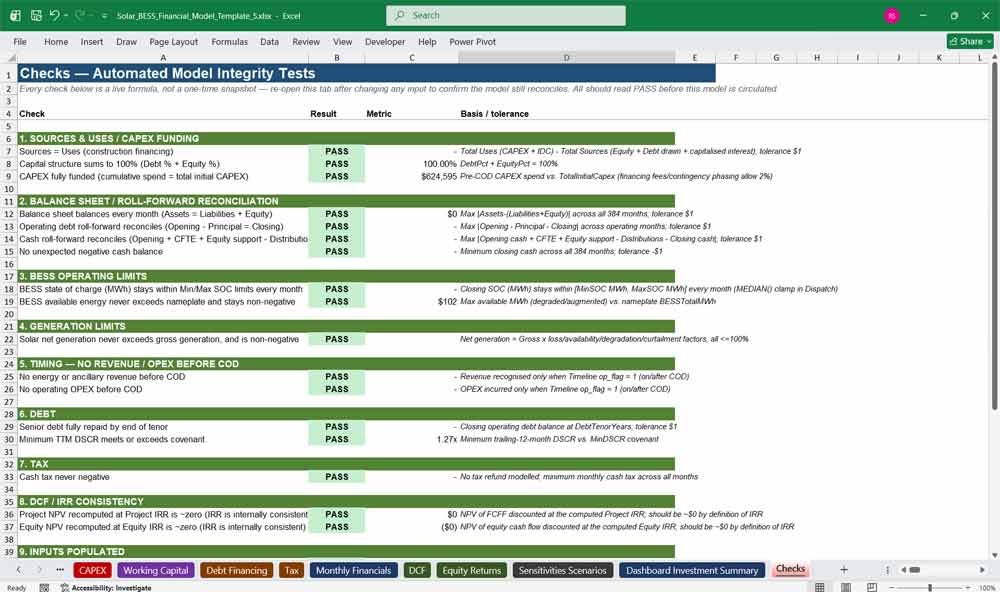
- Automated model Checks tab with 18 integrity tests covering sources and uses, debt, cash, BESS SOC, generation and COD timing.
Who Is This Solar + BESS Financial Model For?
This Excel financial model is suitable for:
- Solar project developers
- Battery energy storage developers
- Renewable energy investors
- Infrastructure funds
- Project finance teams
- Banks and lenders
- Financial advisors and consultants
- Asset managers
- Investment analysts
- Energy and infrastructure students
- Investment committee and board reporting
Build a Complete Solar + Battery Project Finance Model
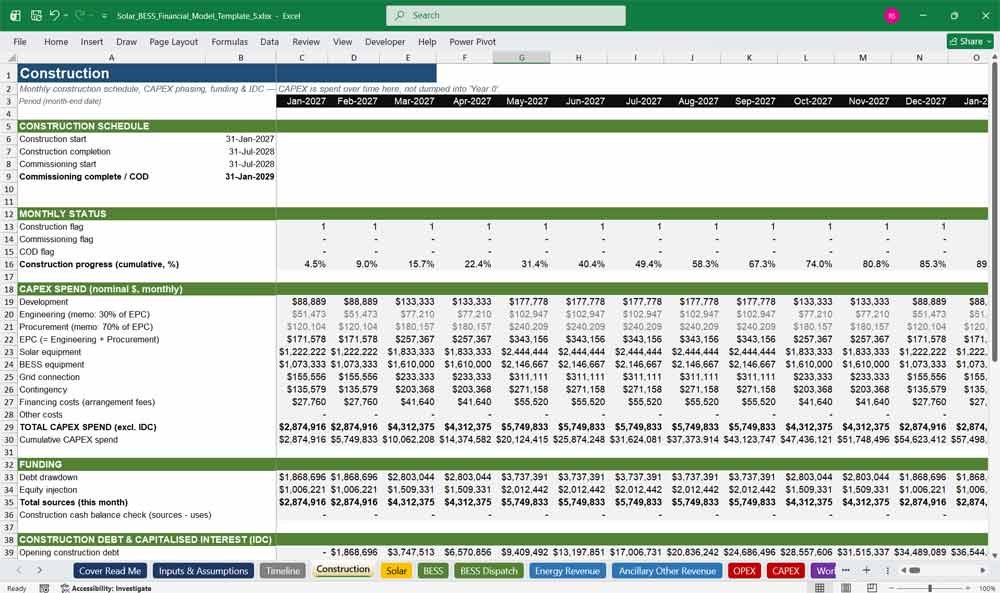
The model brings the entire project lifecycle together in one interconnected workbook — from construction and CAPEX phasing through solar generation, BESS dispatch, revenue, operating costs, financing and tax, through to project valuation and investor returns.
The Construction tab models monthly CAPEX expenditure using an editable S-curve, alongside debt drawdowns, equity funding and interest during construction. The Solar and BESS tabs provide the operational foundation, while the BESS Dispatch tab models battery charging, discharging, SOC and cycling.
Revenue can be split between PPA, merchant solar, BESS arbitrage and ancillary services, allowing different Solar + BESS revenue stacks to be tested. Lifecycle CAPEX, including battery augmentation and replacement, can also be incorporated across the operating period.
Project Finance, DCF & Investment Returns
The model separates unlevered project valuation from levered equity returns, providing a clear view from both the project and sponsor perspectives.
The dedicated DCF tab calculates unlevered free cash flow to the firm, Project NPV, Project IRR and discounted payback using an editable WACC. The Equity Returns tab then calculates levered Equity IRR, Equity NPV and equity multiple after considering debt financing, distributions and sponsor capital requirements.
Debt financing is modelled separately, including target-DSCR debt sculpting, monthly interest and principal repayments, trailing-12-month DSCR testing and LLCR.
Flexible BESS Modelling
Unlike a fixed battery assumption, the model uses an editable BESS asset register. Add or remove battery containers and assign individual MW, MWh, efficiency, degradation and augmentation assumptions.
This allows the template to accommodate different battery configurations, from a single container to a multi-container utility-scale BESS fleet, while automatically recalculating available capacity, dispatch, revenue and lifecycle CAPEX.
Scenario & Sensitivity Analysis
Test the investment case under different market and financing assumptions using built-in Downside, Base and Upside scenarios.
Live two-way sensitivity tables allow you to assess the impact of changes in:
- Power price
- Solar and BESS CAPEX
- Leverage
- WACC
- Project returns
- Equity returns
Every sensitivity cell is based on recalculated model cash flows rather than static outputs.
Investment Dashboard
The Dashboard / Investment Summary provides a one-page overview of the project for investors, lenders, management and investment committees.
Key outputs include:
- Solar capacity
- BESS MW and MWh
- Total CAPEX
- Generation
- Revenue
- EBITDA
- Project IRR
- Equity IRR
- NPV
- Equity multiple
- DSCR
- Debt balance
- BESS degradation
Native Excel charts provide visual analysis of revenue, EBITDA, cash flow, debt paydown, BESS degradation and IRR sensitivity.
Built-In BESS Financial Model Checks
Model integrity is critical when using an Excel financial model for investment or financing decisions. The dedicated Checks tab runs 18 automated PASS/FAIL tests covering key model mechanics.
Checks include:
- Sources and uses reconciliation
- Balance sheet reconciliation
- Debt roll-forward
- Cash roll-forward
- DSCR covenant compliance
- CAPEX funding
- BESS SOC limits
- Generation limits
- COD timing
- Revenue timing
- Debt repayment
A live overall status provides a simple indication of whether the model is ready to circulate.
Why Buy This Solar + BESS Financial Model?
Save significant modelling time with a ready-built Solar + BESS Financial Model Template in Excel designed around the way utility-scale renewable energy projects are actually analysed. Instead of starting with a blank spreadsheet, you get an integrated 20-tab model covering construction, solar generation, BESS, dispatch, revenue, CAPEX, OPEX, financing, tax, DCF valuation, equity returns, sensitivities and model checks. With editable assumptions, a 30-year operating horizon, flexible battery configurations and automated financial checks, the template provides a professional foundation for evaluating project economics, testing investment scenarios and presenting a defensible Solar + BESS investment case.
Frequently Asked Questions About Solar + BESS Financial Models
What is a Solar + BESS financial model?
A Solar + BESS financial model is an Excel-based model used to forecast the technical, operational and financial performance of a solar photovoltaic project combined with Battery Energy Storage Systems (BESS). It brings together solar generation, battery dispatch, energy and ancillary revenues, CAPEX, OPEX, financing, tax and cash flow to calculate project and equity investment returns.
How long does this Solar + BESS financial model cover?
The model uses a monthly 384-period structure, comprising 18 months of construction, 6 months of commissioning and a 30-year operating period. The construction, commissioning and operating-life assumptions are editable, allowing the template to be adapted to different project requirements.
Can I model multiple BESS containers?
Yes. The BESS is designed as a flexible asset register, rather than a single fixed battery assumption. You can add or remove containers and assign individual MW, MWh, efficiency, degradation and augmentation assumptions. Fleet-level capacity and lifecycle calculations then update automatically.
Does the model include BESS degradation and augmentation?
Yes. The BESS model supports individual degradation assumptions and augmentation schedules for each battery container. This allows available MW and MWh capacity, battery performance and lifecycle CAPEX to change throughout the operating period.
Does the model include battery dispatch?
Yes. The BESS Dispatch tab models charging, discharging, state of charge, round-trip losses and equivalent full cycles. Solar-to-BESS charging and grid charging can also be separated within the model.
Does the model include a DCF valuation?
Yes. A dedicated DCF tab calculates unlevered free cash flow to the firm, Project NPV, Project IRR and discounted payback. The DCF is kept separate from the financing structure so that project valuation can be assessed independently of debt and equity.
Can I calculate Equity IRR?
Yes. The dedicated Equity Returns tab calculates levered equity cash flows, Equity IRR, Equity NPV, equity multiple (MOIC) and payback after considering debt financing, distributions and sponsor capital requirements.
Does the financial model include project debt?
Yes. The Debt Financing tab includes debt drawdowns, interest, principal repayments, debt sculpting and DSCR analysis. Senior debt can be sculpted to a target DSCR, with minimum and average DSCR and LLCR calculated within the model.
Can I test different Solar + BESS scenarios?
Yes. The model includes Downside, Base and Upside scenarios, together with live two-way sensitivity analysis. Key variables such as power price, CAPEX, leverage and WACC can be tested to understand their impact on Project IRR and Equity IRR.
Is the model suitable for lender or investment analysis?
The template is designed to provide a structured basis for project finance and investment analysis, with separate project-level DCF, equity returns, debt metrics and automated integrity checks. It can be used as a starting point for underwriting, investment committee analysis, lender analysis and financial presentations.
Does the model include construction CAPEX?
Yes. The Construction and CAPEX tabs model monthly capital expenditure during the construction period, including solar, BESS, grid connection, EPC, contingency and other project costs. Debt drawdowns, equity injections and capitalised interest are also incorporated.
Does the model include automated checks?
Yes. A dedicated Checks tab contains 18 automated integrity tests covering key areas including sources and uses, balance sheet reconciliation, debt and cash roll-forwards, BESS SOC limits, generation limits and COD timing.
Final Notes on the Financial Model
This 20 Year 18 month construction, 6 month commissioning and 30 year operations Solar + BESS Supplier Financial Model focuses on balancing capital expenditures with steady revenue growth from a diversified product line. By optimizing operational costs, and power efficiency, and maximizing high-margin sales, the models ensure sustainable profitability and cash flow stability.
Download Link On Next Page