
Air Conditioning Financial Model Template
The Air Conditioning Supplier Financial Model is a fully integrated, 5-year monthly Excel financial model built for HVAC distributors, air conditioning wholesalers, importers and installers. It forecasts revenue, cost of sales, operating expenses, working capital, capex, debt, and the three financial statements: Income Statement, Balance Sheet and Cash Flow Statement. Everything runs from one assumptions tab, so you can build a lender-ready HVAC business plan in hours instead of weeks.
5 Year Financial Model for an Air Conditioning Supplier
Revenue is built bottom-up across 14 product and service segments: residential, commercial and industrial air conditioning, portable units, split and multi-split systems, VRF/VRV, ducted systems, chillers, heat pumps, accessories, spare parts, installation and maintenance. Revenue is also split across seven sales channels, from wholesale and contractors to government contracts and online. Monthly seasonality reflects the summer peak in AC demand. Landed costs cover freight, import duty, FX and supplier rebates, so your margins reflect how an air conditioning supply business really trades.
The model is designed for business owners, investors, banks and consultants. It follows professional financial modelling standards: colour-coded inputs, formula-driven dates, Base/Upside/Downside scenarios, an automatic revolving credit facility, and 23 integrity checks that confirm the Balance Sheet balances every month. Change the model start date once and the whole 60-month timeline re-dates automatically. That makes it a reusable air conditioning business plan template for startup funding, bank loans, acquisitions or annual budgeting.
What’s Inside: Tab-by-Tab Overview
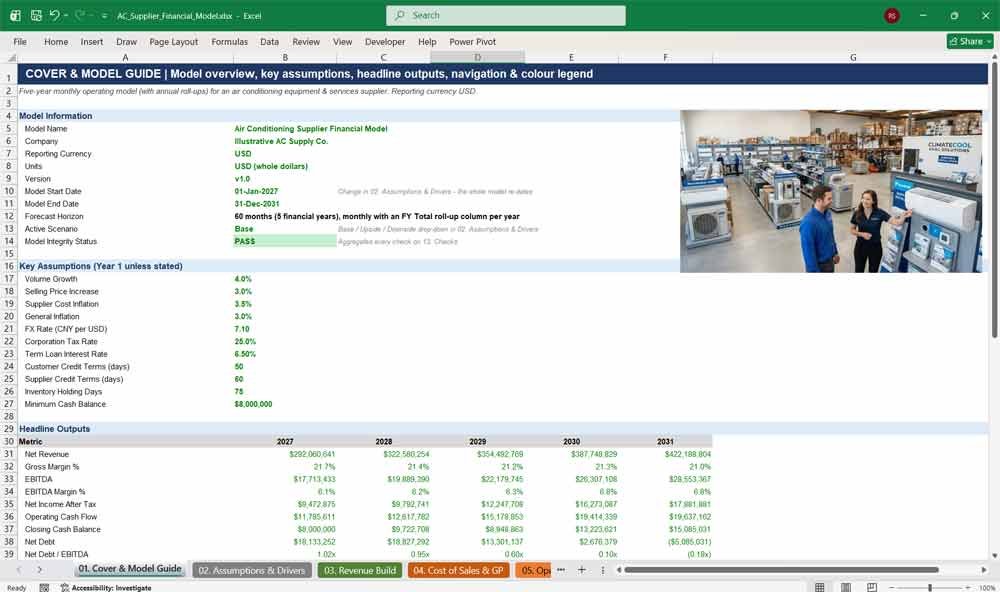
01. Cover & Model Guide
Your HVAC financial model’s control centre. The cover shows model details, the active scenario, headline five-year outputs and a live integrity status, plus clickable navigation to every tab. A colour legend and step-by-step guide help any user get started immediately.
- Live PASS / REVIEW model integrity status
- Headline outputs: revenue, gross margin, EBITDA, net income, cash and net debt by year
- Hyperlinked navigation to all 13 tabs
- Colour legend: inputs, formulas and cross-tab links
- Quick-start “How to Use the Model” guide
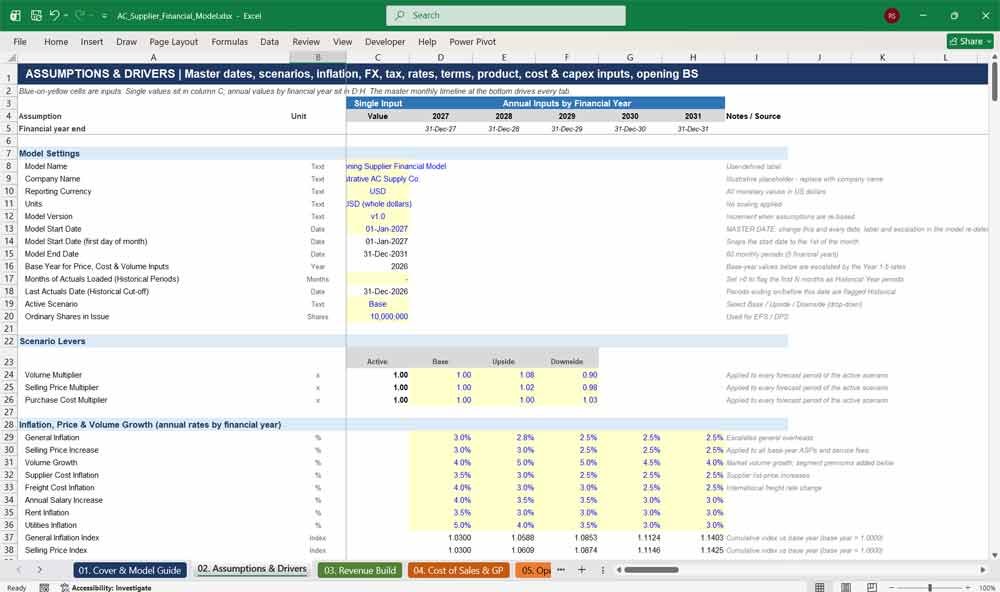
02. Assumptions & Drivers
Every input for the air conditioning supplier forecast lives here. You set inflation, selling price increases, volume growth, supplier cost inflation, FX rates, tax, interest rates and payment terms in one place, with yearly inputs and a master start date that re-dates the entire model.
- Single Model Start Date drives every date, label and escalation
- Base / Upside / Downside scenario selector (drop-down)
- Annual inflation, price, volume, salary, rent and utilities indices
- FX rate impact on imported purchase costs
- Product table: units, growth premium, ASP, unit cost and opening inventory for 12 product lines
- Opening balance sheet with automatic balancing check
Air Conditioning Supplier Revenues & Capex
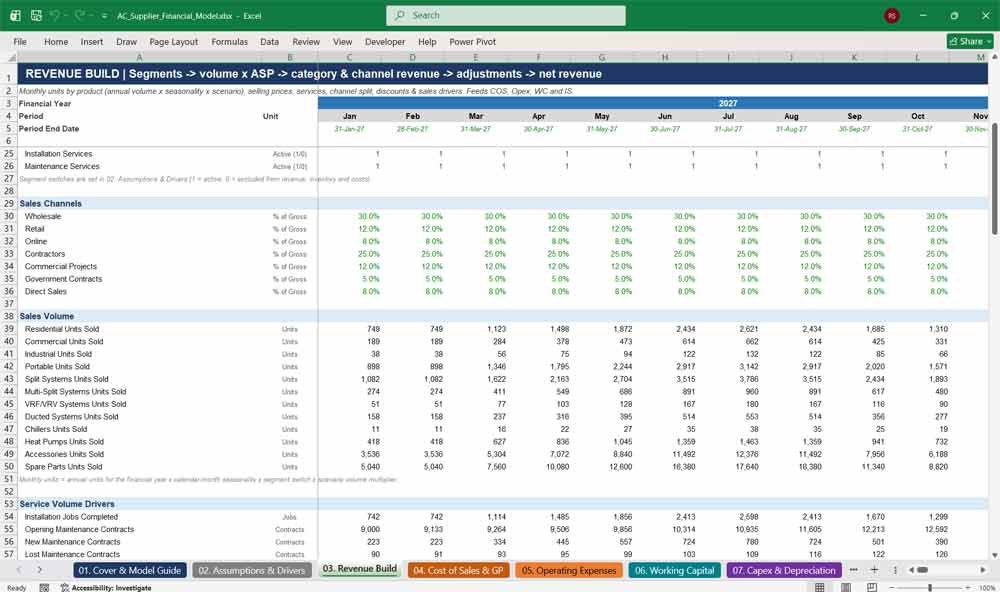
03. Revenue Build
A bottom-up air conditioning sales forecast. Monthly units for 12 product lines are multiplied by average selling prices and combined with installation and maintenance revenue, then split by sales channel. Discounts, rebates and returns bring you to net revenue, with seasonality applied.
- 14 revenue segments with on/off switches
- 7 sales channels: Wholesale, Retail, Online, Contractors, Commercial Projects, Government, Direct
- Units sold x average selling price for every product line
- Maintenance contract base with new contracts and churn
- Sales discounts, volume rebates, returns, allowances and credit notes
- Customer metrics: active customers, retention, revenue per customer, order backlog
- Monthly seasonality profile reflecting peak summer AC demand
- Revenue reconciliation check: product vs channel
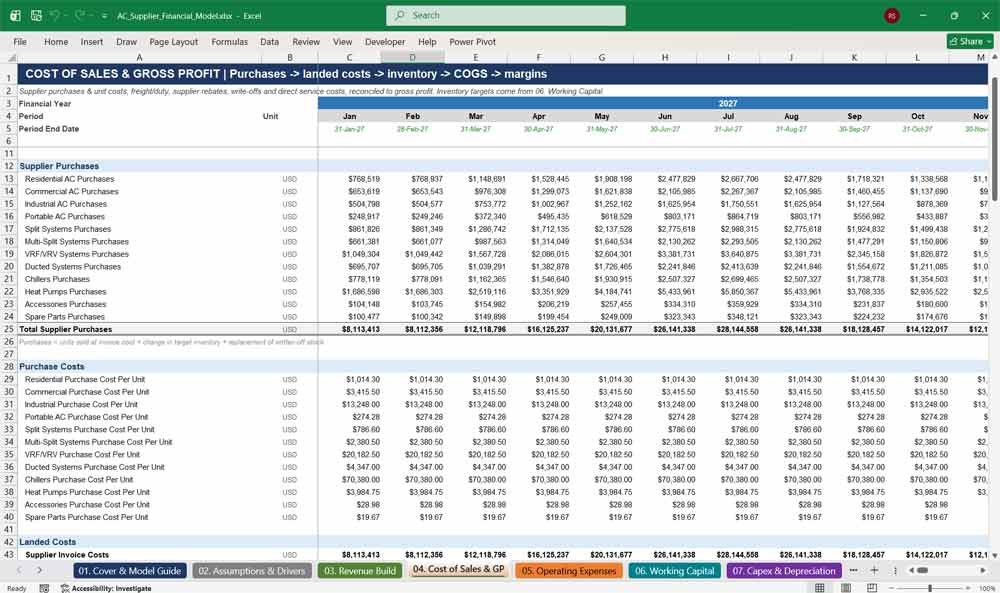
04. Cost of Sales & Gross Profit
This tab calculates true landed cost for an HVAC importer and distributor. Supplier purchases, freight, import duties, customs, port charges and insurance flow into cost of goods sold, net of supplier rebates and inventory write-offs, producing product, service and total gross margins.
- Supplier purchases and purchase cost per unit for all 12 product lines
- Full landed cost build: international freight, domestic freight, duty, customs, port, insurance and inspection
- Supplier rebates, volume discounts, early-payment discounts and credit notes
- Inventory write-downs, obsolescence, damage and shrinkage
- Direct costs for installation labour, subcontractors, warranty and delivery
- Gross margin % for every product and service line
- Gross profit and gross margin reconciliation checks
05. Operating Expenses
A detailed overhead budget for an air conditioning supply business. It covers employee costs by department, premises, sales and marketing, logistics and distribution, administration and other expenses, with inflation-linked escalation. Depreciation is included, and the tab builds through to EBITDA and operating profit.
- Headcount x salary for six departments, plus NI, pension, benefits and bonuses
- Warehouse, showroom and office rent, utilities and premises costs
- Marketing budget allocated across digital, SEO, trade shows and promotions
- Logistics costs: outbound freight, fuel, vehicles and couriers
- Administrative, professional, compliance and R&D expenses
- EBITDA, EBITDA margin, EBIT and operating margin
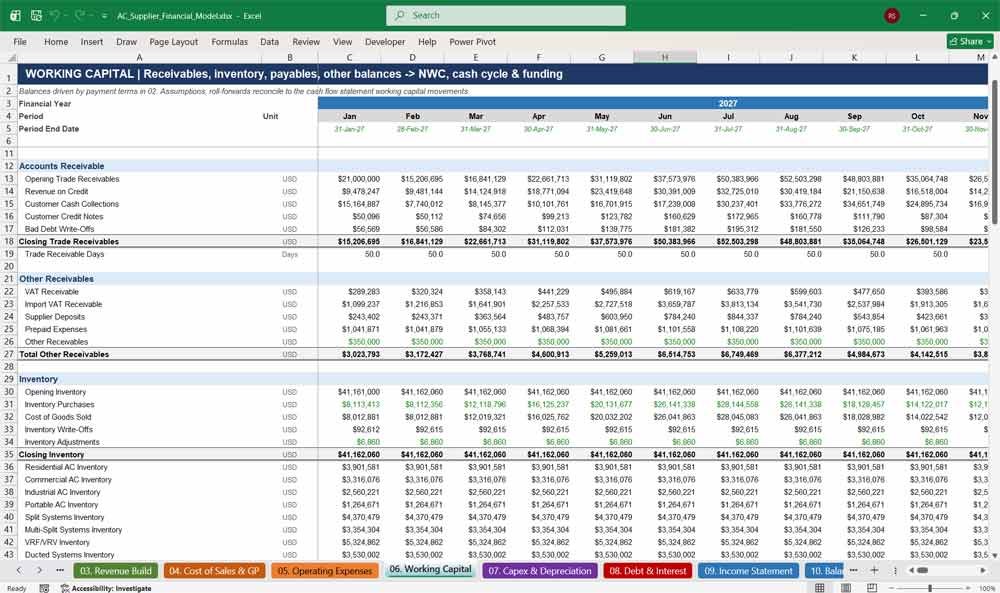
06. Working Capital
This tab models the cash tied up in stock and receivables, which is critical for any seasonal HVAC distributor. It covers trade receivables, inventory by product, trade payables and other balances, and shows the full cash conversion cycle and the peak seasonal funding requirement.
- Receivables, inventory and payables roll-forwards
- Inventory held for each of the 12 product lines
- Inventory days, turnover, safety stock and stock cover
- VAT, import VAT, supplier deposits, prepayments and accruals
- Customer deposits, deferred maintenance revenue and warranty provisions
- Cash conversion cycle (DIO + DSO − DPO)
- Peak seasonal working capital funding requirement
07. Capex & Depreciation
This tab plans warehouse expansion, racking, forklifts, delivery vehicles, IT, software and showroom fit-outs over five years. Straight-line depreciation is tracked by asset class and by the month each asset was purchased. Disposals, gains and losses, and a full fixed asset register feed the financial statements.
- 12 capital expenditure categories
- 8 asset classes with individual useful lives
- Vintage-tracked straight-line depreciation (each month’s capex depreciated separately)
- Asset disposals with proceeds and gain/loss on disposal
- Maintenance vs growth capex split
- Capex-to-depreciation ratio and average asset age
- Fixed asset roll-forward check
Air Conditioning Supplier Financial Statements
08. Debt & Interest
Complete debt modelling for an air conditioning business: term loans, a revolving credit facility, an overdraft and leases. The RCF draws and repays automatically to keep a minimum cash balance. Interest, fees, leverage, interest cover, DSCR and covenant headroom are all calculated.
- Term loan, RCF, overdraft and lease schedules
- Automatic cash sweep: the RCF funds shortfalls and repays from surplus cash
- Interest expense, arrangement fees and commitment fees
- Interest rate stress-test input
- Net Debt / EBITDA, Interest Coverage and DSCR on a last-twelve-months basis
- Facility headroom and covenant headroom tracking
- Debt roll-forward check
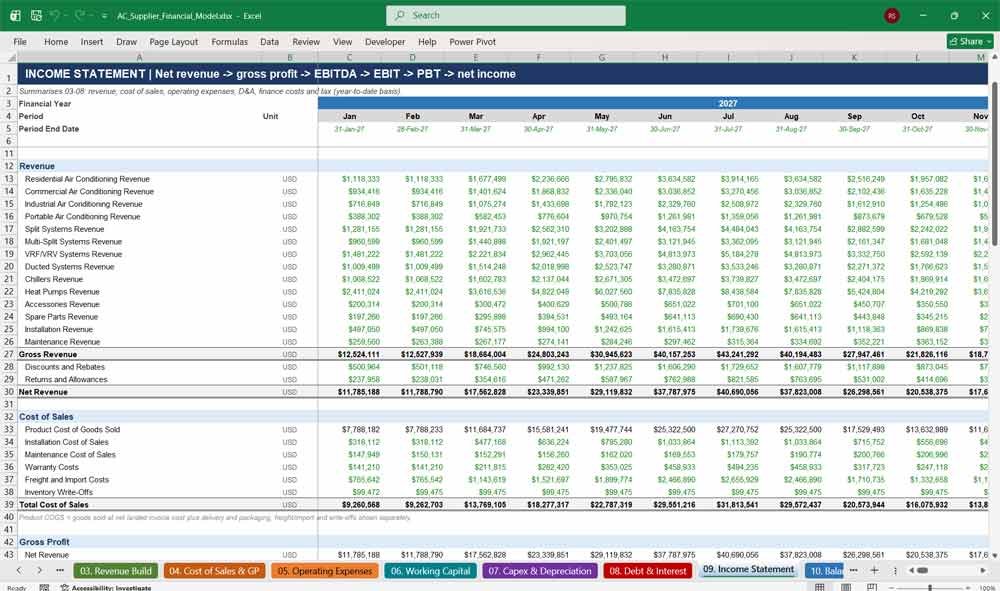
09. Income Statement
A full monthly and annual profit and loss statement for an HVAC supplier. It runs from gross revenue by segment, through cost of sales, gross profit, EBITDA, depreciation and finance costs, to profit before tax, corporation tax and net income, with margins and per-share metrics.
- Revenue for all 14 product and service lines
- Cost of sales breakdown, including warranty, freight and write-offs
- EBITDA, EBIT, profit before tax and net income
- Gross, EBITDA, operating and net margins
- Year-to-date corporation tax with deferred tax
- Earnings per share and dividends per share
10. Balance Sheet
A fully integrated monthly balance sheet showing fixed assets, cash, receivables, inventory, payables, tax, debt and equity. It is linked to every supporting schedule, splits current and long-term debt, and includes balance sheet checks that confirm assets equal liabilities plus equity in every period.
- Non-current and current assets, liabilities and equity
- Current vs long-term split of loans and leases
- Retained earnings roll-forward with dividends
- Net working capital, net current assets and net debt
- Current ratio and quick ratio
- Balance check plus retained earnings, fixed asset and debt reconciliation checks
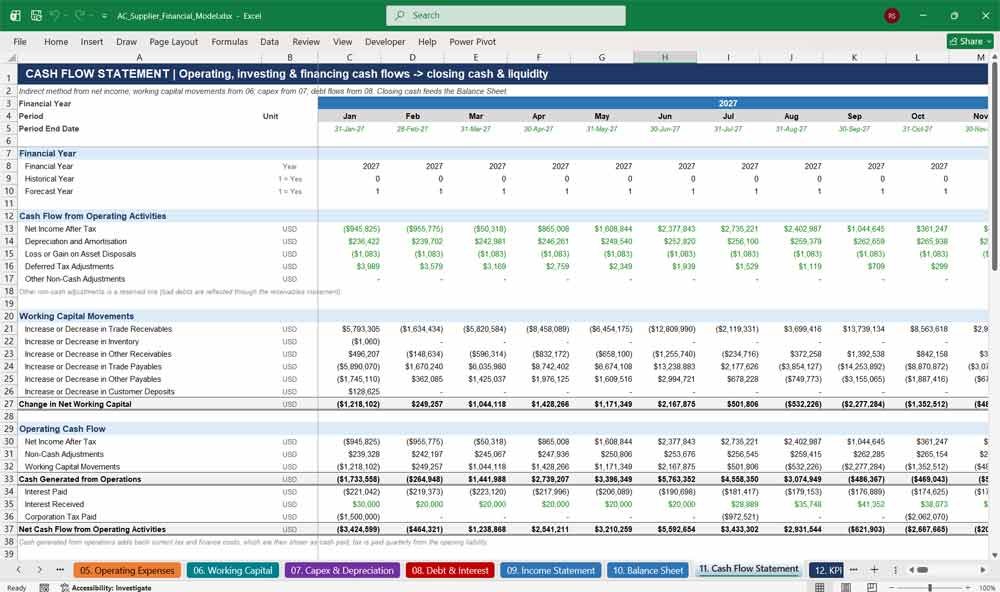
11. Cash Flow Statement
An indirect-method cash flow statement for an air conditioning distributor. It shows operating cash flow after working capital movements, interest and tax, investing cash flows from capex and disposals, and financing flows from debt and dividends, through to closing cash and total available liquidity.
- Net income to cash generated from operations
- Detailed working capital movements
- Quarterly corporation tax payments
- Capex by category and disposal proceeds
- Debt drawdowns, repayments, share issues and dividends
- Minimum cash, available facilities and peak funding requirement
- Closing cash reconciliation checks
Key Financial Metrics for an Air Conditioning Supplier
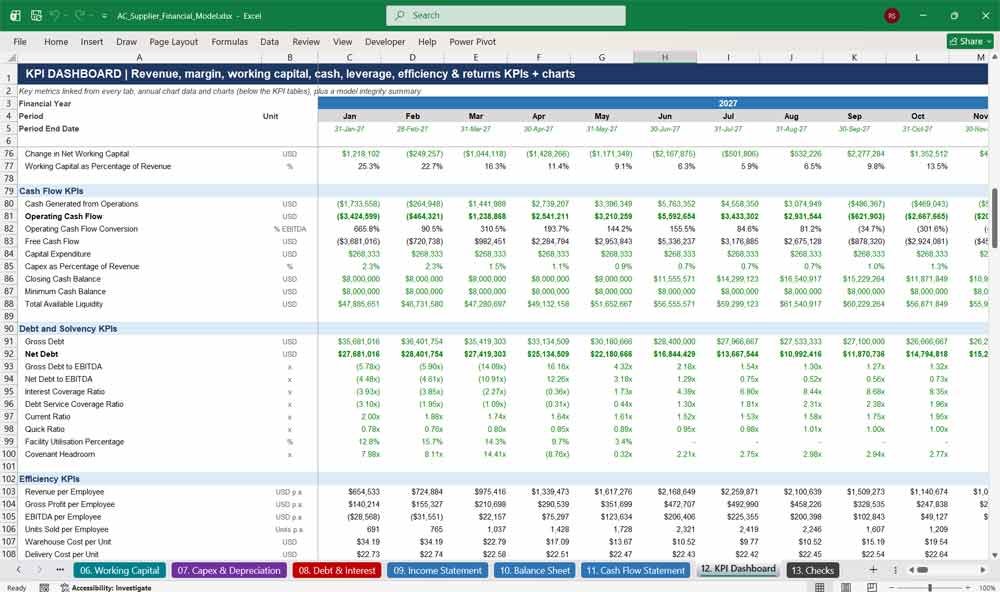
12. KPI Dashboard
An at-a-glance performance dashboard for your HVAC business plan. It brings together more than 70 KPIs for revenue, gross profit, operating performance, working capital, cash flow, debt and solvency, efficiency and returns, plus ten ready-made Excel charts for presentations to investors and lenders.
- Revenue, units, ASP, retention and backlog KPIs
- Gross margin, EBITDA margin and net margin trends
- Receivable, inventory and payable days, and the cash conversion cycle
- Free cash flow, operating cash conversion and liquidity
- Leverage, interest cover, DSCR and covenant headroom
- ROCE, ROIC, ROA, ROE and per-employee metrics
- 10 charts, including revenue mix by product and channel, and a scenario comparison
13. Checks
The model’s quality-control tab. It collects 23 reconciliations from across the workbook into one PASS/REVIEW flag for every month and year, so you and your lender can trust every number in the air conditioning supplier financial forecast.
- 23 automated integrity checks across every tab
- Balance Sheet, cash flow, debt, fixed asset and working capital tie-outs
- Revenue and gross profit reconciliations
- Input checks: seasonality, channel mix and budget allocations must total 100%
- Failing-check counter and PASS/REVIEW status for each period
- Failing cells are highlighted automatically in red
Why Buy This Model?
Building a credible financial forecast for an air conditioning supply business from scratch takes weeks, and one broken formula can undermine your credibility with a bank or investor. This model gives you a professionally structured, fully integrated 5-year monthly forecast designed specifically for the HVAC sector. It covers seasonal demand, imported landed costs, FX exposure, supplier rebates, heavy inventory requirements and service revenue from installation and maintenance contracts. Every forecast number is formula-driven from one assumptions tab, and three scenarios let you stress-test your plan instantly. Automatic revolver funding shows exactly how much finance you need through the summer peak, and 23 built-in checks confirm the Balance Sheet balances in every period. Whether you are raising a bank loan, pitching to investors, valuing an acquisition or setting next year’s budget, you get a ready-to-use, presentation-quality model that you can adapt to your own business in hours, not weeks.
Air Conditioning Supply Frequently Asked Questions
Q: I run a small HVAC distributor, not a large wholesaler. Will this model work for my business?
A: Yes. All the volumes, prices, costs and headcount figures are inputs, so you can scale the model to any size. You can also switch off product segments you don’t sell (for example chillers or VRF/VRV systems) by setting them to 0 on the Assumptions tab.
Q: I only sell equipment and don’t offer installation or maintenance. Can I remove those?
A: Yes. Installation Services and Maintenance Services each have an on/off switch. Turn them off and the related revenue, direct costs, deferred revenue and margins drop out automatically.
Q: What if my financial year doesn’t start in January?
A: Just change the Model Start Date on the Assumptions tab. Every month, year label, financial year column, seasonality pattern and escalation updates automatically across all 13 tabs.
Q: Is the forecast monthly or annual?
A: Both. The model forecasts 60 months (five financial years) with an FY Total column after each year. You can collapse the monthly columns to view annual figures only.
Q: Can I add my historical actuals?
A: Yes. Set the number of months of actuals loaded on the Assumptions tab, and those periods are flagged as Historical Year throughout the model. The opening balance sheet takes your last actual position.
Q: How does the model handle seasonality? Air conditioning sales peak in summer.
A: There is a monthly seasonality profile (January to December) that you can edit. By default it weights sales towards June to August. It drives units sold, customer acquisition and working capital, so the model shows your peak seasonal funding requirement.
Q: I import most of my stock. Does the model handle freight, duty and exchange rates?
A: Yes. The Cost of Sales tab builds a full landed cost: international and domestic freight, import duty, customs clearance, port handling, cargo insurance, inbound warehousing and inspection. FX rates adjust the cost of foreign-currency purchases, and you set what share of purchases is invoiced in foreign currency.
Q: Will it show how much funding I need?
A: Yes. A revolving credit facility draws automatically whenever cash would fall below your minimum cash balance, and repays from surplus cash. An overdraft is used if the RCF limit is reached. The Cash Flow tab shows the peak funding requirement and total available liquidity.
Q: Can I run best-case and worst-case scenarios?
A: Yes. Choose Base, Upside or Downside from a drop-down. Each scenario applies its own volume, selling price and purchase cost multipliers, which you can edit. There is also an interest rate stress input on the Assumptions tab.
Q: Is this model suitable for a bank loan application or investor pitch?
A: Yes. It produces an integrated Income Statement, Balance Sheet and Cash Flow Statement, plus the metrics lenders look for: Net Debt/EBITDA, Interest Coverage, DSCR, covenant headroom and liquidity. The KPI Dashboard includes ten charts you can drop into a presentation.
Q: How do I know the model is working correctly?
A: The Checks tab runs 23 reconciliations in every period, including the balance sheet balancing, cash reconciliation and debt and fixed asset roll-forwards. It shows a PASS or REVIEW status, which also appears on the cover page.
Q: Do I need advanced Excel skills to use it?
A: No. You only edit the blue-on-yellow input cells on the Assumptions tab. Everything else is calculated automatically. A colour legend and quick-start guide on the cover explain how the model works.
Q: Which software do I need?
A: Microsoft Excel. The model uses standard Excel functions with no macros, so there is no VBA to enable.
Q: Can I change the product lines or sales channels?
A: Yes. You can rename labels, change the channel mix percentages, adjust each product’s base units, growth premium, selling price and unit cost, or switch segments off. All formulas are unlocked if you want to customise further.
Q: Which currency is the model in?
A: The model reports in US dollars, but you can relabel the currency on the Assumptions tab. All values are inputs, so you can enter figures in any currency.
Q: Does the model include tax and dividends?
A: Yes. Corporation tax is calculated on year-to-date profit and paid quarterly, deferred tax arises from capital allowances, and dividends are declared each year from a payout ratio you set. VAT and payroll taxes are included on the Balance Sheet.
Q: Are the numbers in the model real company data?
A: No. The model comes pre-filled with illustrative figures for a mid-sized air conditioning distributor, so you can see how it works. Replace them with your own figures to produce your forecast.
Final Notes on the Financial Model
These 5 Year Air Conditioning Service Financial Models focus on balancing capital expenditures with steady revenue growth from diversified subscription-based services. By optimizing operational costs, and power efficiency, and maximizing high-margin services land managed offerings, these models ensures sustainable profitability and cash flow stability.
Download Link On Next Page