
Air Cargo Hub Financial Model Template Excel
This Air Cargo Hub Financial Model is a complete, lender-ready Excel template for planning, financing and valuing an airport cargo development. It covers a cargo terminal, coldstore warehouse, customs and border control facility, storage warehouse and shared site infrastructure. The model brings construction capex, cargo demand, tariffs, operating costs, debt, tax and investor returns into one integrated workbook. Whether you are preparing a feasibility study, an investment memorandum or a bank financing case, this air cargo terminal financial model gives you a clear, defensible view of project economics.
30-Year Financial Model for an Air Cargo Hub
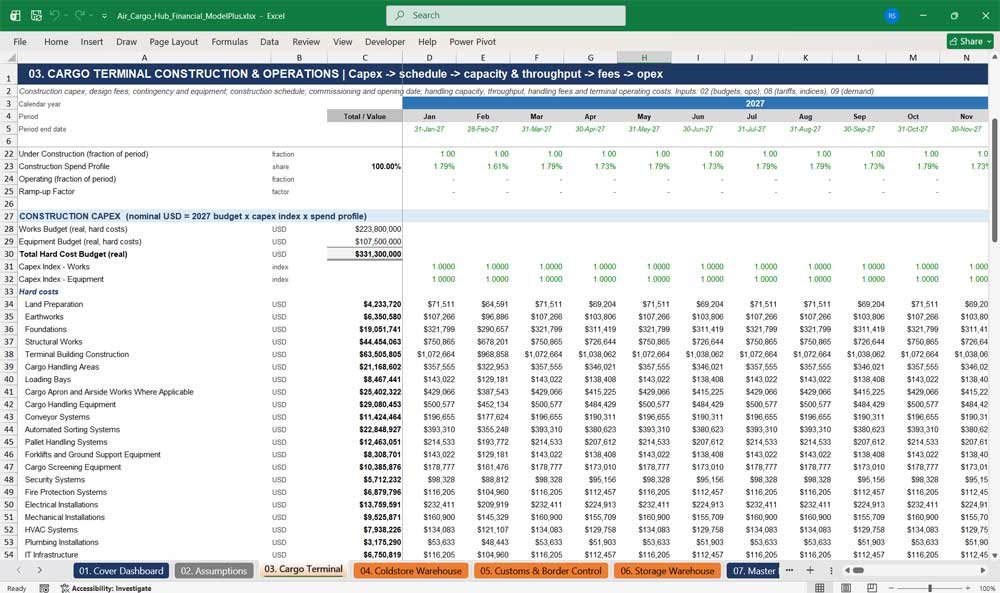
This model runs over a 35-year horizon: a five-year phased construction period modelled monthly, followed by 30 years of operations. Operations Years 1–5 are monthly with full-year totals, and Years 6–30 are annual. Each facility opens on its own commissioning date, so revenue, staffing and costs phase in realistically as the hub comes online. Every date in the workbook comes from a single Model Start Date. Change it once and every schedule, label and escalation index updates automatically.
The model covers:
- Cargo Terminal Construction & Operations
- Coldstore Warehouse Construction & Operations
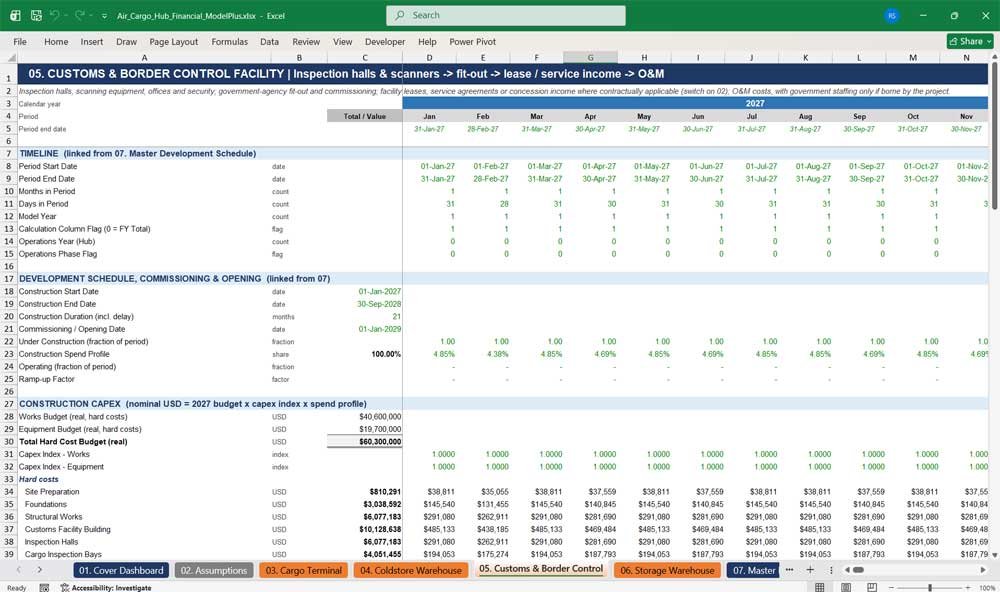
- Customs & Border Control Facility Construction & Operations
- Storage Warehouse Construction & Operations
Built to the standards that project finance lenders, infrastructure funds and airport operators expect, the workbook links the income statement, cash flow statement and balance sheet in every period. It includes senior and subordinated debt, capitalised interest, a debt service reserve account (DSRA), a major maintenance reserve account (MMRA), DSCR and LLCR covenants, corporate tax, VAT and deferred tax. You also get project and equity IRR, NPV, payback, Base, Upside and Downside scenarios, sensitivity analysis and over 100 automated integrity checks.
What’s Inside: Tab-by-Tab Guide
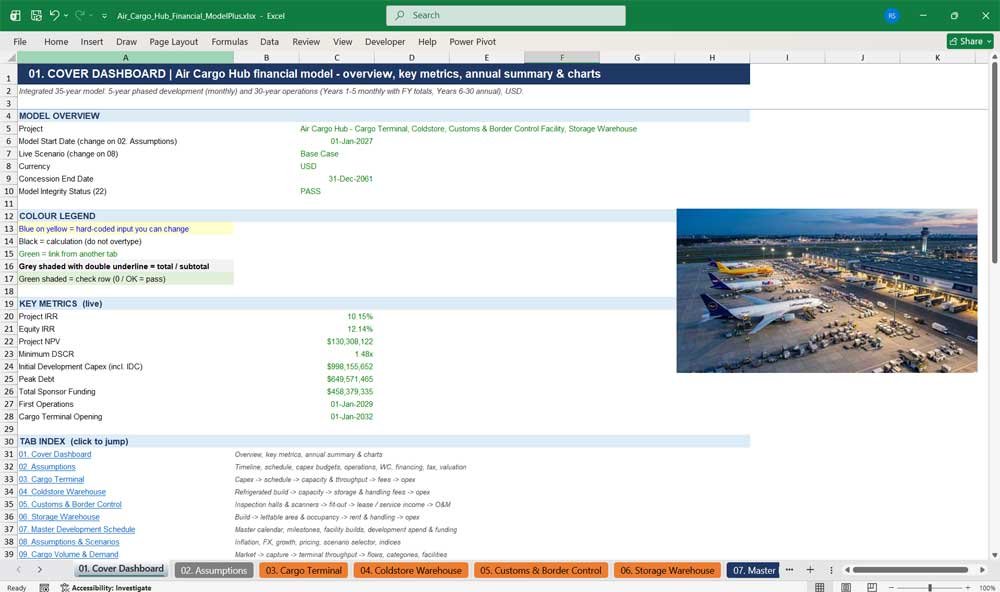
01. Cover Dashboard
The cover dashboard summarises the whole air cargo hub investment on one page. It shows project IRR, equity IRR, NPV, minimum DSCR, peak debt and opening dates, plus an annual summary table and charts that investors and lenders can read at a glance.
- Live key metrics for the selected scenario
- 35-year annual summary of revenue, EBITDA, capex, CFADS, debt and cash
- Revenue, EBITDA, debt and capex charts
- Clickable index to every tab, plus a colour-code legend
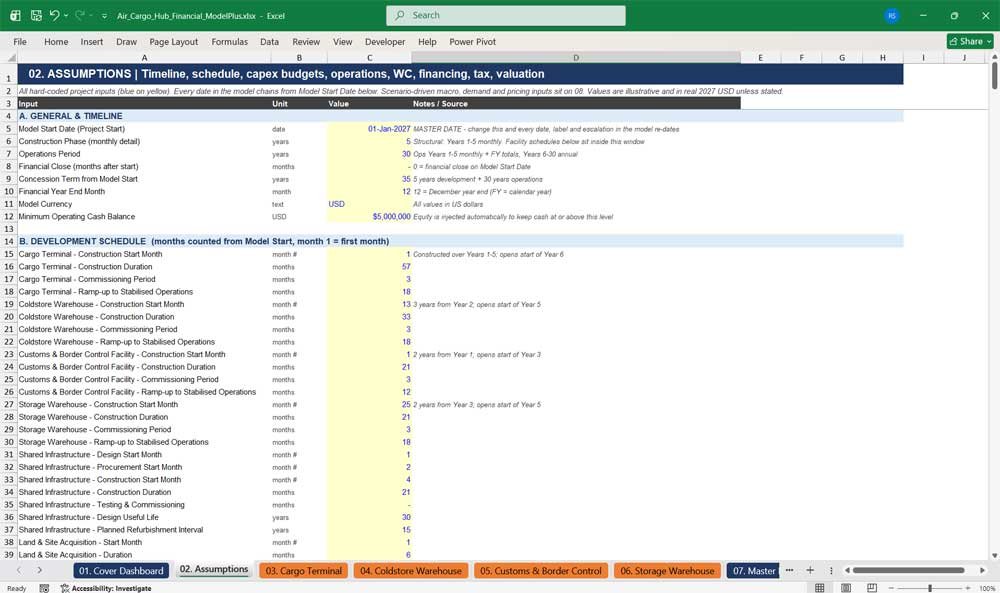
02. Assumptions
All project inputs are on one clearly labelled sheet: the development schedule, construction budgets, facility operating drivers, working capital, debt terms, tax and valuation. Blue-on-yellow input cells make the airport cargo model easy to adapt to your project’s own data.
- One master Model Start Date drives the entire timeline
- Construction start, duration, commissioning and ramp-up for every facility
- Line-by-line capex budgets, contingency, soft costs and lifecycle capex
- Financing, reserve account, tax and valuation inputs
Air Cargo Hub Revenues & Opex
04. Coldstore Warehouse
This tab models a temperature-controlled coldstore for pharmaceutical, perishable, fresh produce, seafood, and meat and dairy cargo. It calculates refrigeration capex, storage capacity, cold-chain storage and handling fees, energy consumption and maintenance costs for cold-chain logistics.
- Insulated panels, cold rooms, refrigeration plant and backup power capex
- Storage-day revenue by cargo type, with a capacity constraint
- Refrigeration electricity and energy intensity per tonne
- Food safety, quality control and refrigerant costs
05. Customs & Border Control
This tab models the customs and border control facility: inspection halls, X-ray and cargo scanning equipment, offices and security. Lease, service and concession income can be switched on or off to match your contract, and government staffing costs are included only where the project bears them.
- Shipments, declarations, inspections and scans linked to cargo flows
- Facility rental, government lease and inspection or scanning fees
- Switch for contractual income and government staffing costs
- Inspection capacity utilisation tracking
06. Storage Warehouse
This tab models a logistics storage warehouse. It covers construction, racking, loading docks and handling equipment, lettable area, occupancy, rent per square metre and lease escalation. Income comes from leased space and from operated third-party logistics (3PL) services, including pallet storage and pick-and-pack.
- Lettable area, occupancy ramp-up and leased versus operated space
- Rent, pallet storage, bulk storage and distribution revenue
- Staffing, racking, dock and fire safety maintenance costs
- Revenue per occupied square metre
07. Master Development Schedule
This is the master calendar for the whole model. It sets construction windows, commissioning dates, milestones, phase flags and the debt availability period. It also tracks annual development spend and project funding, and flags any unfunded capital requirement.
- Milestone dates from feasibility study through commercial opening
- Construction, operating and ramp-up flags for every facility
- Development capex and funding sources by period
- Delay, overrun and funding-sufficiency controls
08. Assumptions & Scenarios
This tab is the scenario control centre. Choose Base, Upside or Downside, then adjust inflation, cargo growth, market share, tariffs, occupancy, capex overrun, construction delay and interest rates. The live column feeds every escalation index and the tariff card used across the model.
- One-click scenario selector
- 11 sensitivity levers applied on top of any scenario
- Complete tariff card for every facility and revenue stream
- CPI, wage, construction, equipment, energy, lease and FX indices
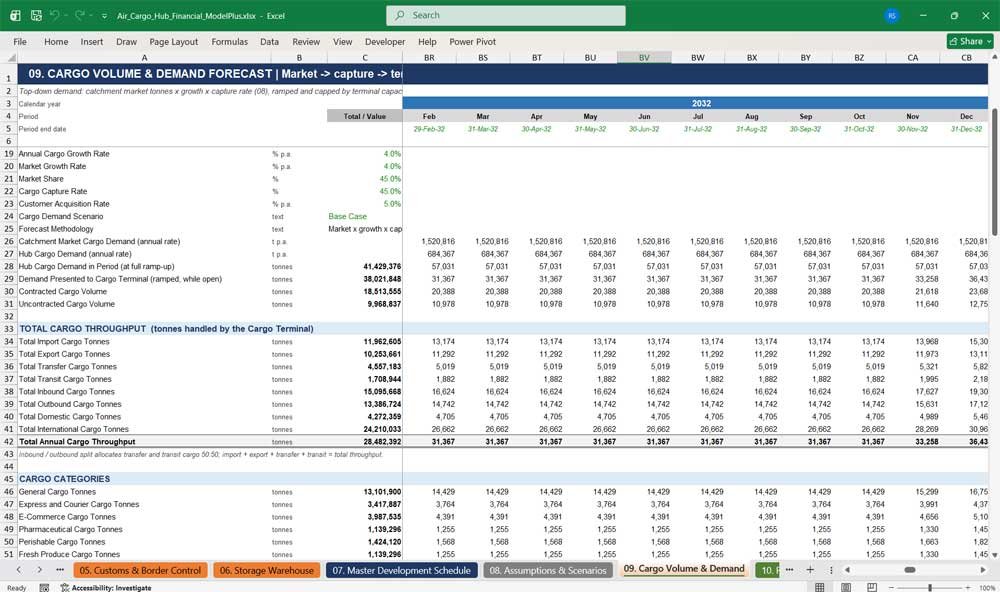
09. Cargo Volume & Demand
This tab builds the cargo demand forecast from catchment market tonnes, growth and capture rate, ramp-up and terminal capacity. It splits throughput by flow and cargo category, and drives coldstore, customs and warehouse demand along with airline and freight forwarder counts.
- Import, export, transfer, transit, domestic and international tonnes
- 12 cargo categories, from general cargo to dangerous goods
- Peak day, peak month, congestion and unserved demand analysis
- Customer, airline and contracted volume metrics
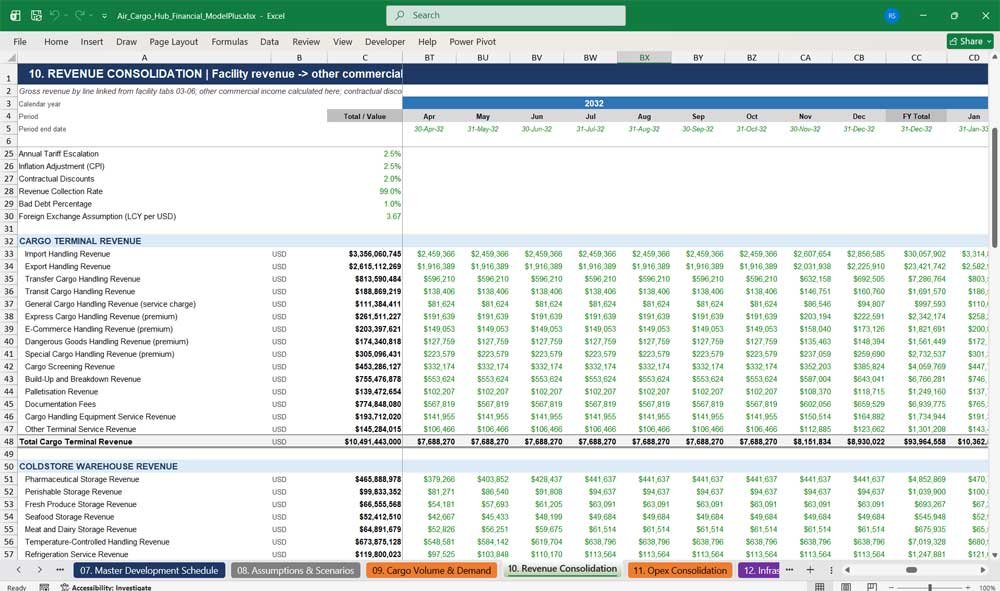
10. Revenue Consolidation
This tab brings every revenue line from the cargo terminal, coldstore, customs facility, storage warehouse and other commercial activities into one place. It then deducts discounts, rebates, concession revenue share, service credits and bad debts to give the net revenue used in the financial statements.
- Gross revenue by facility and by individual line
- Land, office, parking, advertising and trucking income
- Revenue adjustments and net-to-gross factor
- Revenue per tonne, per square metre, per customer and concentration KPIs
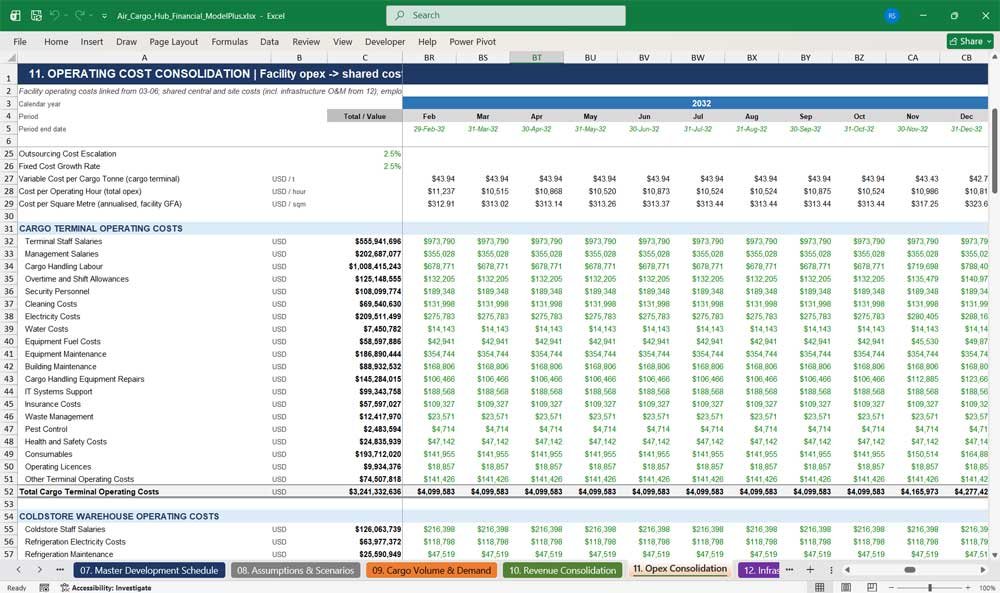
11. Opex Consolidation
This tab consolidates facility operating costs with shared overheads, infrastructure maintenance and employee on-costs. It calculates EBITDA and EBITDA margin for the hub and for each facility, allocating shared costs using transparent percentages you can edit.
- Line-by-line opex for all four facilities
- Central management, IT, security, insurance and marketing costs
- Payroll, social contributions, pensions and benefits
- Facility EBITDA and cost-per-tonne benchmarks
12. Infrastructure & Shared
This tab models the shared airport cargo site infrastructure: access roads, truck parking, drainage, water, power, telecoms, security, fire protection and landscaping. It covers capex, utility demand, rooftop solar savings, O&M costs, cost allocation, capacity utilisation and lifecycle planning.
- 21 infrastructure capex lines
- Electricity, water, wastewater and generator fuel demand
- Shared cost allocation to each facility, with a reconciliation check
- Road, power and water capacity utilisation
13. Capex Consolidation
This tab consolidates all capital expenditure: construction, land, development costs, maintenance capex, expansion and end-of-life replacement. It reconciles capex by facility, by classification, and to the fixed asset register and cash flow, giving lenders a full, auditable capex budget.
- Land acquisition and project development cost schedules
- Maintenance, expansion and repeating replacement capex cycles
- Annual capex profile for each of the 35 model years
- Capex funding and nine reconciliation checks
14. Fixed Assets & Depreciation
This tab holds a full fixed asset register with commissioning dates, useful lives and straight-line depreciation calculated daily. It tracks construction in progress, transfers when assets are commissioned, the lifecycle asset pool, the deferred capital grant and net book value by facility.
- Asset register by facility and asset class
- Construction in progress (CIP) roll-forward
- Depreciation and amortisation by facility
- Capital grant released over the asset life
Air Cargo Hub Financial Statements
15. Working Capital
This tab models trade receivables, inventory, prepayments, payables, accruals, VAT, tenant deposits and deferred revenue using days and months outstanding. It works out the net working capital requirement and its cash flow impact, and releases working capital at the end of the concession.
- Receivable days by facility, including slower government payments
- Inventory by type of consumable and spare
- Payables and accruals by cost type
- Reconciles to the balance sheet and cash flow statement
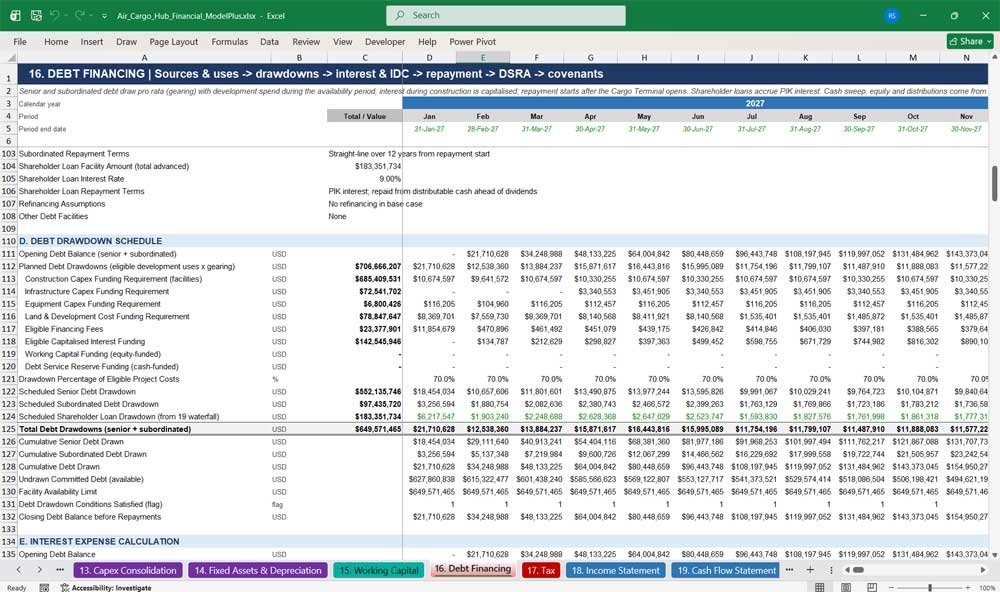
16. Debt Financing
This is a complete project finance debt schedule. It covers sources and uses, senior and subordinated drawdowns, interest during construction, annuity or straight-line repayment, the DSRA and MMRA, covenants, and DSCR, LLCR and PLCR ratios. A refinancing case is included as a memo.
- Floating or fixed rates, with a rate floor and cap
- Commitment and arrangement fees, capitalised interest
- Shareholder loans with payment-in-kind (PIK) interest
- 15 financing reconciliation checks
17. Tax
This tab calculates corporate income tax from accounting profit. It applies tax depreciation, interest deductibility limits, tax holidays and loss carry-forward, and also models deferred tax, VAT on revenue and capex, withholding taxes, payroll taxes and cash tax payment timing.
- Taxable profit reconciliation and tax written-down values
- Loss carry-forward schedule with a utilisation cap
- Deferred tax asset and liability calculation
- VAT receivable and payable, with a settlement lag
18. Income Statement
The integrated income statement runs from net revenue through direct and indirect costs, EBITDA, depreciation, EBIT, finance costs and tax to net profit. It is monthly for the first ten years with full-year totals, then annual to the end of the concession.
- EBITDA, EBIT and net profit margins and growth rates
- EBITDA by facility
- Per-tonne, per-square-metre and per-employee metrics
- Eight income statement reconciliation checks
19. Cash Flow Statement
This is an indirect-method cash flow statement covering operating, investing and financing activities. A funding and distribution waterfall injects sponsor equity when cash falls below the minimum, funds the reserve accounts, applies any cash sweep, and pays shareholder loans and dividends subject to a DSCR lock-up test.
- Cash flow available for debt service (CFADS) and DSCR
- Equity injections split between share capital and shareholder loans
- Distributions only after the lock-up test is passed
- Equity cash flow and construction funding summary
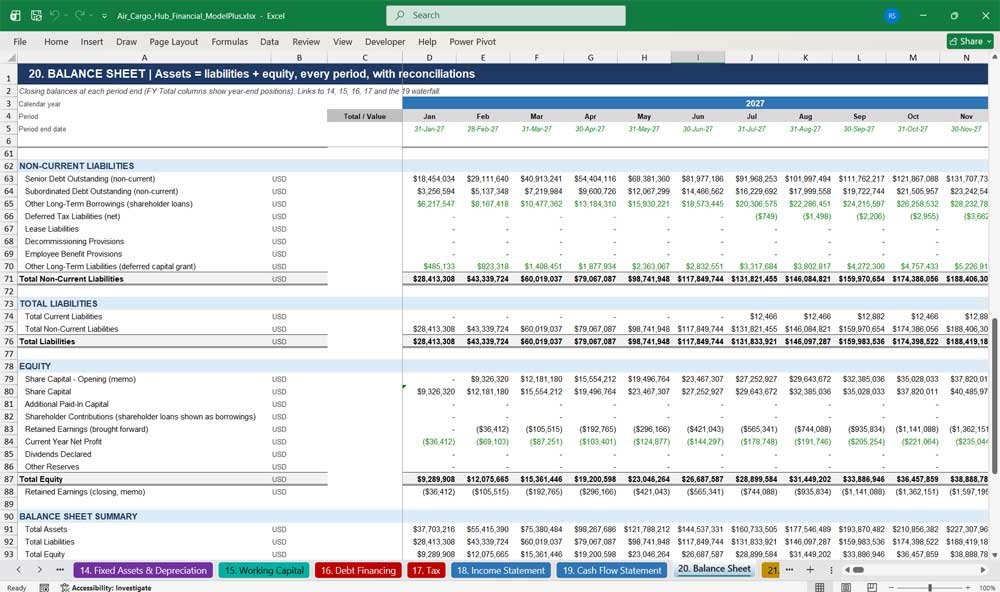
20. Balance Sheet
The fully linked balance sheet shows cash, restricted reserve accounts, working capital, fixed assets by category, construction in progress, debt, deferred tax, the deferred grant and equity. It balances in every period, and its reconciliation checks confirm the integrity of all three financial statements.
- Current and non-current assets and liabilities
- Current portion of long-term debt, split out
- Net debt, current ratio and gearing ratios
- Balance check on every period
Key Financial Metrics for an Air Cargo Hub
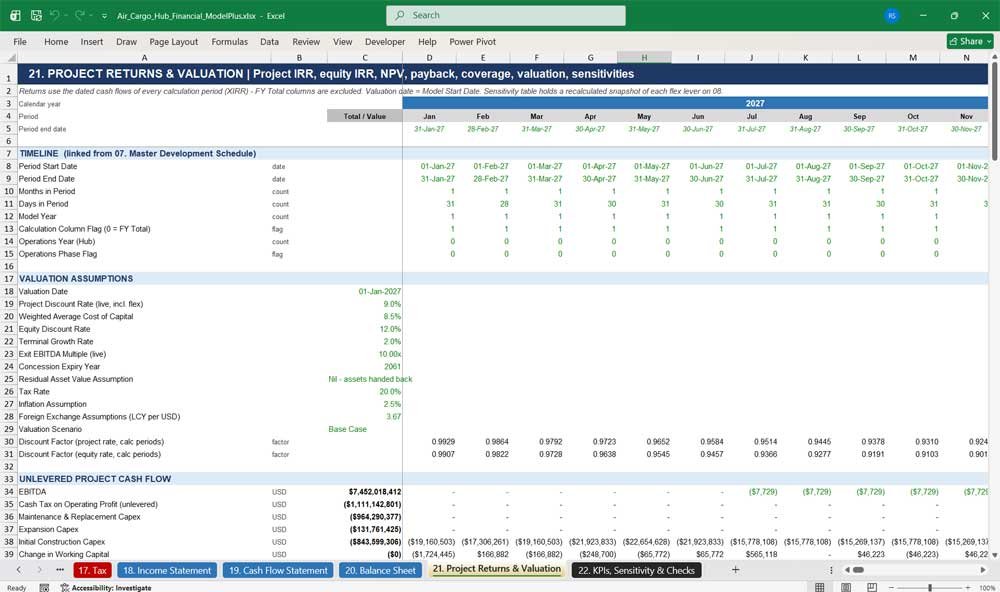
21. Project Returns & Valuation
This tab calculates unlevered project cash flow, project IRR, NPV and payback, plus equity IRR, equity NPV, equity multiple and equity payback. It includes DCF and EBITDA-multiple valuations, terminal value options, break-even analysis and a sensitivity table across 21 cases.
- Date-accurate XIRR returns
- Enterprise and equity valuation
- Break-even throughput, tariff and occupancy
- Concession handback and terminal value analysis
22. KPIs, Sensitivity & Checks
This tab is the investor dashboard and model integrity hub. It shows the key performance indicators, Base, Upside and Downside scenario results and break-even points. It also lists every model check with a PASS or REVIEW status, rolled up into one overall flag.
- One-page KPI summary
- Side-by-side scenario comparison
- Over 100 automated integrity checks
- Period-by-period check status
Why Buy This Model?
Building an air cargo hub financial model from scratch takes weeks of specialist work, and one broken link can undermine an investment case. This template gives you a fully integrated, error-checked model that is ready to use. Its structure, formatting and checks follow what banks, infrastructure investors and airport authorities expect to see. Every formula is transparent and every input is clearly marked, so you can replace the illustrative assumptions with your own data and produce credible results quickly. It covers the whole hub, not just the terminal: coldstore, customs, warehousing and shared infrastructure are all included. It also comes with the project finance features serious funding discussions require: phased construction, capitalised interest, reserve accounts, covenants, tax and scenario analysis. It suits feasibility studies, airport master planning, PPP and concession bids, lender submissions and investor presentations.
Air Cargo Frequently Asked Questions (Faq)
Q: What type of project is this model designed for?
A: It is designed for an airport air cargo hub with four facilities: a cargo terminal, a coldstore warehouse, a customs and border control facility and a storage warehouse, all served by shared site infrastructure. You can use it for a new greenfield hub, an expansion of an existing cargo area, or a concession or PPP bid.
Q: Can I use it for just a cargo terminal, without the other facilities?
A: Yes. Set the budgets and operating inputs for any facility you don’t need to zero, and the model continues to calculate and balance. Each facility has its own construction schedule, revenue and costs, so removing one doesn’t affect the others.
Q: Which version of Excel do I need?
A: Microsoft Excel 2019, Excel 2021 or Microsoft 365 is recommended. The model uses standard functions such as XIRR, SUMPRODUCT and MINIFS. It contains no macros or VBA, so there are no security prompts. Google Sheets isn’t recommended because of the workbook’s size.
Q: Can I change the project start date and timeline?
A: Yes. Every date in the model comes from one Model Start Date on the Assumptions tab. Change it and all schedules, column headers, escalation indices and debt dates update automatically. You can also set construction start, duration, commissioning and ramp-up separately for each facility.
Q: Are the numbers in the model real project data?
A: No. The model comes with realistic illustrative assumptions for a hub handling about 800,000 tonnes a year, so you can see how it works straight away. Replace them with your own market studies, tariffs, cost estimates and financing terms before using the results for decisions.
Q: Is the model suitable for a bank or lender submission?
A: Yes. It is built to project finance standards. It has integrated financial statements, a sources and uses table, annuity or straight-line repayment, DSRA and MMRA reserve accounts, DSCR, LLCR and PLCR covenant ratios, a cash waterfall with a distribution lock-up, and over 100 automated checks. Lenders can follow every calculation.
Q: How are construction costs handled?
A: Construction capex is set out line by line for each facility and the shared infrastructure, with separate works and equipment cost escalation. It includes soft costs, contingency, land, development costs, owner’s costs and pre-opening costs. Spending is phased by day across each facility’s construction window, and interest during construction is capitalised.
Q: How is cargo demand forecast?
A: Demand starts from the catchment market’s cargo tonnage. It is grown each year, multiplied by the hub’s capture rate, ramped up after opening and capped by terminal capacity, including any expansion. Throughput is then split by flow type and cargo category, which drives coldstore, customs and warehouse activity.
Q: Can I run different scenarios and sensitivities?
A: Yes. The Assumptions & Scenarios tab has a Base, Upside and Downside selector and 11 sensitivity levers. These cover volume, tariffs, occupancy, capex overrun, construction delay, opex inflation, interest rates, gearing, discount rate and exit multiple. Results update live on the KPI dashboard.
Q: Does the model include tax?
A: Yes. It calculates corporate income tax with tax depreciation, an interest deductibility limit, an optional tax holiday and loss carry-forward. It also covers deferred tax, VAT on revenue and capex with a settlement lag, withholding tax on dividends and interest, payroll taxes and property tax. All rates can be changed to suit your jurisdiction.
Q: What returns does the model calculate?
A: It calculates project IRR, project NPV, payback and discounted payback on unlevered free cash flow. It also calculates equity IRR, equity NPV, the equity multiple and equity payback. On top of these are DCF and EBITDA-multiple valuations, terminal value options and break-even throughput, tariff and occupancy.
Q: Can I change the currency?
A: The model is in US dollars by default. You can enter values in any currency and change the currency label on the Assumptions tab. For local cost exposure, an exchange rate and local-currency cost share are included in the scenario inputs.
Q: How do I know the model is working correctly?
A: The KPIs, Sensitivity & Checks tab gathers over 100 integrity checks into one PASS or REVIEW flag. They include the balance sheet balancing, cash reconciliation, capex and fixed asset tie-outs, debt fully repaid, sources and uses, and tax links. The model shows PASS on every check across all scenarios.
Q: Can I add more facilities or extend the forecast?
A: Yes. The structure is consistent and well labelled, so experienced Excel users can add facilities, revenue lines or cost lines. Every tab follows the same layout, formulas run consistently across all periods, and inputs are kept apart from calculations.
Final Notes on the Financial Model
This 30 Year Air Cargo Hub Financial Model must focus on balancing capital expenditures with steady revenue growth from diversified services. By optimizing operational costs, and power efficiency, and maximizing high-margin services like Landing & Parking Fees, Cargo Handling & Warehousing, and Freight Forwarder & Shipper Fees, the model ensures sustainable profitability and cash flow stability.