
Elearning Company Financial Model
This 20-Year, 3-Statement Excel Elearning Company Financial Model includes revenue streams from 6-tier subscriptions, PAYG B2B Training Solutions, Niche Content Sales, Pay-Per-Module, Virtual/Hybrid Event sales, etc. Cost structures, and financial statements to forecast the financial health of your EdTech learning management system (LMS) business.
20-Year Financial Model for an Elearning Company
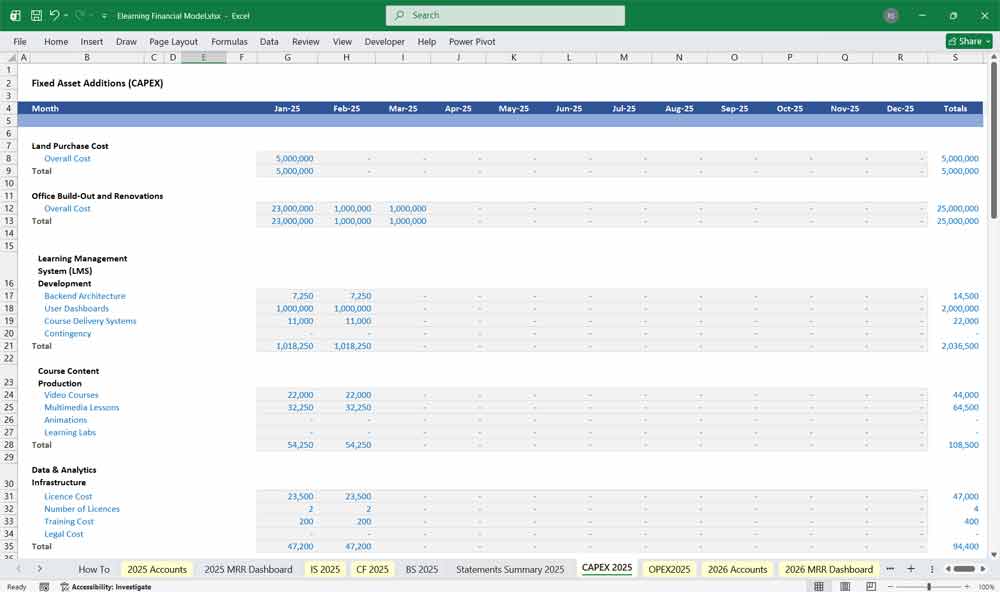
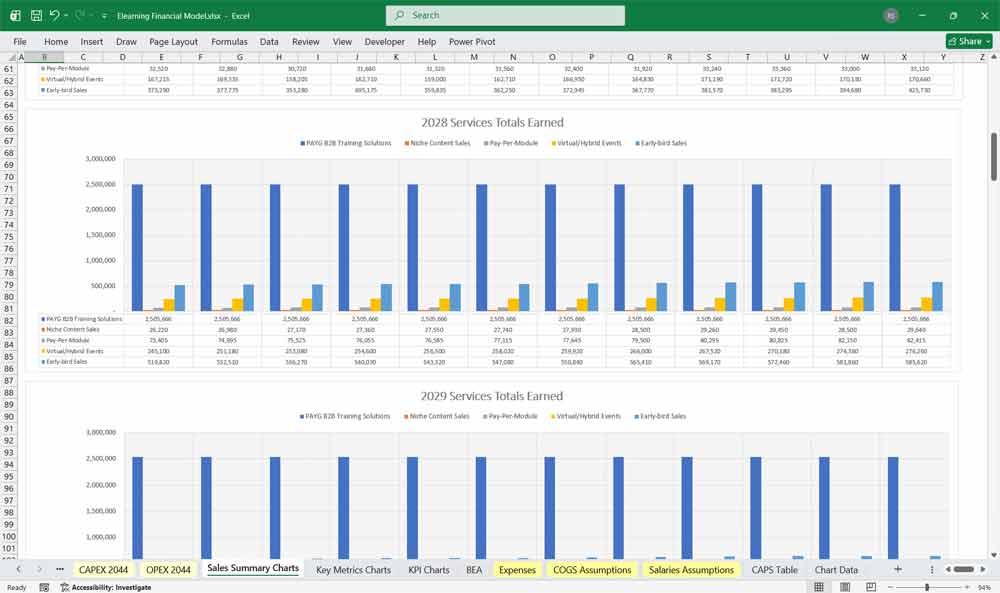
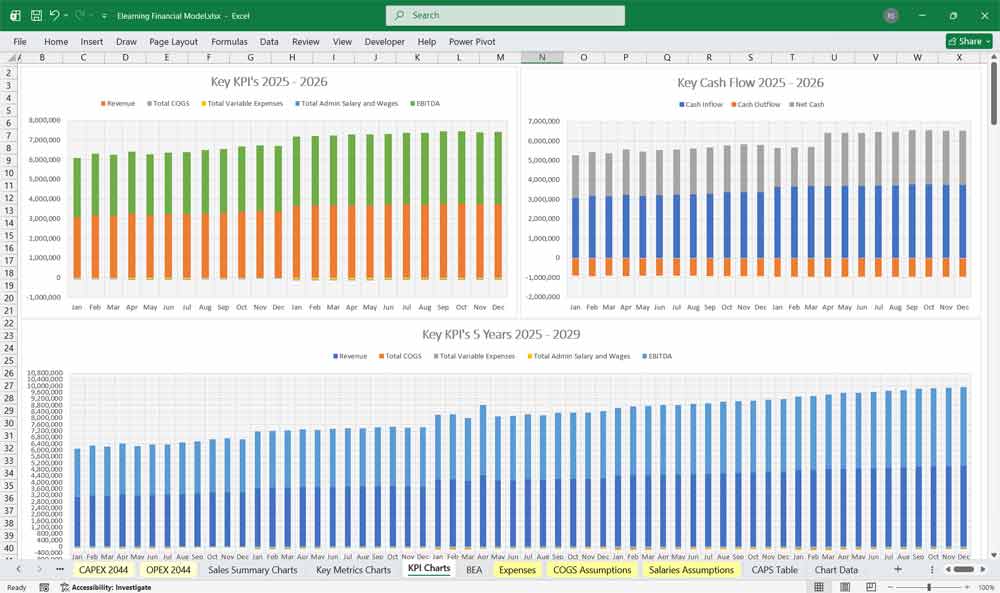
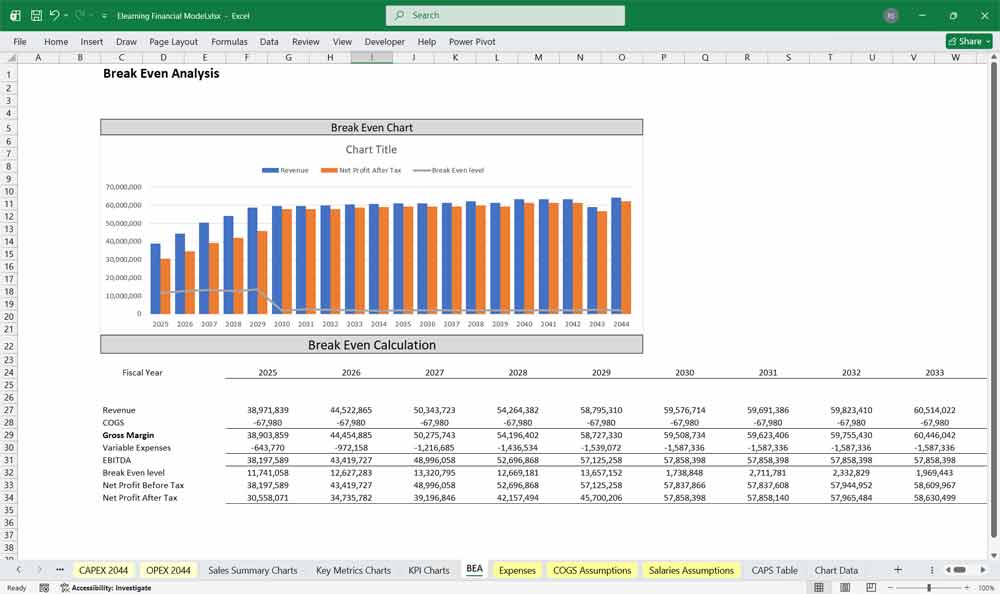
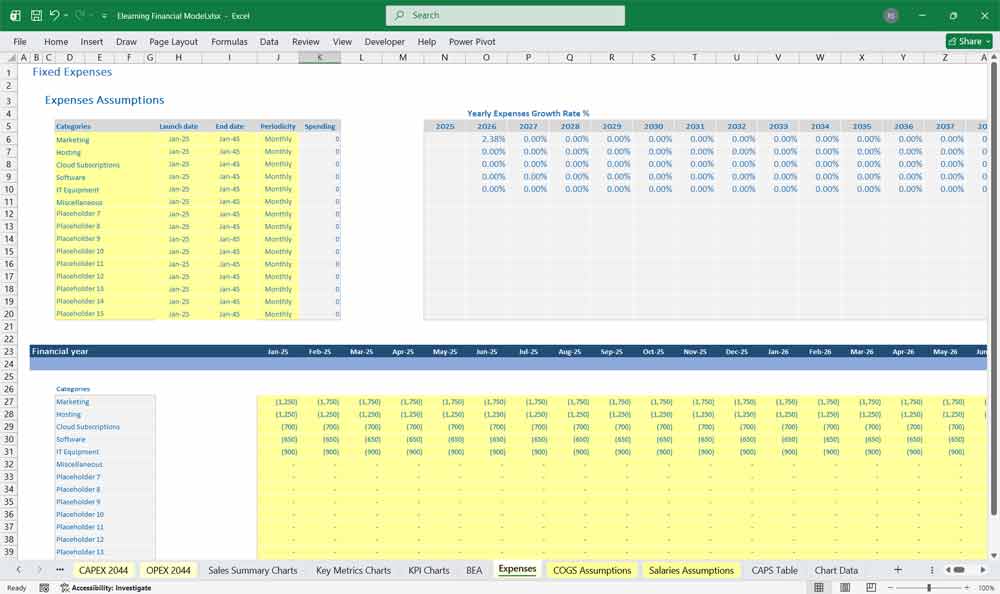
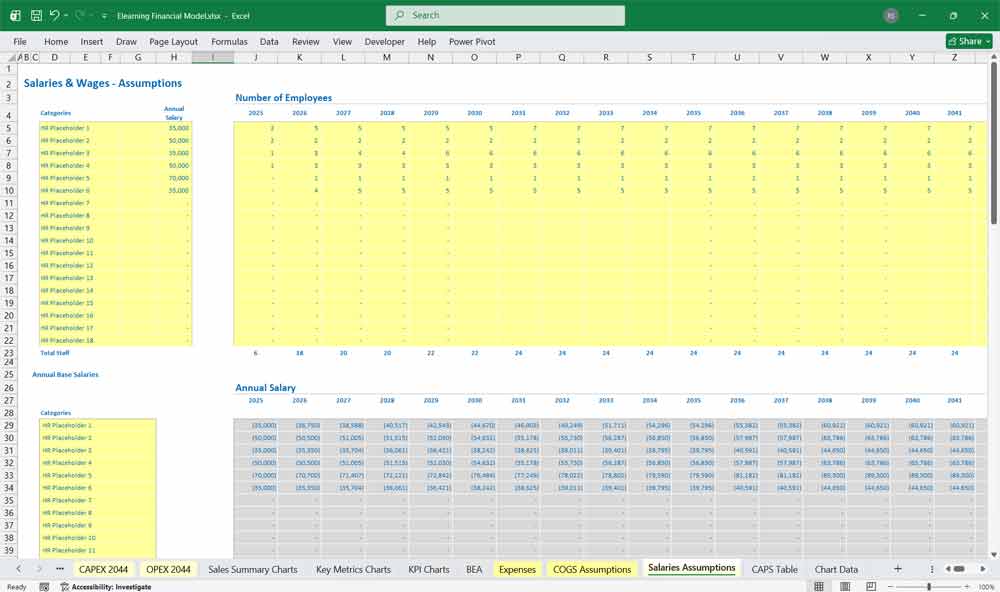
This very extensive 20 Year ELearning Edtech LMS Model involves detailed revenue projections, cost structures, capital expenditures, and financing needs. This model provides a thorough understanding of the financial viability, profitability, and cash flow position of your manufacturing company. Includes: 20x Income Statements, Cash Flow Statements, Balance Sheets, CAPEX sheets, OPEX Sheets, Statement Summary Sheets, and Revenue Forecasting Charts with the revenue streams, BEA charts, sales summary charts, employee salary tabs and expenses sheets. Over 130 Spreadsheets in 1 Excel Workbook.
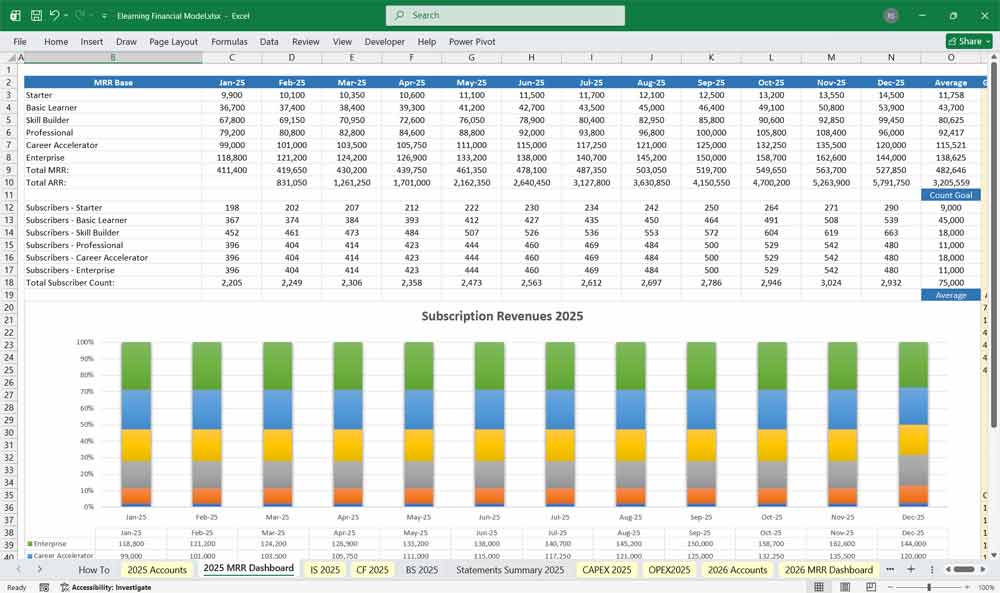
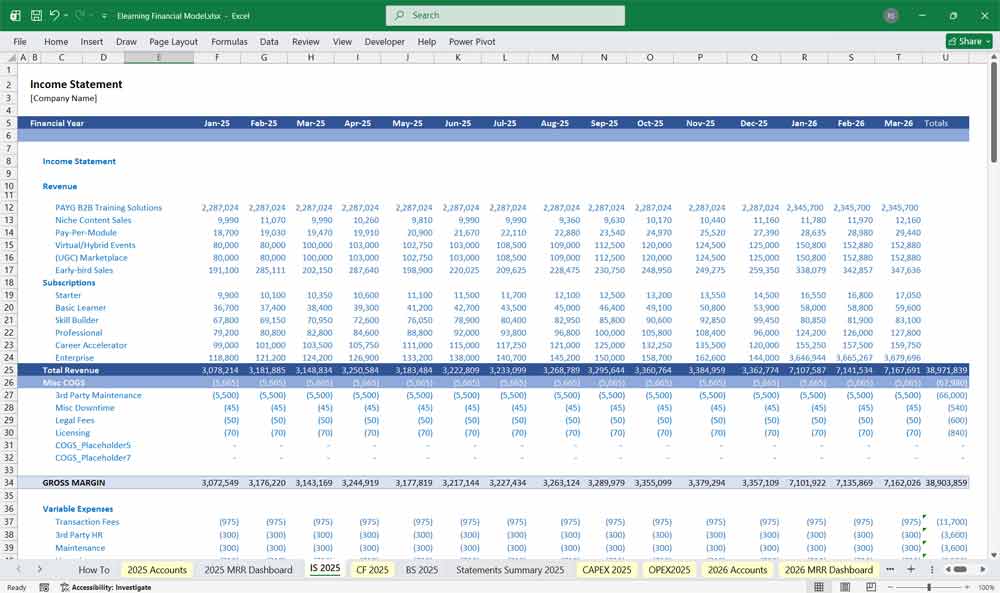
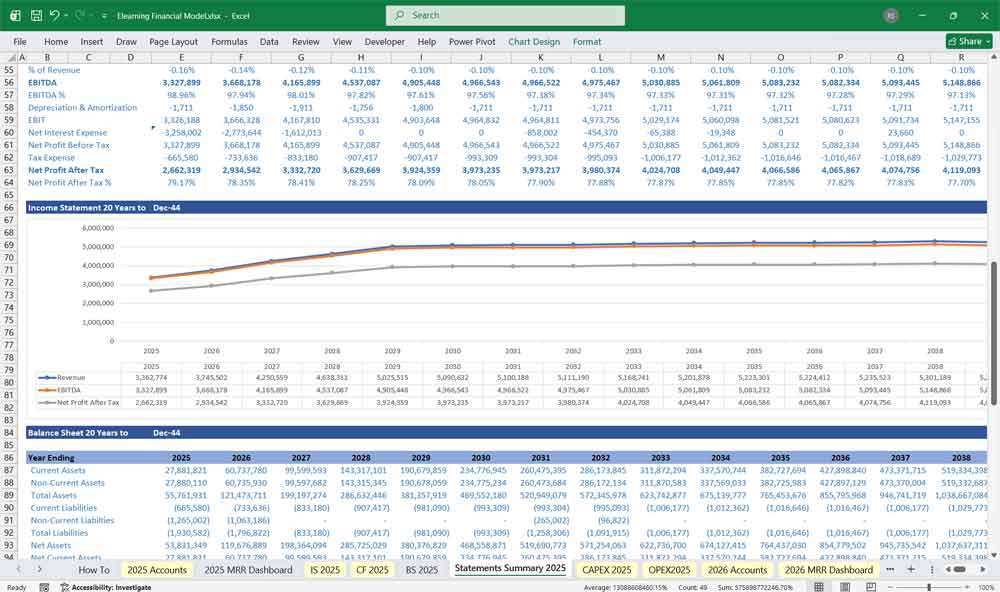
Income Statement (Profit & Loss)
The Income Statement shows profitability over time (monthly or annually).
Revenue
Segmented Revenue Streams:
Subscription revenue (by tier)
One-time course purchases
Certification & exam fees
Corporate/enterprise contracts
Mentorship & coaching fees
Key Metrics Modeled:
ARPU (Average Revenue Per User)
MRR / ARR
Revenue growth rate
Revenue concentration risk (B2B)
Cost of Revenue (Direct Costs)
Costs directly tied to delivering learning:
Cloud hosting & content delivery (CDNs)
Instructor royalties or revenue share
Proctoring & certification fees
Payment processing fees
Student support costs
Gross Profit = Revenue – Cost of Revenue
Gross Margin Indicators:
Scalable platforms: 65%–85%
Content-heavy / mentorship models: lower initial margins
Operating Expenses (OPEX)
1. Research & Development
LMS platform development
Content creation & instructional design
AI & personalization features
2. Sales & Marketing
Paid acquisition (ads, affiliates)
Partnerships & events
Sales team compensation (B2B)
Promotional campaigns
3. General & Administrative
Executive and finance salaries
HR, legal, accounting
Office and software subscriptions
EBITDA
Earnings before interest, taxes, depreciation & amortization
Key metric for:
Valuation benchmarking
Operational efficiency
Depreciation & Amortization
Capitalized software & platform costs
Capitalized course content
Studio equipment depreciation
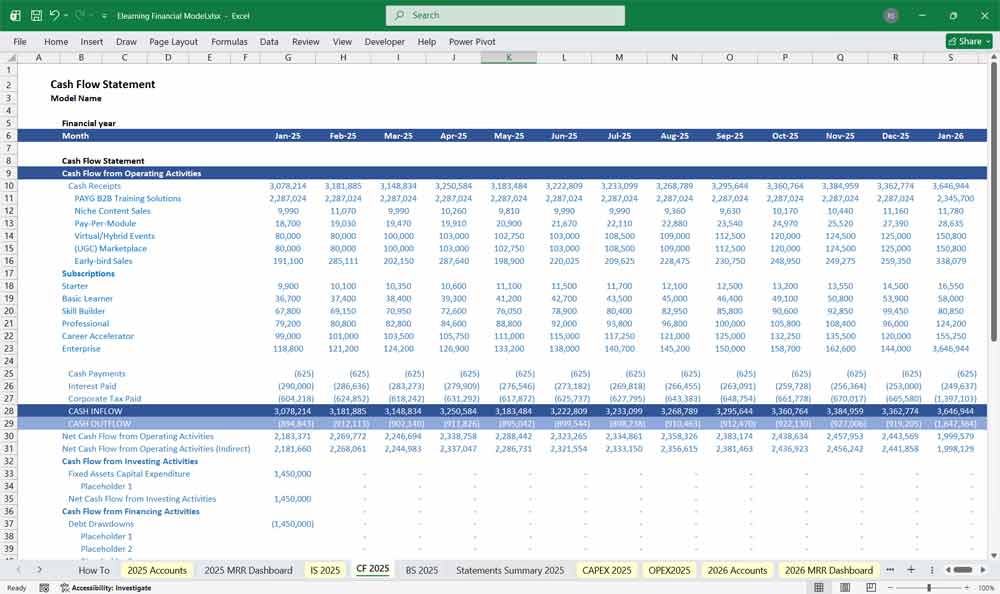
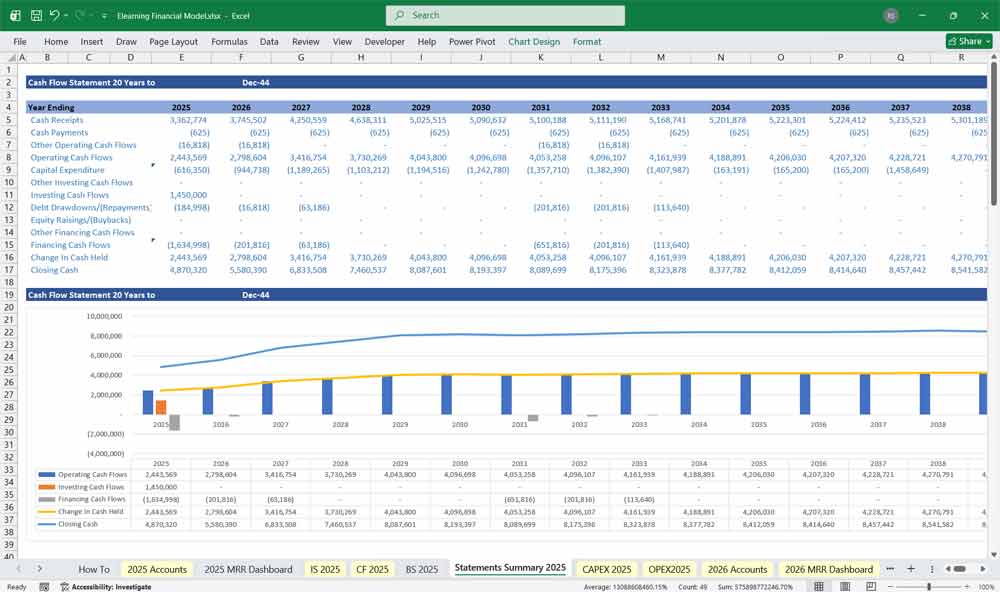
ELearning Company Cash Flow Statement
Tracks actual cash movement, critical for runway management.
Cash Flow from Operating Activities
Starts from Net Income, adjusted for:
Depreciation & amortization (non-cash)
Deferred revenue changes (subscriptions paid upfront)
Changes in working capital:
Accounts receivable (B2B contracts)
Accounts payable
Accrued expenses
Key Insight:
An eLearning company can be profitable but still cash-negative if growth and content investment are aggressive.
Cash Flow from Investing Activities
Capitalized platform development
Capitalized content creation
Studio & equipment purchases
IP acquisitions
Often negative during growth phases.
Cash Flow from Financing Activities
Equity funding rounds
Debt issuance or repayment
Convertible notes
Dividends (rare in growth stage)
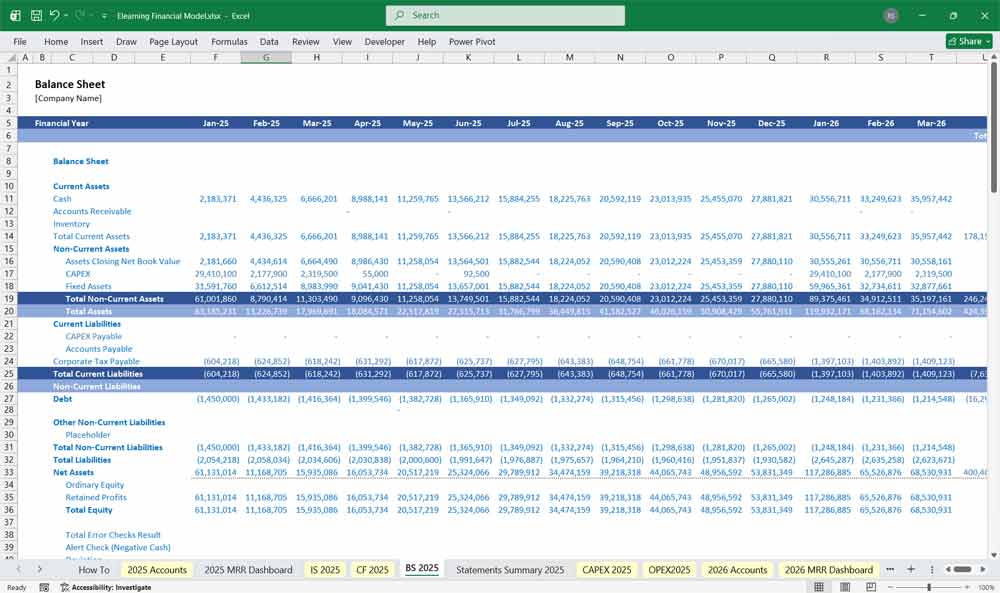
ELearning Company Balance Sheet
Snapshot of financial position at a given point in time.
Assets
Current Assets
Cash and equivalents
Accounts receivable (enterprise clients)
Prepaid expenses
Non-Current Assets
Capitalized software development
Capitalized course content (intangible assets)
Property & equipment (studio, IT equipment)
IP and trademark assets
Liabilities
Current Liabilities
Deferred (unearned) revenue from subscriptions
Accounts payable
Accrued payroll & expenses
Long-Term Liabilities
Long-term debt
Lease obligations
Deferred tax liabilities (if applicable)
Equity
Share capital
Additional paid-in capital
Retained earnings (accumulated losses or profits)
Scenario & Sensitivity Analysis For An ELearning Company
Major Fluctuations:
Pricing changes
Churn improvements
Content spending acceleration
Hiring freezes or sales expansion
B2B vs B2C mix shifts
6-tier subscription framework suggestions For An eLearning company
Tier 1: Starter (Free / Entry Tier)
Purpose: Lead generation & trial experience
Ideal For: Beginners exploring the platform
Features:
Access to introductory courses only (e.g., “Foundations” or “Essentials”)
Limited lessons per course (e.g., first 20–30%)
Community forum (read-only)
Mobile & desktop access
In-platform quizzes (no certificates)
Course previews & learning paths overview
Limits:
No downloadable resources
No completion certificates
No instructor interaction
Value Proposition:
“Try before you buy — start learning with zero risk.”
Tier 2: Basic Learner
Purpose: Entry-level paid conversion
Ideal For: Casual EdTech learners & hobbyists
Features:
Full access to all beginner-level courses
Structured learning paths
Downloadable practice materials
Course completion certificates (non-accredited)
Community forum participation
Progress tracking dashboard
Limits:
No advanced or professional courses
Instructor interaction limited to FAQs
Value Proposition:
“Build real skills with guided beginner programs.”
Tier 3: Skill Builder (Intermediate LMS)
Purpose: Core recurring revenue
Ideal For: Career switchers & serious learners
Features:
Access to beginner + intermediate courses
Hands-on projects & assignments
Skill assessments with performance scoring
Instructor Q&A via monthly live sessions
Downloadable resources & templates
Verified certificates with shareable credentials
Extras:
AI-powered learning recommendations
Resume & portfolio guidance
Value Proposition:
“Go beyond theory — practice real-world skills.”
Tier 4: Professional (Advanced)
Purpose: Career advancement tier
Ideal For: Professionals seeking advancement or specialization
Features:
All course access (beginner → advanced)
Industry-aligned capstone projects
Priority instructor support & feedback
Advanced certifications (industry-recognized or partner-endorsed)
Monthly expert workshops & masterclasses
Interview preparation resources
Extras:
Career path specialization tracks
Peer collaboration spaces
Value Proposition:
“Learn at a professional level with expert guidance.”
Tier 5: Career Accelerator / Mentorship Tier
Purpose: High-touch premium EdTech offering
Ideal For: Job seekers, freelancers, & career climbers
Features:
Everything in Professional, plus:
1-on-1 mentorship sessions
Personalized learning roadmap
Resume review & LinkedIn optimization
Mock interviews & real-world case studies
Job board & referral access
Portfolio-ready project reviews
Support Level:
Dedicated success mentor
Priority response times
Value Proposition:
“Turn learning into a job — with personal mentorship.”
Tier 6: Enterprise / Elite
Purpose: B2B & executive-level growth
Ideal For: Companies, teams, executives, or institutions
Features:
Unlimited LMS platform access for teams or individuals
Custom learning paths & private cohorts
Team analytics & reporting dashboard
Dedicated account manager
Live private workshops & trainings
White-label branding options
LMS integrations (SCORM, SSO, API)
Extras:
Custom certification programs
Workforce upskilling & compliance tracking
Value Proposition:
“Enterprise-grade learning solutions tailored to your organization.”
Strategic Notes
Each tier solves a distinct problem (exploration → skill building → career outcomes).
Pricing increases with outcome certainty, support, and personalization.
Tier 3–4 drive scale. Tier 5–6 drive profit.
Final Notes on the Financial Model
This 20 Year Elearning Company Financial Model focuses on balancing capital expenditures with steady revenue growth from varied LMS Elearning services. By optimizing operational costs, and power efficiency, and maximizing high-margin services, the models ensure sustainable profitability and cash flow stability.
Download Link On Next Page