
Cybersecurity Services Financial Model
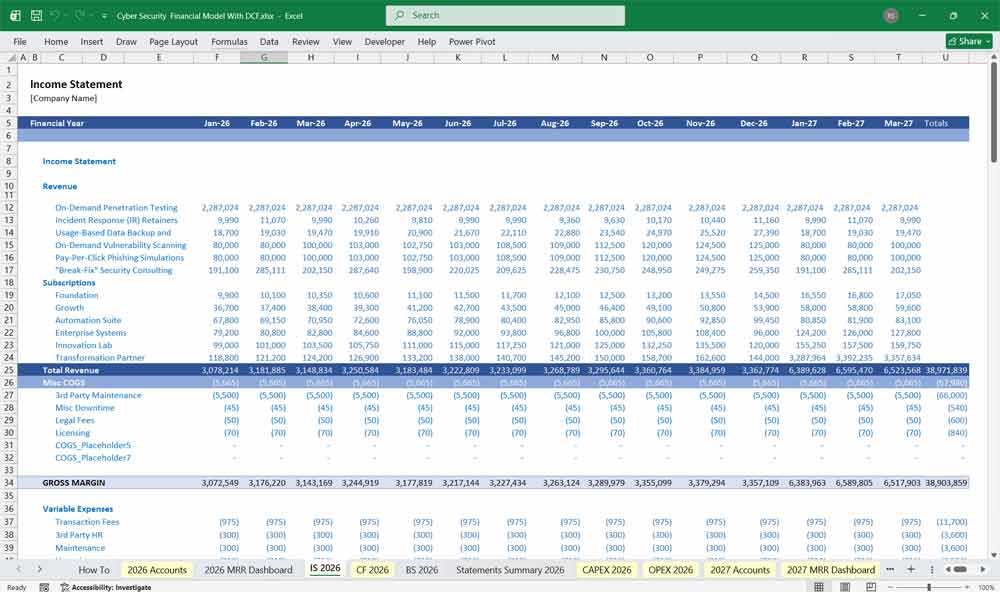
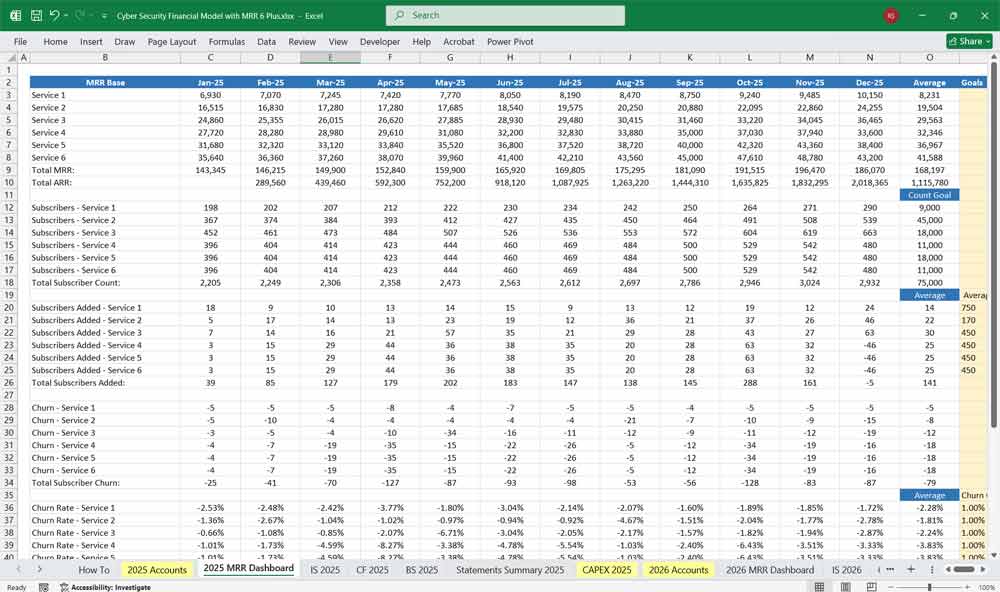
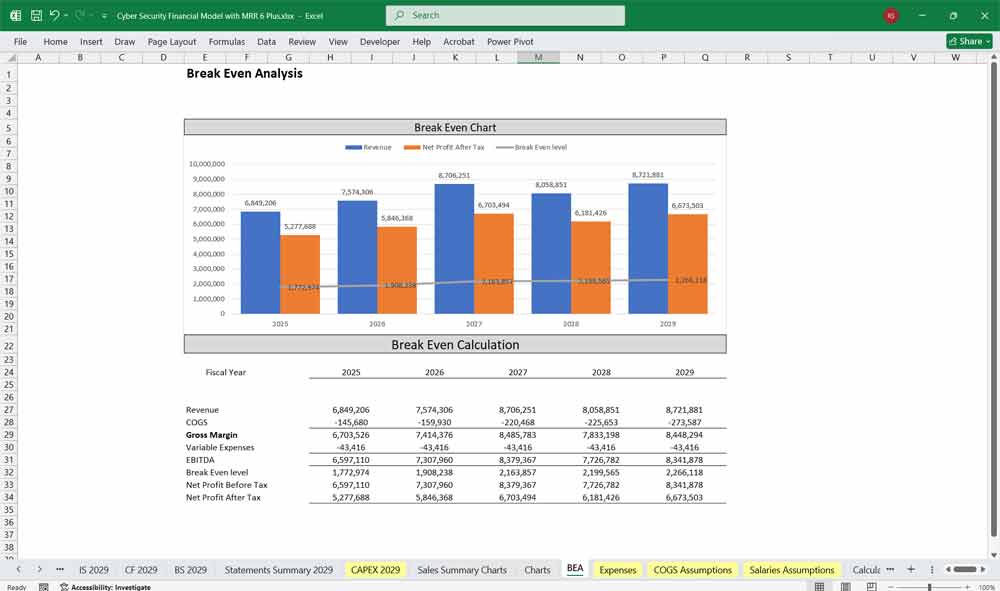
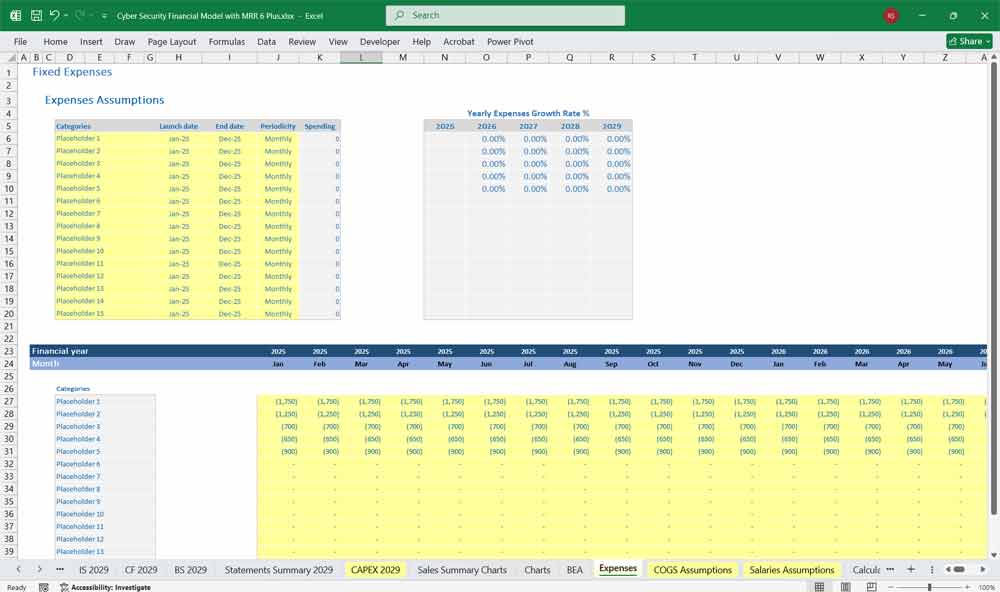
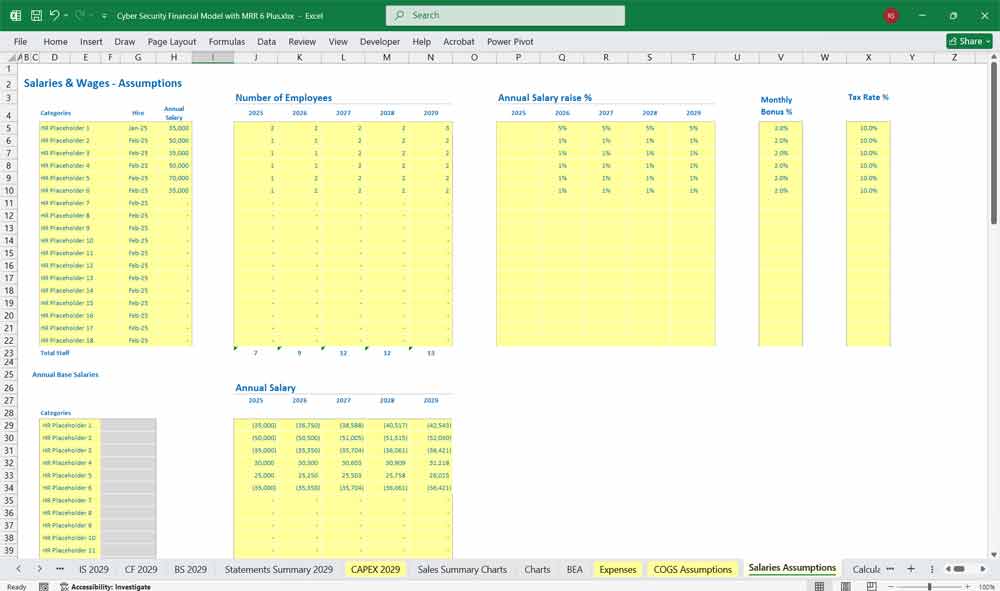
This 5-Year, 3-Statement Cybersecurity Services Financial Model in MS Excel includes revenue streams from Subscription to project-based services, set-up fees and consulting. Financial statements, Discounted Cash Flow (DCF) with Terminal Value, Sensitivity Analysis, and WACC to forecast the financial health of your Cybersecurity company.
DCF Financial Model for a CyberSecurity Company
1. Revenue Model
The editable revenues for this cybersecurity company depend on its business model, which may include:
- Subscription-Based Services (e.g., SaaS security solutions, endpoint protection)
- On-Demand Penetration Testing (Pen Testing)
- Usage-Based Data Backup and Recovery
- Pay-Per-Click Phishing Simulations
- Incident Response (IR) Retainers (Ad-Hoc)
- “Break-Fix” Security Consulting
- Consulting & Managed Security Services (e.g., penetration testing, threat intelligence)
- Incident Response & Forensic Services
- Licensing & Partnerships
Revenue is categorized as:
- Recurring Revenue (subscriptions, managed services)
- Non-Recurring Revenue (one-time software licenses, consulting projects)
Income Statement (Profit & Loss Statement)
Revenue
- Subscription Revenue
- One-Time Software Sales
- Consulting & Managed Security Services
- Incident Response Services
- Licensing Revenue
- Other Revenue Streams
Cost of Goods Sold (COGS)
- Hosting & Cloud Infrastructure Costs
- Security Infrastructure (e.g., threat intelligence tools)
- Direct Personnel Costs (security analysts, SOC team)
- Customer Support Costs
Gross Profit = Revenue – COGS
Operating Expenses (OPEX)
- Research & Development (R&D) (software updates, threat detection improvements)
- Sales & Marketing (advertising, sales commissions, branding)
- General & Administrative (G&A) (executive salaries, legal, HR, rent, office expenses)
EBITDA = Gross Profit – Operating Expenses
Depreciation & Amortization
- Depreciation of infrastructure
- Amortization of software development costs
EBIT (Operating Profit) = EBITDA – Depreciation & Amortization
Other Expenses / Income
- Interest Expense (loans, financing)
- Investment Income
- Foreign Exchange Gains/Losses
Taxes
- Corporate Taxes
- Deferred Taxes
Net Profit = EBIT – Interest – Taxes
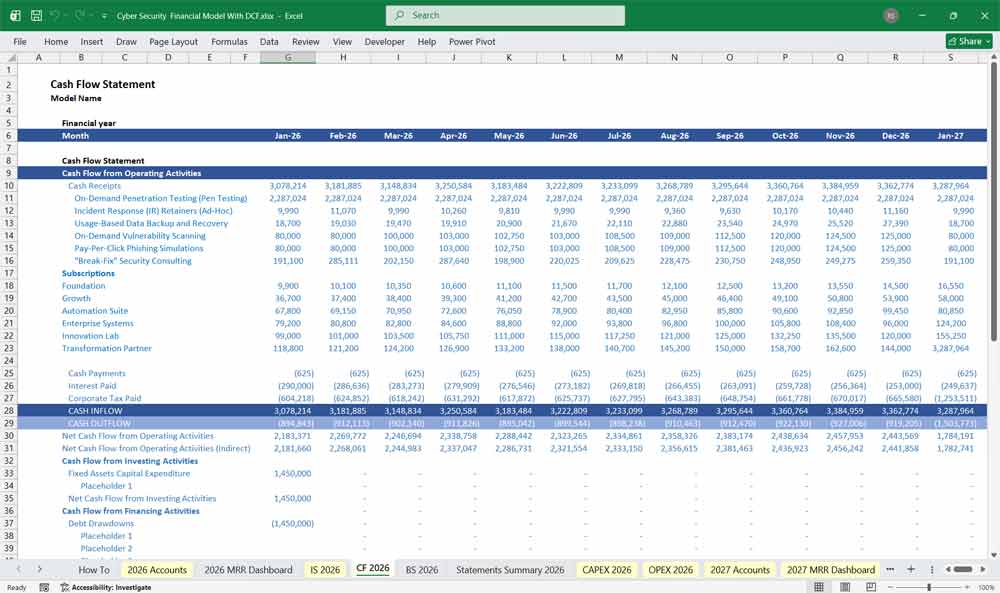
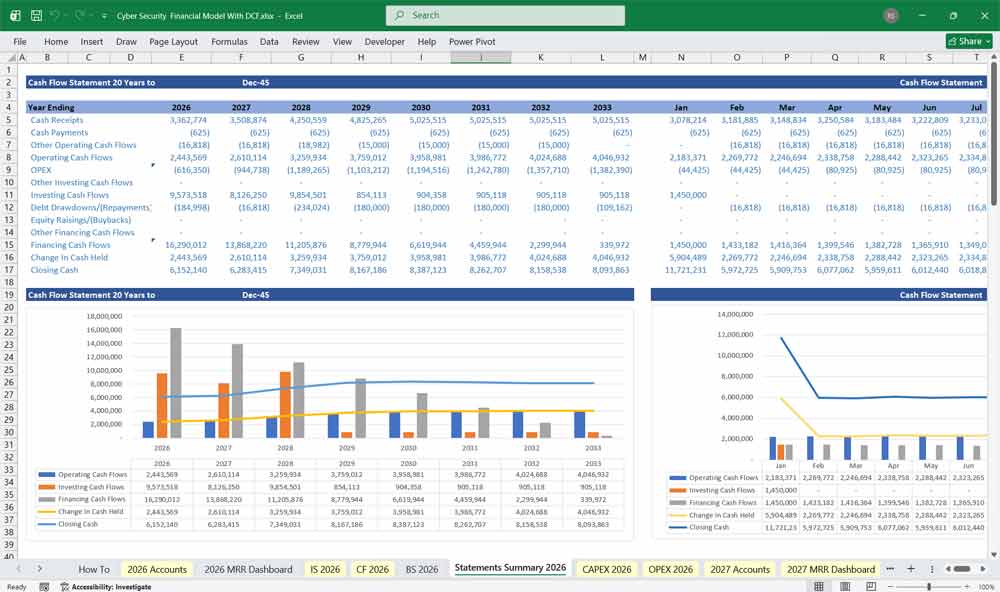
Cybersecurity Services Financial Model Cash Flow Statement
Cash Flow from Operations
- Net Income
- Adjustments for Non-Cash Items:
- Depreciation & Amortization
- Stock-Based Compensation
- Changes in Deferred Revenue
- Changes in Working Capital:
- Increase/Decrease in Accounts Receivable
- Increase/Decrease in Accounts Payable
- Increase/Decrease in Prepaid Expenses
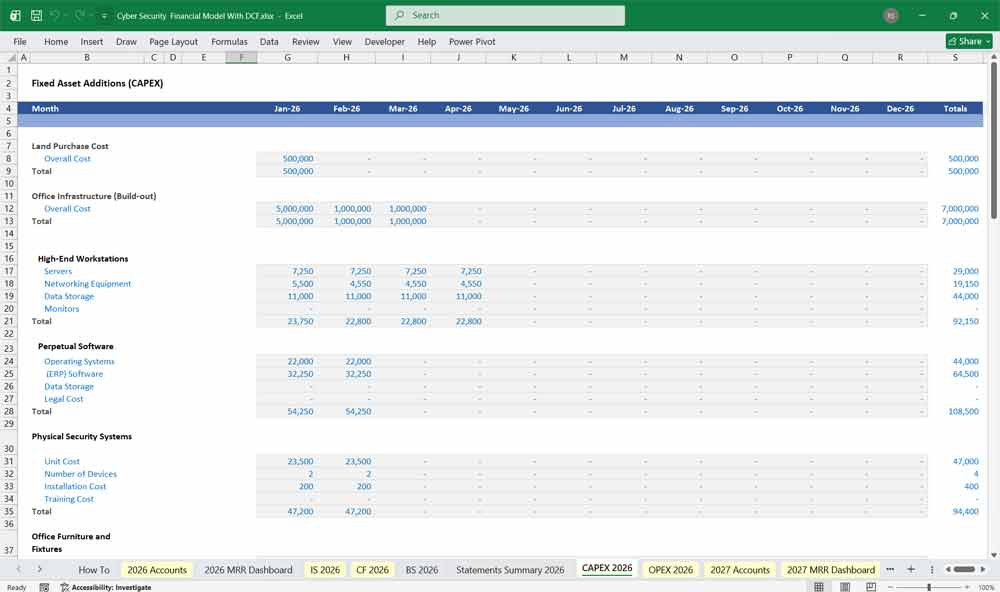
Cash Flow from Investing Activities
- Capital Expenditures (new technology investments)
- Software Development Costs (if capitalized)
- Acquisitions of Other Companies
- Purchase of Equipment (servers, security hardware)
Cash Flow from Financing Activities
- Issuance of Equity (fundraising, stock issuance)
- Issuance of Debt (bank loans, bonds)
- Repayment of Loans
- Dividends (if applicable)
Net Change in Cash = Operating Cash Flow + Investing Cash Flow + Financing Cash Flow
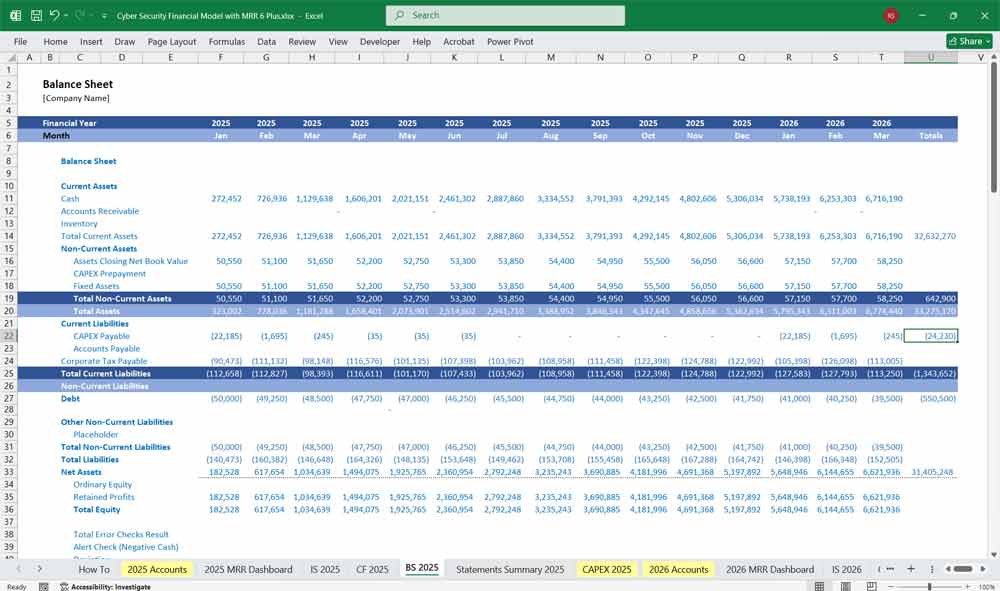
Cybersecurity Services Financial Model Balance Sheet
Assets
Current Assets
- Cash & Cash Equivalents
- Accounts Receivable
- Prepaid Expenses
- Inventory (if selling physical security products)
Non-Current Assets
- Property, Plant & Equipment (servers, security infrastructure)
- Capitalized Software Development Costs
- Intangible Assets (patents, proprietary security algorithms)
Liabilities
Current Liabilities
- Accounts Payable
- Deferred Revenue (for prepaid subscriptions)
- Short-Term Loans
Non-Current Liabilities
- Long-Term Debt
- Lease Liabilities
Equity
- Common Stock
- Retained Earnings
- Additional Paid-In Capital
Total Assets = Total Liabilities + Equity
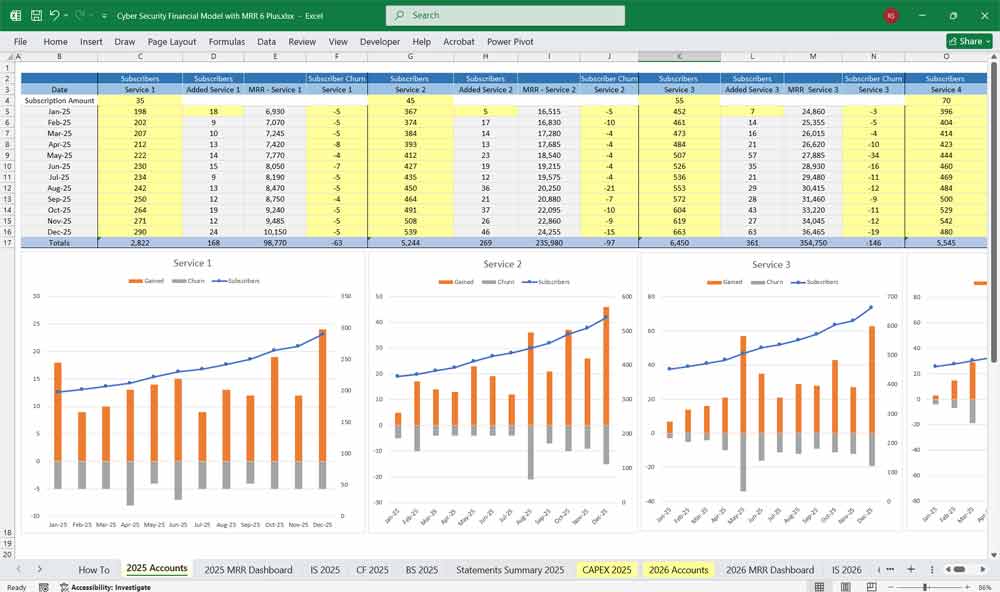
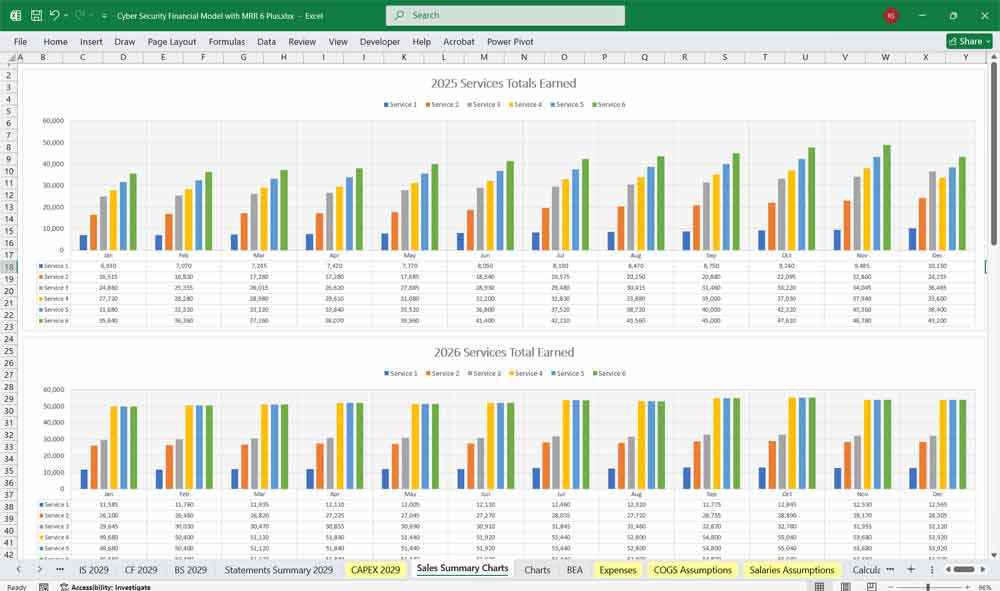
6-Tier Subscription Model for Cybersecurity Company
Each tier progressively offers more advanced features, security levels, and support, catering to different customer needs, from individuals to enterprises.
1. Free Tier (Basic CyberSecurity)
Target Audience: Individuals & Small Businesses (Freemium Model)
Price: $0/month
Features:
- Basic Antivirus & Malware Protection
- Firewall Protection (Basic)
- Limited Threat Intelligence Reports (Monthly Summary)
- Safe Browsing Extension (Blocks Malicious Websites)
- Email Security (Basic Spam & Phishing Filter)
- Device Limit: 1
Support & Service:
- Community Support & Knowledge Base
- No Live Support
- No Advanced Reporting
2. Essential Tier (Advanced Personal CyberSecurity)
Target Audience: Individuals & Freelancers
Price: $9.99/month
Features:
- All Free Tier features plus:
- Real-Time Malware & Ransomware Protection
- VPN for Secure Browsing (Limited Bandwidth)
- Dark Web Monitoring (Email & Password Breaches)
- Secure Password Manager
- Basic Identity Theft Protection
- Device Limit: 3
Support & Service:
- Email Support (24-48 Hour Response Time)
- No Phone or Live Chat Support
3. Professional Tier (Small Business CyberSecurity)
Target Audience: Small Businesses & Professionals
Price: $29.99/month
Features:
- All Essential Tier features plus:
- AI-Driven Threat Detection & Response
- Advanced Firewall with Intrusion Detection
- Full VPN Access (Unlimited Bandwidth)
- Cloud Backup (Up to 500GB Secure Storage)
- Phishing & Social Engineering Defense
- Data Encryption for Local & Cloud Storage
- Device Limit: 5
Support & Service:
- Priority Email & Chat Support
- Quarterly Security Reports
4. Business Tier (Mid-Size Business & Corporate CyberSecurity)
Target Audience: Medium-Sized Companies
Price: $79.99/month
Features:
- All Professional Tier features plus:
- Endpoint Security for Remote Workforces
- Zero-Trust Access Management
- SIEM (Security Information & Event Management) Integration
- Cloud Application Security (SaaS Protection)
- Network Traffic Analysis & Anomaly Detection
- 24/7 Dark Web Scanning for Business Data Leaks
- Device Limit: 15
Support & Service:
- 24/7 Live Chat & Email Support
- Monthly Security Reports & Threat Analysis
- One-On-One Security Consultation (Annually)
5. Enterprise Tier (High-CyberSecurity Organizations & Large Enterprises)
Target Audience: Large Enterprises & Regulated Industries
Price: $199.99/month
Features:
- All Business Tier features plus:
- Advanced Threat Hunting & Incident Response
- SOC (Security Operations Center) as a Service
- AI-Driven Behavioral Analytics & Insider Threat Detection
- Security Compliance & Governance Reporting (GDPR, HIPAA, ISO 27001)
- Custom Cloud Security Policies & Endpoint Protection
- Zero-Day Threat Protection & AI-Powered Security Automation
- Device Limit: 50+ (Scalable)
Support & Service:
- Dedicated Account Manager
- 24/7 Phone Support
- Customized Security Reports & Risk Assessments (Monthly)
- Annual Security Audits & Penetration Testing
6. Ultimate Tier (Custom High-CyberSecurity Solutions)
Target Audience: Fortune 500, Government, Military, Critical Infrastructure
Price: Custom Pricing (Starting at $499.99/month)
Features:
- All Enterprise Tier features plus:
- Custom AI-Powered Cyber Defense & Threat Intelligence
- Private Cloud Deployment & On-Premise Security Solutions
- Full Red Team & Blue Team Cybersecurity Drills
- Government-Grade Encryption & Data Privacy
- Dedicated Cybersecurity Experts for 24/7 Monitoring
- Zero-Trust Security Architecture Implementation
- Unlimited Devices & Custom Integrations
Support & Service:
- VIP Priority Support (Immediate Response Time)
- On-Site Cybersecurity Consulting & Training
- Custom SLA (Service Level Agreements) & Compliance Audits
- Annual Cyber Resilience & Business Continuity Planning

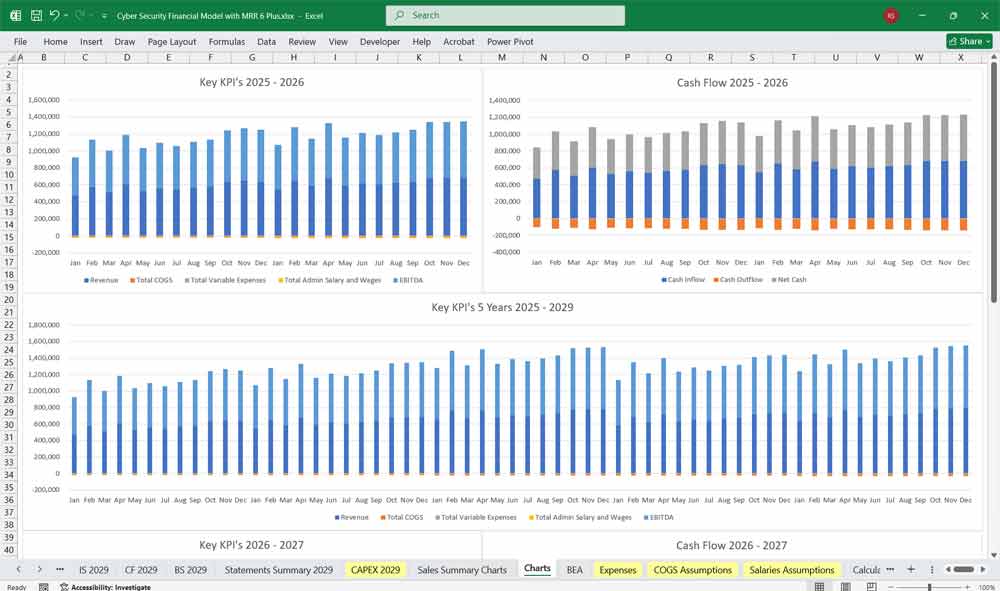
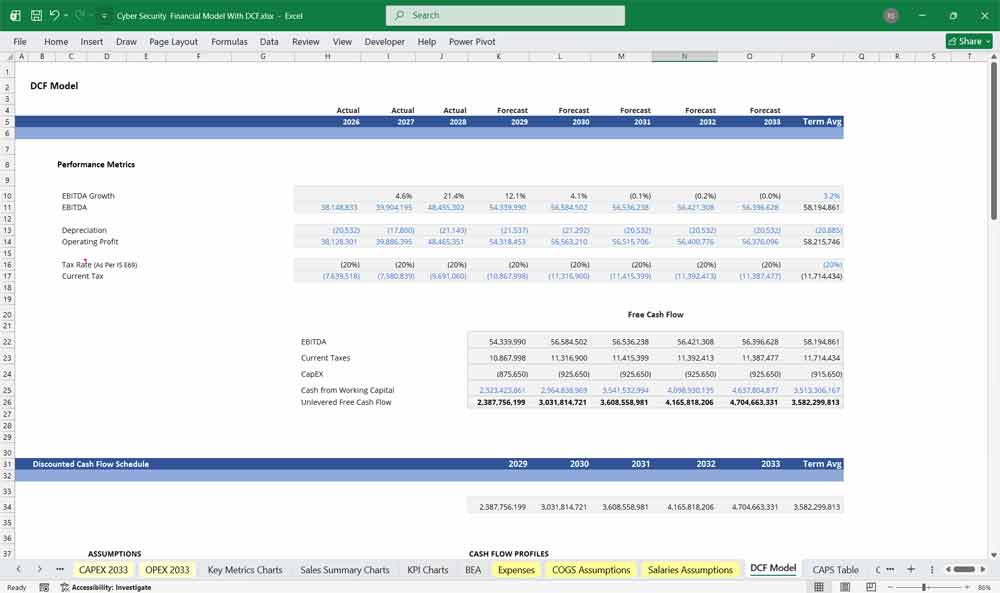
Valuing Your Cybersecurity Services With A DCF
Discounted Cash Flow (DCF): Valuing the “Digital Mercenaries” and Resilience
This Discounted Cash Flow (DCF) analysis for a cybersecurity agency provides a forecast of “contractual fortification” versus “incident-based firefighting.” The model treats the high-margin Managed Security Services (MSSP)—the monthly monitoring and threat hunting—as a stable, recurring annuity that forms the base of the firm’s value. However, it must also project lumpy, high-premium cash flows from Incident Response (IR), where the agency’s “digital mercenaries” are called in to handle active breaches. The Terminal Value represents the agency’s evolution into a permanent “cyber-insurance” surrogate, assuming it can maintain its elite talent moat and outpace the evolving “zero-day” exploit market.
WACC: Pricing Liability and the “Breach Beta”
The Weighted Average Cost of Capital (WACC) for a cybersecurity agency typically ranges from 10% to 15%, reflecting an asset-light profile with extreme operational stakes. Since these firms rely on specialized human capital rather than heavy machinery, they lack the physical collateral needed for cheap debt, leaving the Cost of Equity as the heavy lifter. In the 2026 market, the discount rate must price in a massive “liability premium”—the existential risk that a client suffers a catastrophic ransomware attack under the agency’s watch. This high hurdle rate ensures that future earnings are appropriately “punished” for the high-intensity talent war and the constant threat of technical obsolescence in a post-AI hacking world.
Sensitivity Analysis: Stress-Testing Utilization and “Liability Leakage”
For a cybersecurity firm, Sensitivity Analysis is the primary tool for measuring “reputational and operational elasticity.” Analysts use sensitivity tables to see how a 10% increase in senior cybersecurity architect salaries or a decline in billable utilization (the percentage of time experts spend on client work versus internal training) impacts the firm’s valuation. Most critically, the model must stress-test “Net Revenue Retention” (NRR); if a single high-profile breach causes a cluster of clients to lose faith and churn, the valuation can crater instantly. By identifying the break-even point for customer acquisition costs versus contract life, the sensitivity analysis reveals whether the agency is a scalable security powerhouse or just an expensive consultancy one mistake away from a total brand collapse.
Key Financial Metrics
- Gross Margin (%) = (Revenue – COGS) / Revenue
- Operating Margin (%) = EBIT / Revenue
- EBITDA Margin (%) = EBITDA / Revenue
- Net Profit Margin (%) = Net Income / Revenue
- Customer Acquisition Cost (CAC) = Total Sales & Marketing Expenses / New Customers Acquired
- Lifetime Value (LTV) of a Customer = Average Revenue per Customer × Gross Margin × Retention Period
Conclusion for Financial Model
This Cybersecurity Services financial model gives a structured approach to analyzing your company’s financial health. The 6-tier subscription model ensures flexible pricing for different customer segments while optimizing revenue potential.
Download Link On Next Page
Download Link On Next Page